Endangered
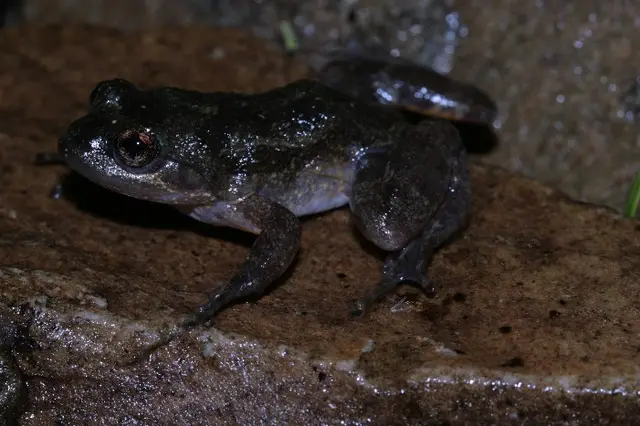
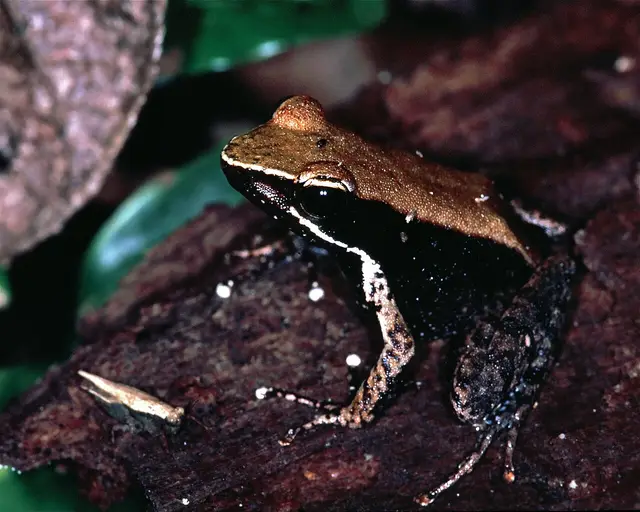
Mantidactylus bourgati
Mantidactylus bourgati
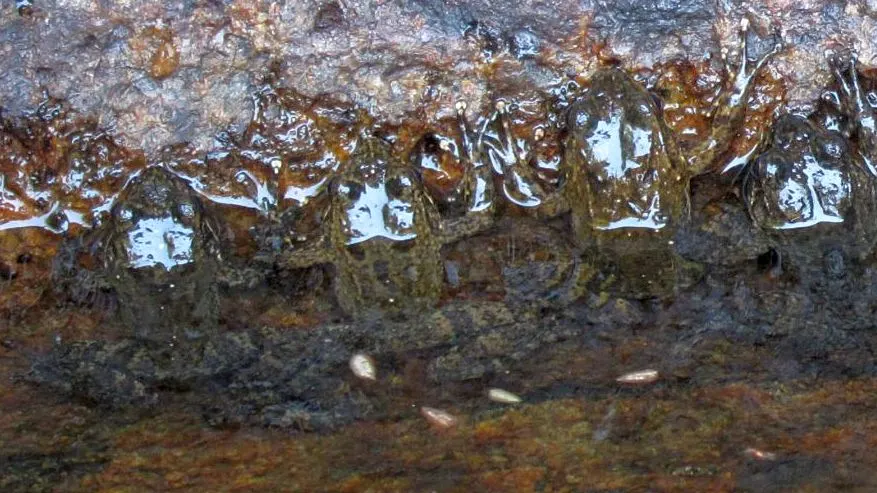
Bourgat's mantidactylus (Mantidactylus bourgati) is a stream frog found only on the Andringitra Massif in the Central Highlands of Madagascar. The IUCN Red List lists it as Endangered (2017), based on a single location and a range of about 1,300 km2. It lives in clear mountain streams, in forest and in open grassland.
How to recognise it
It belongs to the family Mantellidae and was described by Guibé in 1974. Frogs along its streams, in forest and above the treeline, are reported to vary quite a bit in form and colour, which makes field identification tricky.
For years it was treated as the same species as the more widespread Mantidactylus curtus. Andringitra populations were later recognised again under the name M. bourgati.
Where it lives
The species is known only from the Andringitra Massif. The Red List gives its extent of occurrence as about 1,313 km2 and counts it as a single location, with an elevation range of 1,400 to 2,000 m. It uses three habitats: montane forest, high-altitude grassland above the treeline, and permanent streams.
Andringitra National Park lies in the Haute Matsiatra region. Its highest point, Imarivolanitra, rises to 2,658 m, and the park's humid eastern slopes carry forest that gives way to grassland and scrub higher up. The Red List records the frog as occurring in at least one protected area.
Pins are Wikidata “endemic to” fields. Orange dots, when present, are GBIF occurrence tiles — survey bias included.
How it lives
It is reported to breed in the clear streams where it lives and to depend on them. How many individuals there are, and whether numbers are rising or falling, is not known. The 2017 assessment lists the trend as unknown.
Why it is in trouble
The Red List names several ongoing pressures: grazing by nomadic herders and small-holders, shifting agriculture, and small-scale farming. They convert or degrade the frog's habitat, and the assessment also records a threat of direct mortality. The area the frog occupies is still shrinking.
Even inside the park, people use the land. Cattle grazing, rice cultivation and irrigation have been reported within its boundaries. Park-wide threats listed for the Andringitra site also include fire and subsistence logging.
What is being done
The assessment lists no conservation actions aimed at this frog. Its main protection is the park itself, declared a strict nature reserve in 1927 and a national park in 1999.
Sources
Written for this catalog in our own words from the sources below, checked against them on 12 November 2026. Population figures are estimates and carry the year they were made. Status and assessment year: IUCN. 2026. The IUCN Red List of Threatened Species. Version 2026-1. iucnredlist.org.