Endangered
Mantidactylus albofrenatus
Mantidactylus albofrenatus
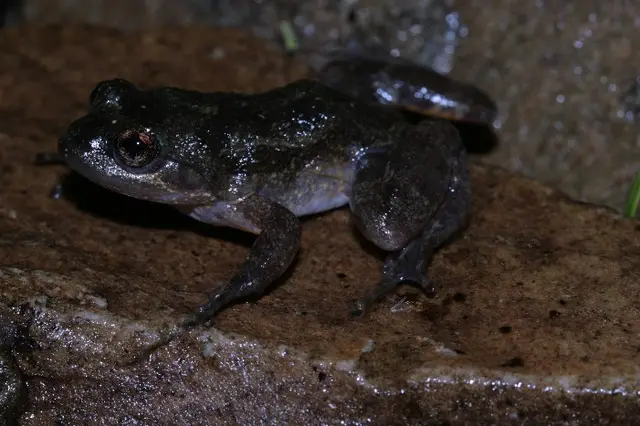
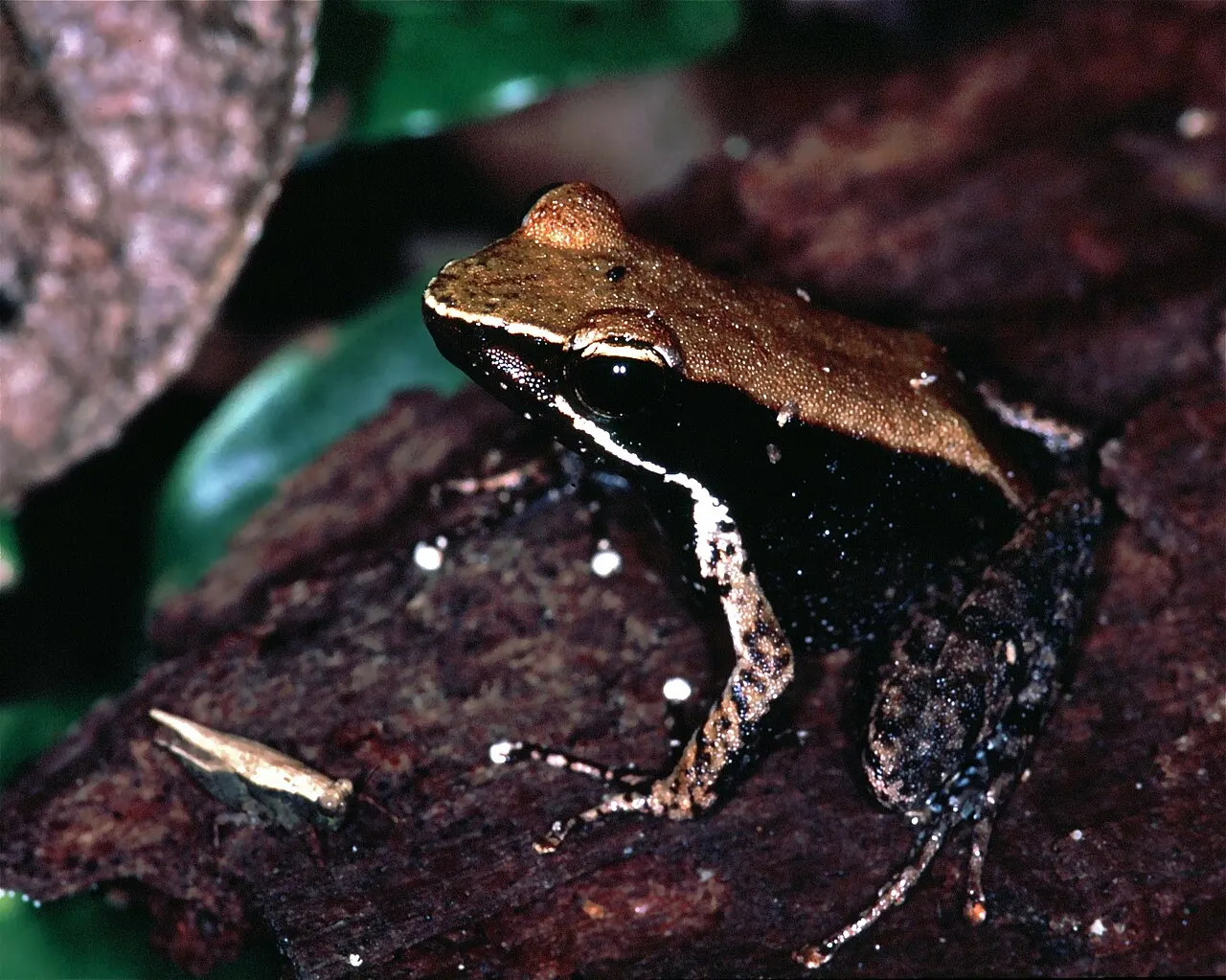
Mantidactylus albofrenatus, the eastern Madagascar frog (a proposed common name), is a small brown rainforest frog known from just two localities near Andasibe and An'Ala in eastern Madagascar. The IUCN Red List lists it as Endangered (2017 assessment), with shifting agriculture among the pressures on its forest.
How to recognise it
It's a small frog. Adult males measure about 19 to 23 mm from snout to vent and females about 25 to 27 mm. The legs are short and the toes have only rudimentary webbing.
The back is brown, with a distinct colour border along each side separating it from darker brown flanks. A light stripe runs from the forelimb almost to the nostril. The throat is dark grey with a central row of white spots, and the hind legs carry dark crossbars. Males have a large eardrum, bigger than the eye, and distinct glands on the thighs.
Where it lives
The species is endemic to eastern Madagascar and is known from two localities, near An'Ala and Andasibe, at about 850 to 900 m above sea level. It occurs in the Analamazaotra Special Reserve. The IUCN gives its extent of occurrence as roughly 1,850 square kilometres and counts only 1 to 2 locations. It was first described by Müller in 1892 under the name Rana albofrenata.
It lives on the ground in rainforest that's still pristine or only slightly disturbed, often near streams. The IUCN lists tropical moist lowland forest and permanent streams among its habitats.
Pins are Wikidata “endemic to” fields. Orange dots, when present, are GBIF occurrence tiles — survey bias included.
How it lives
Calling males have been found beside streams during the day. The advertisement call is a rapid series of 31 to 36 short, pulsed notes. Eggs are presumably laid on land, though its breeding biology has not been described in detail.
Where it occurs the frog can be locally abundant, but the population is suspected to be shrinking.
Why it is in trouble
With such a tiny known range, any loss of forest matters. The IUCN names shifting agriculture, small-holder farming and grazing, and housing as the pressures, and records a continuing decline in the area of habitat. The IUCN rated the species Data Deficient in 2004 and 2008, and Endangered in 2017.
What is being done
At least part of the population lies inside a protected area, the Analamazaotra Special Reserve. The IUCN lists site protection, site management and habitat protection as needed actions.
Sources
Written for this catalog in our own words from the sources below, checked against them on 12 November 2026. Population figures are estimates and carry the year they were made. Status and assessment year: IUCN. 2026. The IUCN Red List of Threatened Species. Version 2026-1. iucnredlist.org.