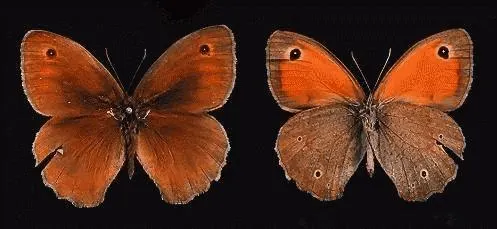
Endangered
Thomson's Meadow Brown
Maniola halicarnassus
Thomson's meadow brown (Maniola halicarnassus) is a small brown butterfly of the Aegean, found only on the Bodrum peninsula of south-west Turkey and on the Greek island of Nisyros. The IUCN Red List rated it Endangered in 2015. Its range is tiny, and some geneticists doubt it is a species at all.
How to recognise it
It is a meadow brown, a plain, brownish member of the satyrine (browns) group, and it looks very like two relatives, the common meadow brown (Maniola jurtina) and Maniola telmessia. Telling them apart in the field is not easy. A European butterfly database gives a wingspan of 40 to 55 mm, and a table of published values in a 2015 genetic study lists 42 to 47 mm for both sexes, a little larger than M. telmessia.
It was formally described in 1990 by Thomson. Before that, butterflies from the Bodrum area were recorded as forms of M. telmessia. The IUCN lists Thomson's meadow brown as its main English name, with Halicarnas brown as another.
Where it lives
Its known range is the Bodrum peninsula in Muğla province, Turkey, and the neighbouring island of Nisyros in Greece. Bodrum is the type locality. The two populations lie about 16 km apart across the sea, and most of the butterflies are in Turkey. The Red List counts only two locations, puts its extent of occurrence at under 700 square km and its area of occupancy at about 498 square km, and gives an elevation of sea level to about 100 m. The genetic study's table gives a maximum of about 450 m, so figures differ.
Habitat descriptions vary a little. In Turkey it is described from moist, shaded grassy places close to bushes and trees. On Nisyros it is recorded from dry, open scrub, near farmland and in the town. Databases also list meadows, pastures, dry calcareous grassland and sclerophyllous scrub. The IUCN lists Mediterranean-type shrubland and temperate grassland.
Pins are Wikidata “endemic to” fields. Orange dots, when present, are GBIF occurrence tiles — survey bias included.
How it lives
It has one generation a year. In Turkey it flies from early May to early June and then, after a summer rest, again until August, although the genetic study's table gives May to October. On Nisyros, fresh adults were found as late as 17 July in 1987 during hot weather. It emerges roughly two and a half weeks after M. telmessia, and hybrids between the two have been recorded.
The caterpillars feed on grasses, and eggs are laid on meadow grasses. Adults are often seen taking nectar from oregano. The population size has never been estimated.
Why it is in trouble
The Red List assessment rests on the butterfly's small range and on a continuing decline in the area and quality of its habitat. On the Bodrum peninsula, one of the most popular tourist areas in Turkey, new houses and tourist facilities keep eating into the natural habitat, and local development plans take no account of the butterfly. The assessment names two ongoing threats, tourism and recreation areas, and housing and urban development, both scored as low impact but affecting a majority of the range. It also notes that a decline in Turkey could harm the Nisyros population if the two exchange butterflies. The population trend is listed as unknown.
The species is also a taxonomic question mark. A 2015 study in Ecology and Evolution found that the seven Maniola species fall into just two incompletely separated genetic lineages, with M. halicarnassus, M. telmessia and M. cypricola of Cyprus in the same one, and suggested the genus may be a single species complex. The IUCN accepts it as a valid species, because its genitalia differ from those of M. jurtina and M. telmessia, even though the species exchange genes.
What is being done
The Red List says the butterfly has no conservation status or legal protection and that its only known sites are not protected. It recommends research on its ecology and habitat use, long-term monitoring of the population, and including its habitats in local urban development plans in Turkey. The assessment also lists site and habitat protection, policies and regulations, and awareness work as needed actions, at national and sub-national level.
Sources
Written for this catalog in our own words from the sources below, checked against them on 12 November 2026. Population figures are estimates and carry the year they were made. Status and assessment year: IUCN. 2026. The IUCN Red List of Threatened Species. Version 2026-1. iucnredlist.org.




