Endangered
Gibara Cave Brotula
Lucifuga gibarensis
The Gibara cave brotula (Lucifuga gibarensis) is a small cave fish known from just three caves near the coast of Gibara, in Holguín province, eastern Cuba. It was formally described only in 2020. The IUCN Red List rated it Endangered in 2021, and its population trend is unknown.
How to recognise it
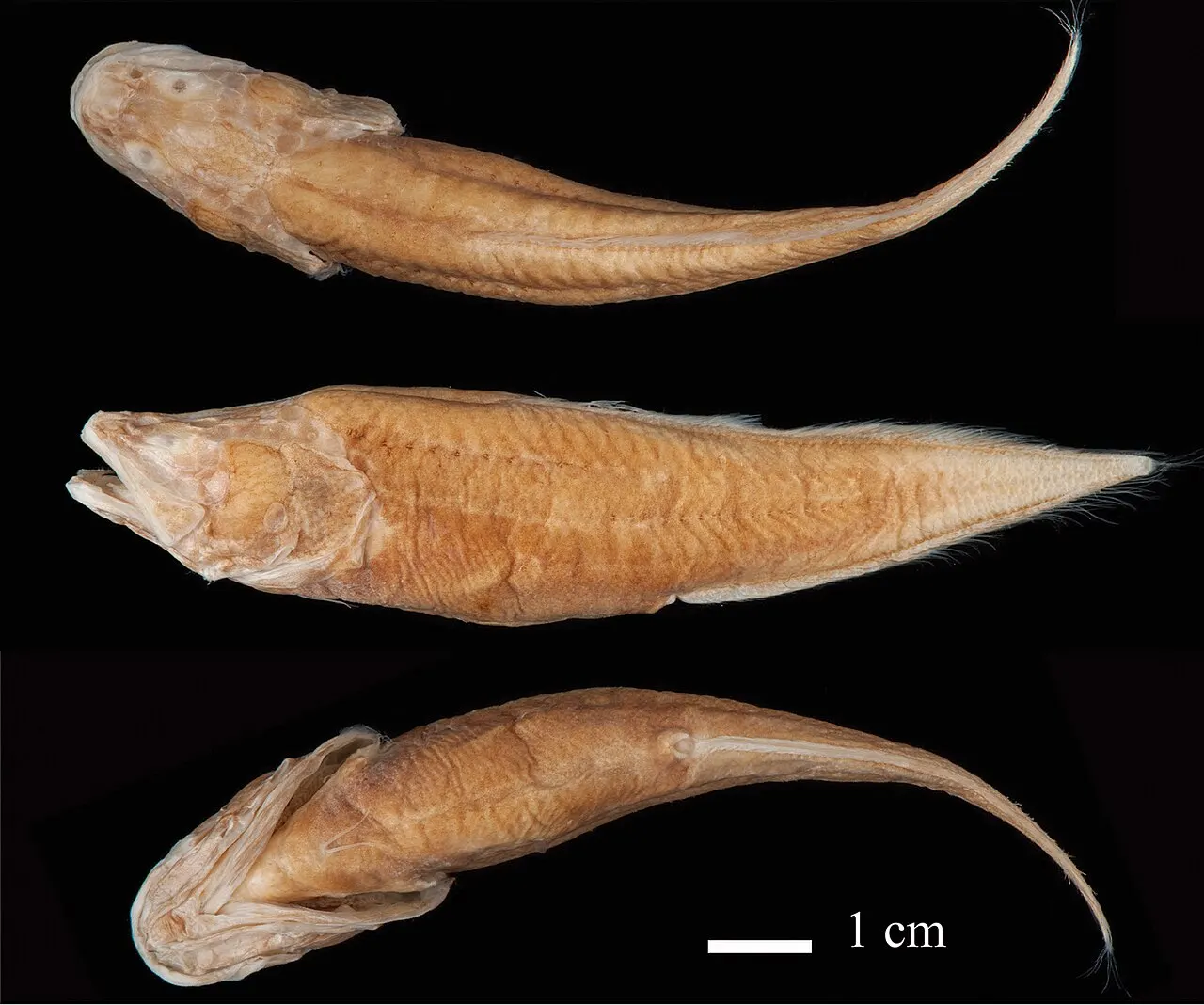
It is a livebearing brotula (family Bythitidae), and a small one. The four specimens in the original description measured 45.0 to 89.3 mm in standard length, with a mean of 73.2 mm. The body is uniformly brown or light brown, with paler fins.
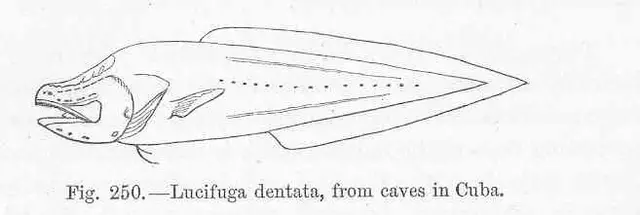
Unlike its western relative the toothed Cuban cusk-eel, it has small pigmented eyes (about 1.1 to 1.9 percent of body length) and no palatine teeth. Teeth sit on the upper and lower jaws and on the vomer. It has 50 to 53 vertebrae.
Where it lives
The species is restricted to an isolated patch of karst in Gibara municipality, near the shore. Its three caves, Aguada de Macigo, Tanque Azul and Cueva El Baga, lie 3 to 15 km apart. The nearest populations of its Cuban relatives are roughly 800 km away in the west.
Aguada de Macigo, the type locality, is a large doline about 22 m deep with water at 16 parts per thousand salinity, so it is brackish. The holotype was taken at 12 m depth. These are anchialine caves, where fresh and marine water mix underground.
Pins are Wikidata “endemic to” fields. Orange dots, when present, are GBIF occurrence tiles — survey bias included.
How it lives
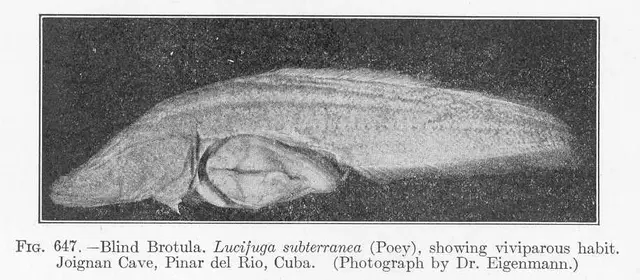
Almost nothing has been recorded about its diet, breeding or lifespan. Its relatives in the genus Lucifuga bear live young, but that has not been documented for this species. Genetic work places it well apart from the toothed Cuban cusk-eel, with about 30 percent divergence in mitochondrial DNA overall.
Why it is in trouble
With a range of just three locations, one local change could reach every known population. The IUCN assessment lists tourism and recreation areas, recreational activities, and groundwater pumping for household and farm use as ongoing threats, though how severe each one is has not been measured. The area occupied is judged to be declining.
What is being done
At least part of the range lies in a protected area, and a regional management plan applies. No monitoring scheme, recovery plan or captive population exists.
Sources
Written for this catalog in our own words from the sources below, checked against them on 12 November 2026. Population figures are estimates and carry the year they were made. Status and assessment year: IUCN. 2026. The IUCN Red List of Threatened Species. Version 2026-1. iucnredlist.org.