Endangered
Toothed Cuban cusk-eel
Lucifuga dentata
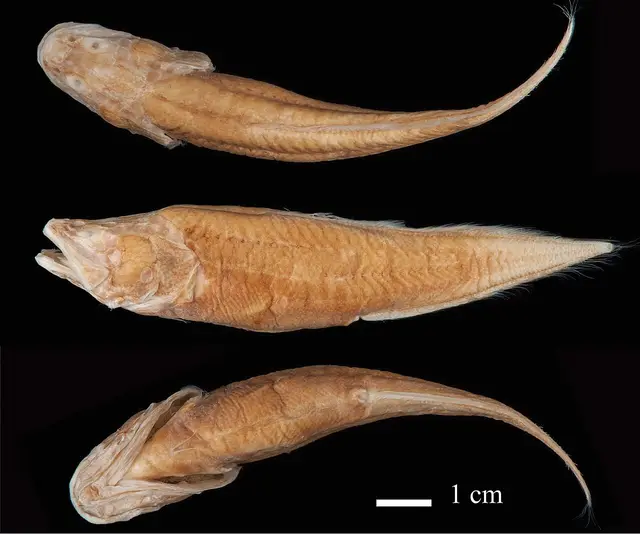
The toothed Cuban cusk-eel (Lucifuga dentata) is a small, eyeless, live-bearing cave fish found only in Cuba, in flooded caves from central Matanzas province west to the Guanahacabibes Peninsula. The IUCN Red List rated it Endangered in 2021, with a decreasing, fragmented population threatened by groundwater pumping.
How to recognise it
It belongs to the livebearing brotulas (family Bythitidae), part of the cusk-eel order Ophidiiformes. A 2020 ZooKeys study measured 126 fish, which ranged from 45 to 124 mm in standard length and averaged about 91 mm. FishBase gives a larger maximum of 15.2 cm for males.
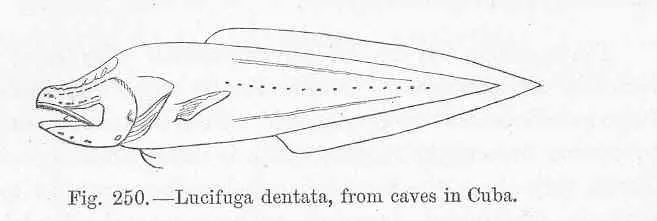
Eyes are absent, or reduced to a pigmented speck at most 0.2 percent of body length. The roof of the mouth carries small teeth (palatine teeth), which separates it from its eastern relative, the Gibara cave brotula. About 60 percent of the fish examined had the tail fin partly joined to the dorsal and anal fins by small membranes.
Where it lives
It was described from the Cueva de Cajío in Havana province and turns up in caves across western and central Cuba, from central Matanzas to the Guanahacabibes Peninsula in Pinar del Río. The range is patchy, with the biggest gap lying between western Havana and Guanahacabibes.
The ZooKeys study calls it the most abundant and widely distributed Lucifuga species in Cuba. It lives in anchialine caves, flooded limestone systems where fresh and sea water meet underground, and in some of them it shares the water with other members of its genus.
Pins are Wikidata “endemic to” fields. Orange dots, when present, are GBIF occurrence tiles — survey bias included.
How it lives
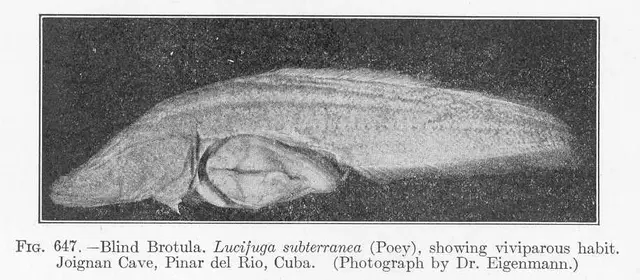
FishBase lists the species as viviparous, meaning it bears live young. Little else is recorded about its breeding.
A diet study of 18 fish found mostly small crustaceans (mysids, isopods, amphipods and decapods) plus mosquito larvae. FishBase singles out cirolanid isopods as prey. Modelled estimates suggest it is slow to rebuild a population, with a doubling time of more than 14 years.
Why it is in trouble
The IUCN assessment records a decreasing, fragmented population. The biggest listed threat is groundwater pumping for farming and household use, rated as affecting the majority of the population. Garbage and oil spills affect a smaller share.
The assessment also names two invasive fish, the African catfish (Clarias gariepinus) and Nandopsis tetracanthus. For Cuban cave fishes in general, introduced marine fish compete for food and prey on them, and some historic cave sites have been partly or fully destroyed or hit by industrial and household pollution and engineering works.
What is being done
Part of its range lies inside a protected area, and an area-based management plan is in place. There is no dedicated recovery plan, no systematic monitoring scheme, no invasive-species control and no captive population.
Sources
Written for this catalog in our own words from the sources below, checked against them on 12 November 2026. Population figures are estimates and carry the year they were made. Status and assessment year: IUCN. 2026. The IUCN Red List of Threatened Species. Version 2026-1. iucnredlist.org.