Endangered
Lucifuga subterranea
Lucifuga subterranea
The Cuban cusk-eel, Lucifuga subterranea, is a small cavefish found only in western Cuba, where it lives in flooded caves linked to the surface by sinkholes and wells. The IUCN Red List assessed it as Endangered in 2021, because its few sites are shrinking and the trend is unknown.
What it is
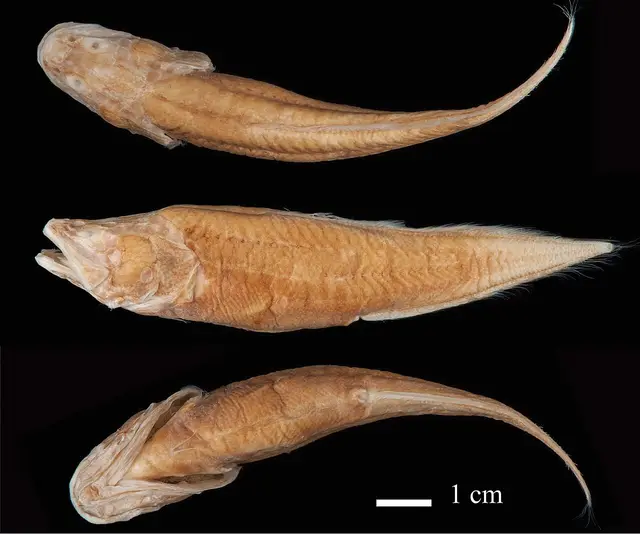
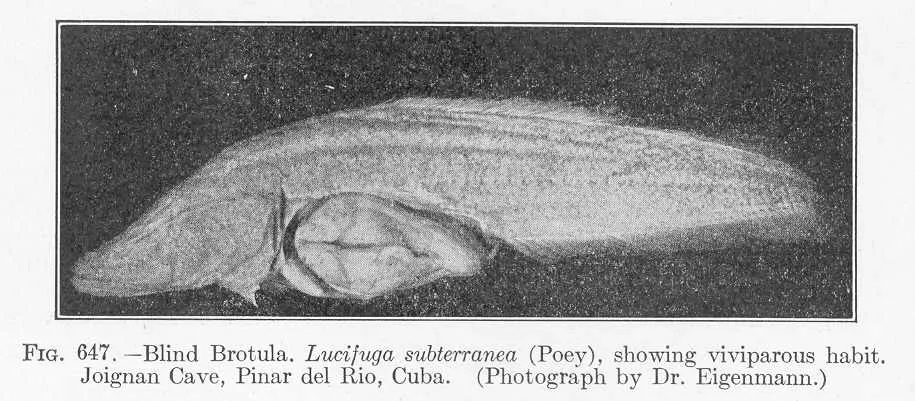
Lucifuga subterranea belongs to the Bythitidae, a family of live-bearing brotulas. Felipe Poey described it in 1858, and it is the type species of its genus. The largest specimen on record measured 8.95 cm in standard length. Pregnant females examined in 1909 carried 2 to 15 embryos, and breeding is thought most likely to fall between March and May.
Another Cuban cave brotula, Lucifuga teresinarum, was described in 1988. The Red List now treats it as a junior synonym of this species, so fish once assigned to teresinarum count within its range. A 2011 study in Molecular Phylogenetics and Evolution reported cryptic allopatric diversity among Cuban Lucifuga, meaning separate lineages that look alike.
Where it lives
The species is endemic to Cuba. It occurs in the karst of Artemisa and Mayabeque provinces in the west, around the towns of Artemisa, Alquizar, Guira de Melena and Quivican. Older sources place the same caves in Habana province. The type locality is Cueva de Cajio, near Guira de Melena.
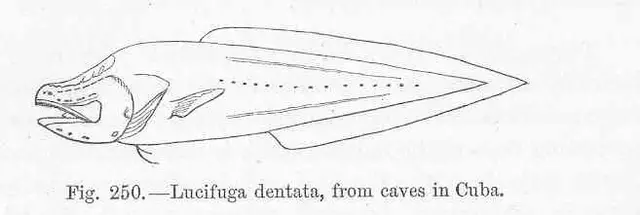
It lives mainly in flooded caves connected to the surface by sinkholes and natural wells, in still, clear water at about 25 degrees C, down to about 30 m. It is often found alongside a relative, Lucifuga dentata. Records exist from 22 localities, of which 13 were confirmed more recently.
The Red List puts its area of occupancy at no more than 40 square kilometres and its extent of occurrence at no more than 588. It counts 3 to 4 locations and describes the habitat as severely fragmented.
Pins are Wikidata “endemic to” fields. Orange dots, when present, are GBIF occurrence tiles — survey bias included.
How it lives
The fish is an opportunistic forager that feeds largely on crustaceans, including cave shrimps and isopods. Two parasites have been recorded from it, a trematode and a nematode.
Some accounts call it common where it occurs, but visual surveys found fewer of these fish than of Lucifuga dentata, and the Red List suspects the total population is small. No population size has been estimated. Reproduction is likely slow, with few young and long generations.
Why it is in trouble
The 2021 assessment rates it Endangered under criteria B1ab(iii,iv,v)+2ab(iii,iv,v), which are tests for a small, fragmented range that is still shrinking. The population trend is recorded as unknown. In 1996 the species had been rated Vulnerable.
Groundwater pumped for farming and for household use is the largest listed threat, each affecting a majority (50 to 90 percent) of the range. Heavy pumping has also made the water table swing sharply in at least one cave, and salt water has seeped into aquifers in the region. Garbage and solid waste, recreational use of caves, industrial pollution and agro-industry are also listed. Some historical sites have been partly or totally destroyed, and introduced surface fishes such as live-bearing poeciliids have reached some caves, where they compete with this species for food and prey on it.
What is being done
Not much, at least on paper. The Red List says there is no recovery plan, no monitoring scheme, no identified conservation sites, and no protected area where it lives, and it is not covered by international trade controls. Cuba has rated it Vulnerable on its national Red List. Habitat protection and population monitoring are named as priorities, and research needs include population size and trends, life history and the severity of the threats.
Sources
Written for this catalog in our own words from the sources below, checked against them on 12 November 2026. Population figures are estimates and carry the year they were made. Status and assessment year: IUCN. 2026. The IUCN Red List of Threatened Species. Version 2026-1. iucnredlist.org.
- IUCN Red List, Lucifuga subterranea (2021)
- IUCN Red List API, Lucifuga subterranea taxon record
- Cavefishes of the World species record
- Lucifuga subterranea, encyclopedia article
- Lucifuga genus article
- Crossref record, Molecular phylogeny and phylogeography of the Cuban cave-fishes of the genus Lucifuga (2011)