Endangered
Louisea balssi
Louisea balssi
Louisea balssi is a small freshwater crab found only in south-western Cameroon. The IUCN Red List lists it as Endangered (assessed 2008). Known for a century only from museum specimens collected between 1900 and 1910, it was found alive again in 2017 in a forest stream on Mount Manengouba, beside a volcanic crater lake.
How to recognise it
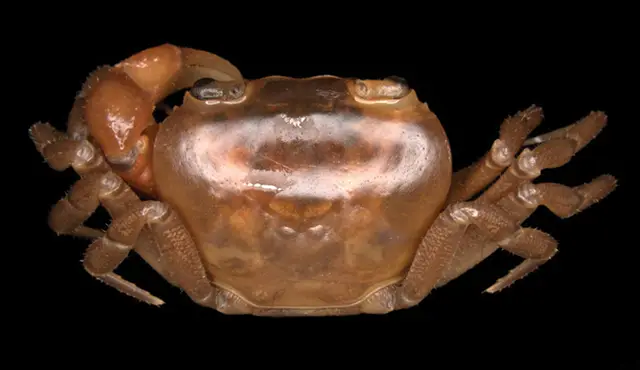
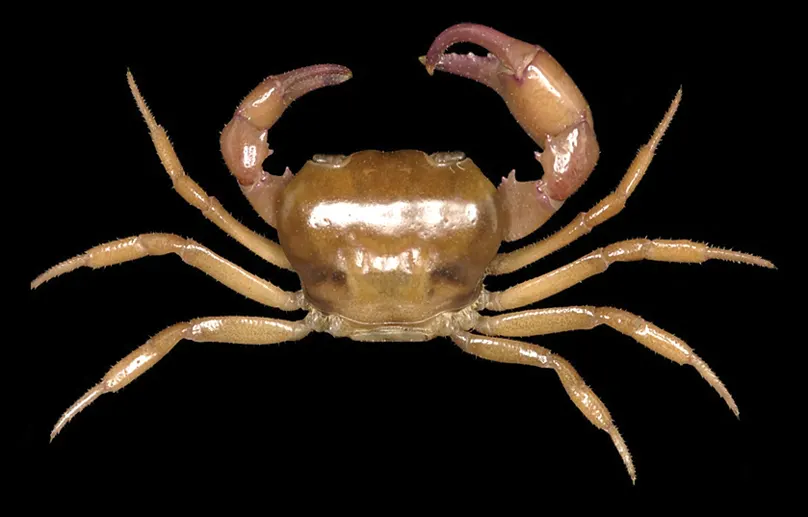
This is a small crab with a smooth, high, oval shell. Adults mature at about 13 to 17 mm across the shell, though the egg-carrying females in the 1909 series were larger, at 21 to 22 mm. The larger claw is slender, and its movable finger is strongly arched, leaving an oval gap when the claw closes.
That claw shape separates it from its close relative Louisea edeaensis, which has a stout, straight finger. The genus Louisea was long thought to hold only these two species. A 2019 revision split out two more, from Nkongsamba and Yabassi, so there are now four, all found only in Cameroon.
Where it lives
The first specimens were collected on 10 September 1909 at Barombi Mbo, a crater lake near Kumba, at 323 metres above sea level. Surveys at Barombi Mbo before 2018 failed to find it again, and researchers have written that current social issues in this part of Cameroon rule out further surveys near Kumba.
The living population was found in the Manengouba Ecological Reserve, near Bangem, at more than 1,300 metres. Mount Manengouba is a dormant volcano on the Cameroon Volcanic Line, with three crater lakes near its summit. The crabs were not in Man's Crater Lake itself but in a small spring-fed stream that runs through the remaining forest on its south side. The Red List counts two locations.
Pins are Wikidata “endemic to” fields. Orange dots, when present, are GBIF occurrence tiles — survey bias included.
How it lives
It is a stream-side species. Crabs were found in puddles beside small permanent streams and in the damp ground under stones and fallen leaves next to them, never in the deeper water in the middle of the stream. The lake itself is nearly lifeless, probably because carbon dioxide builds up in its deep water, which may be why the crab avoids it.
Water at the crab's stream-edge sites was acidic, with an average pH of 5.4, well below the 6.5 to 9.0 range suited to most freshwater animals. Researchers suspect acid water could harm hatching and young crabs, but this has not been tested for this species.
Why it is in trouble
Everything depends on a small patch of forest. Its canopy shades the stream and keeps the ground damp, and that forest is not formally protected. People cutting firewood have degraded and destroyed parts of it, and intensive farming that strips natural vegetation is named as the main threat in the area. The 2008 assessment was made when only one locality was known, and it rates the population trend as unknown.
What is being done
A project led by Pierre Mvogo Ndongo and supported by the Rufford Foundation ran from March 2018 to February 2019. It included meetings with village chiefs and teaching local people how farming harms the streams. The project reports that the steep forested slopes around the crab's stream are now regenerating. A formal conservation action plan and a fresh Red List assessment were named as next steps, and the forest remains unprotected.
Sources
Written for this catalog in our own words from the sources below, checked against them on 12 November 2026. Population figures are estimates and carry the year they were made. Status and assessment year: IUCN. 2026. The IUCN Red List of Threatened Species. Version 2026-1. iucnredlist.org.
- IUCN Red List: Louisea balssi
- Mvogo Ndongo, von Rintelen and Cumberlidge (2019), ZooKeys 881: revision of Louisea
- Rufford Foundation final report 24245-B (Mvogo Ndongo, 2018 to 2019): Conservation of the rediscovered Louisea balssi on Mount Manengouba
- Rufford Foundation final report 20242-2 (Mvogo Ndongo, 2016 to 2017)