Endangered
Louisea edeaensis
Louisea edeaensis
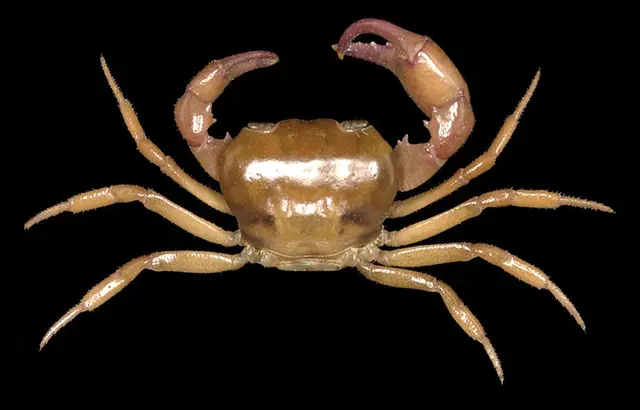
Louisea edeaensis is a small red-brown freshwater crab from the lowland rainforest of southern Cameroon. The IUCN Red List lists it as Endangered (assessed 2008), down from Critically Endangered in 1996. Known for a century from a few museum specimens, it was found alive in 2015 on Bedimet Island in Lake Ossa.
How to recognise it
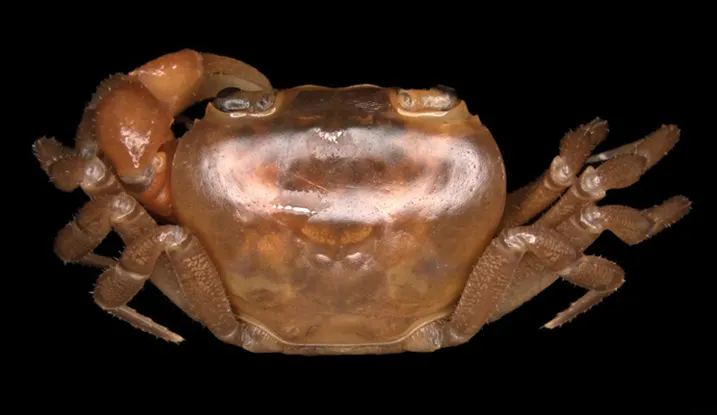
Living adults are red-brown on the shell, claws and legs, with paler brown to cream-yellow sides and underside. It is a small crab, with adults 16.5 to 22.5 mm across the shell, and the change to adulthood comes at about 16 to 17 mm. The shell is smooth, and the larger claw has a stout, straight finger, which helps separate it from its relative Louisea balssi.
Males grow one claw much bigger than the other, with an arched finger that leaves a gap when closed. Females keep claws of similar size but develop a broad abdomen for carrying eggs.
Where it lives
The species is endemic to southern Cameroon. The first specimen, a male, was collected at Edea in January 1910 and was not described until 1969. Specimens from Yaounde date to 1907. A set from Yabassi once counted as this species is now treated as a separate one, Louisea yabassi, described in 2019.
The living population is on Bedimet Island (550 hectares) in the Lake Ossa wetland complex, at about 90 metres above sea level. The complex has nine lakes and more than twenty islands and gets over 3,000 mm of rain a year. It lies inside a wildlife reserve that is managed for mammals and birds, not for freshwater invertebrates. The Red List counts two locations.
Pins are Wikidata “endemic to” fields. Orange dots, when present, are GBIF occurrence tiles — survey bias included.
How it lives
It prefers temporary water, such as puddles beside small permanent streams, and the damp ground under fallen leaves on the bank. In surveys it was never found in the year-round streams themselves. The crab feeds on rotting leaf litter, live prey such as millipedes, and plants, and it is eaten in turn by crab-eating mammals, birds, reptiles and ants.
Twelve monthly transects in 2016 and 2017 found one to twelve crabs per transect, mostly juveniles and subadults, with equal numbers of males and females. No egg-carrying females were seen, and researchers suspect they may brood in tree holes, which they chose not to search to avoid damaging the habitat. Where and when it breeds remains unknown.
Why it is in trouble
Much of Bedimet Island has been cleared of forest for farming, and pesticides may wash into the crab's puddles and streams. With the shade gone, daytime water temperatures reached up to 30 C, against 22 to 26 C in forest-shaded streams. The marginal water was also very acidic, averaging pH 4.5, which could harm hatching and young crabs. The discoverers wrote in 2017 that a new assessment would likely upgrade the species to Critically Endangered.
What is being done
A project supported by the Rufford Foundation ran in 2016 and 2017. It included monthly meetings with village chiefs about how farming affects the island's waters and trained local field assistants to recognise the crab's habitat. The project reports that farmers have moved their fields away from areas where the crab occurs. The 2008 assessment lists no conservation actions in place.
Sources
Written for this catalog in our own words from the sources below, checked against them on 12 November 2026. Population figures are estimates and carry the year they were made. Status and assessment year: IUCN. 2026. The IUCN Red List of Threatened Species. Version 2026-1. iucnredlist.org.