Critically Endangered
Red-tailed sportive lemur
Lepilemur ruficaudatus
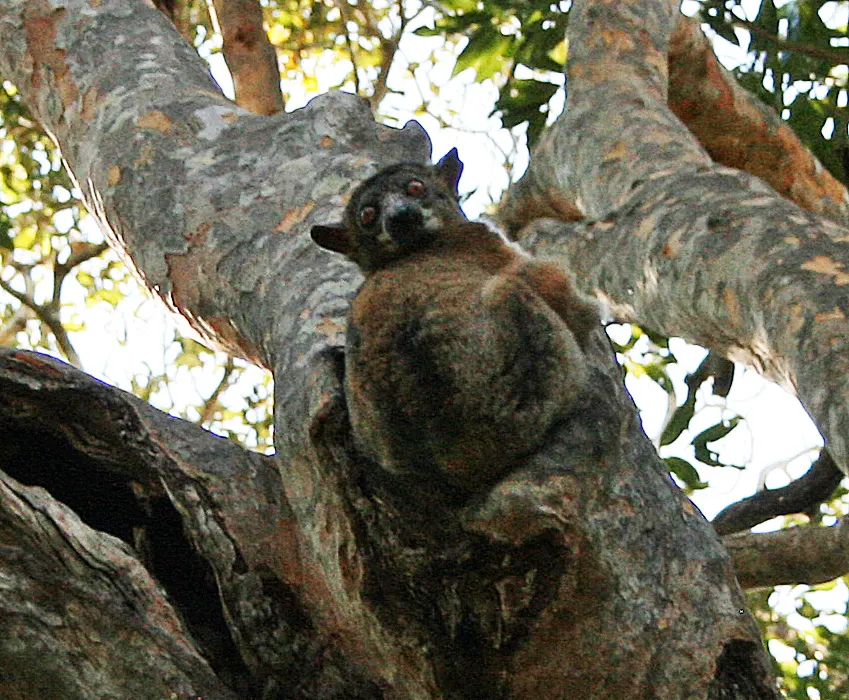
The red-tailed sportive lemur is a small, night-active lemur found only in the dry forests of western Madagascar. It spends its days in tree holes and its nights eating leaves. The IUCN Red List assessed it as Critically Endangered in 2020, citing a steep, continuing decline from forest loss and hunting for food.
How to recognise it
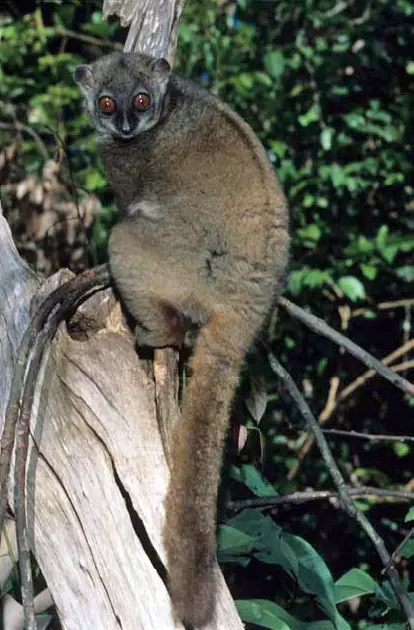
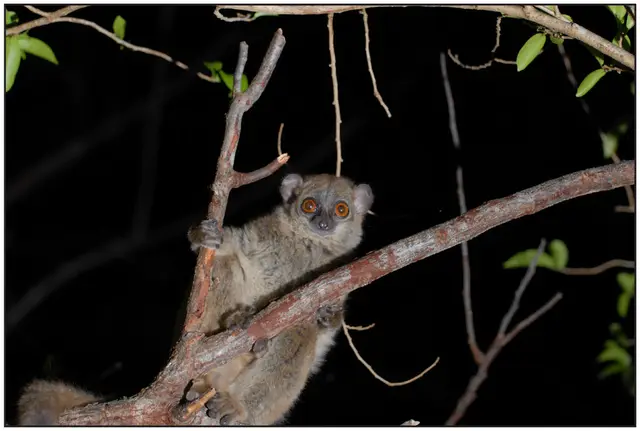
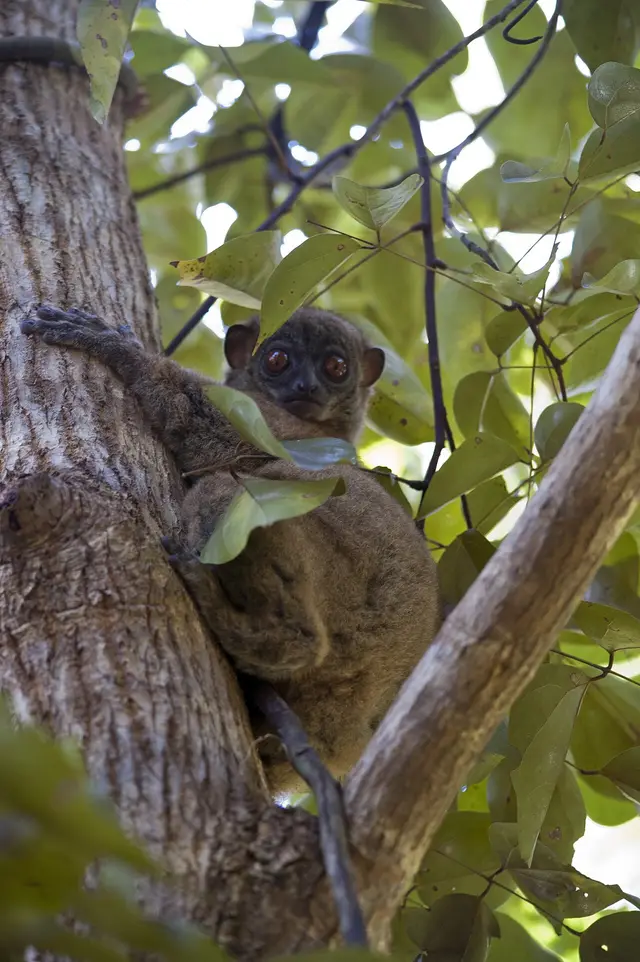
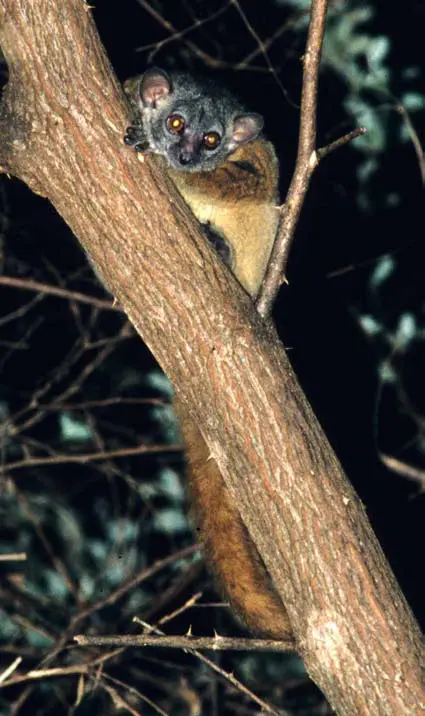
An adult weighs about 800 grams, with a head and body around 28 centimetres long and a tail of 25 to 26 centimetres. The fur is grey-brown and cream, the tail tip is reddish brown, and the large round eyes are yellow and orange. Males and females look alike.
It leaps between trees, with jumps of up to 4 metres reported.
Where it lives
The species is found only in Madagascar, in dry deciduous forest on the west side of the island. One conservation group places it between the Morondava and Tsiribihina rivers, and farther south between the Kambatomena and Mangoky rivers.
The Red List records it only at very low elevation, from about 13 to 48 metres above sea level. Its estimated extent of occurrence is about 23,000 square kilometres, but the population is severely fragmented.
Pins are Wikidata “endemic to” fields. Orange dots, when present, are GBIF occurrence tiles — survey bias included.
How it lives
It is nocturnal and eats mostly leaves, with some fruit. In a 2004 Journal of Zoology study, researchers radio-tracked 14 females and 14 males over 365 half-nights. The sexes travelled similar distances each night, and the fruit females ate was lower in fibre than the fruit males ate. Nightly travel is generally about 100 metres to 1 kilometre, so the animal is fairly inactive.
Most live in pairs that share a home range of roughly one hectare, with little overlap between neighbouring pairs. By day they sleep in tree holes. A 2017 study in Folia Primatologica recorded 60 sleeping sites in Kirindy Mitea National Park in 2012. The lemurs favoured intact, living trees, especially Strychnos madagascariensis, and holes in taller, thicker trees. That study suggested sleeping trees may be an important resource to protect.
Females usually have a single young, born at the start of the rainy season in November. The species has no strong alarm-call system and relies on escape behaviour to avoid predators such as the fossa.
Why it is in trouble
The 2020 assessment records an ongoing population reduction of 80 percent and a projected reduction of 90 percent, with a generation length of 7 years. It lists small-scale farming and grazing, housing, and hunting as threats, and records human food as its use. Forest is being lost, and one conservation group names corn and peanut farming as a driver.
What is being done
The lemur is on CITES Appendix I, which restricts international trade. The Red List says it occurs in at least one protected area, and one conservation group names Menabe-Antimena, Kirindy Mitea, Andranomena and Kasijy. The assessment lists site management and harvest management as actions, and calls for research on threats, ecology, population size and taxonomy.
Sources
Written for this catalog in our own words from the sources below, checked against them on 12 November 2026. Population figures are estimates and carry the year they were made. Status and assessment year: IUCN. 2026. The IUCN Red List of Threatened Species. Version 2026-1. iucnredlist.org.