Critically Endangered
Laysan Noctuid Moth
Agrotis laysanensis
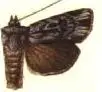
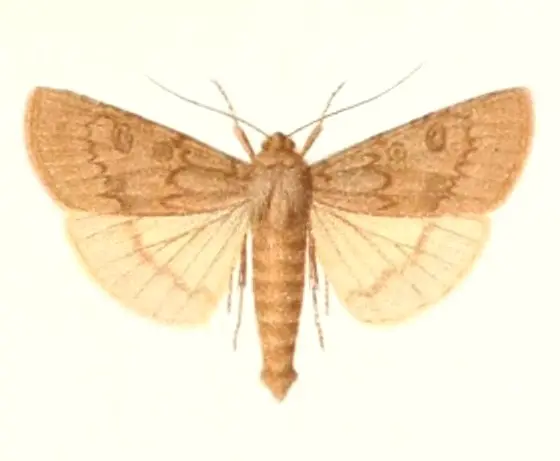
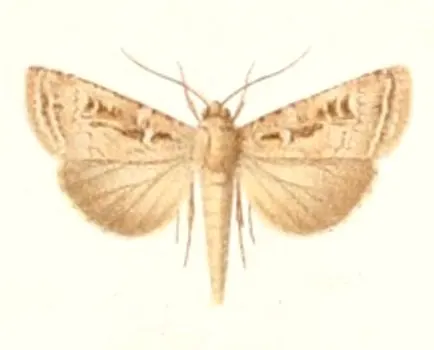
The Laysan noctuid moth (Agrotis laysanensis) is a night-flying moth found only on Laysan, a low, remote island in the Northwestern Hawaiian Islands. The IUCN Red List assessed it as Critically Endangered in 2021. It is best known as a main food of the extinct Laysan millerbird, which was named after it.
Where it lives
Laysan lies about 808 nautical miles northwest of Honolulu. The island covers roughly 411 hectares (1,016 acres) and rises to just 15 metres on a large dune in the north. It is uninhabited and managed by the US Fish and Wildlife Service.
The moth was described by Walter Rothschild in 1894, and it has never been recorded anywhere else. The Red List counts a single location and gives both the extent of occurrence and the area of occupancy as 16 square kilometres. The listed habitats are coastal sand dunes and dry tropical shrubland. The moth isn't a migrant, so there's no wider range to fall back on.
Pins are Wikidata “endemic to” fields. Orange dots, when present, are GBIF occurrence tiles — survey bias included.
A moth with a bird named after it
Moths in the genus Agrotis are called millers, and the Laysan millerbird was named for its favourite food. This moth was one of the main species the bird ate, and possibly the main one.
The Laysan millerbird was last seen in 1923, after introduced rabbits destroyed the island's vegetation, and is now extinct. In 2011 biologists began moving birds of the closely related Nihoa millerbird by boat, about 650 miles, to Laysan, 50 in all. By Audubon's account, Laysan then held more than 125 of them.
Why it is in trouble
A species confined to one low island is vulnerable to a single bad event. The Red List names storms and flooding, and shifting or altered habitat, as threats, along with pressure from unspecified other species. It records a continuing decline in the area the moth occupies. Its population trend is listed as unknown, and no population size has been estimated.
Laysan's history shows how fast conditions can change. Guano was mined there in the late 1800s and early 1900s. Rabbits released in 1894 overgrazed the island, and 26 endemic plant species are said to have been lost to them. The last rabbits were removed in 1923. An introduced grass, sandbur, arrived in the 1960s and was cleared by 2000. A US Geological Survey study has also found that Laysan and similar Pacific islands could be flooded and become unfit to live on during this century.
What is being done
When the moth was assessed in 2021, no recovery plan or monitoring scheme was in place, and no conservation sites had been identified for it. The assessment lists invasive species control and habitat restoration as the actions needed.
Sources
Written for this catalog in our own words from the sources below, checked against them on 12 November 2026. Population figures are estimates and carry the year they were made. Status and assessment year: IUCN. 2026. The IUCN Red List of Threatened Species. Version 2026-1. iucnredlist.org.