Critically Endangered
Agrotis panoplias
Agrotis panoplias
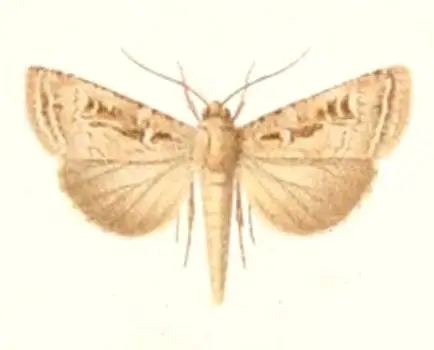
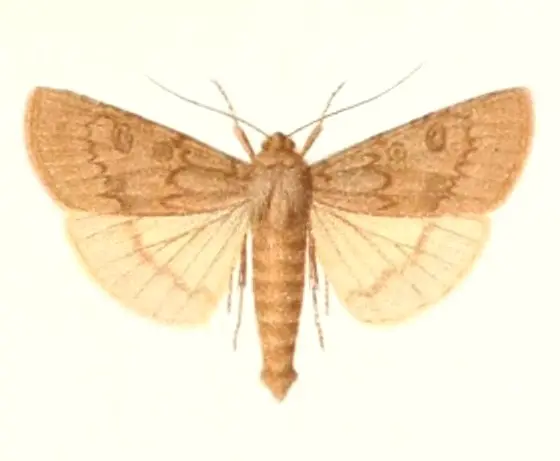
The Kona agrotis noctuid moth (Agrotis panoplias) is a Hawaiian cutworm moth known from a single male collected on Hawaii Island and described in 1899. The IUCN Red List classed it as Critically Endangered, possibly extinct, in 2021, because it has not been recorded in many years.
How to recognise it
The only description comes from the one male known to science, so there is little to go on. Edward Meyrick described it in 1899 with a size of 39 mm, probably its wingspan, a dark grey-brown head and thorax dusted with white, and forewings of the same colour with dark veins. The forewings carried two dark crosswise lines, a dark streak beneath the central cell, and two dark-outlined spots near the middle. The hindwings were dark grey-brown, lighter at the base and darker toward the edge. The male's antennae were bidentate, with fairly long triangular teeth.
Where it lived
The type specimen came from Kona on Hawaii Island, at about 4,000 feet (roughly 1,200 m), and was taken in July. Meyrick published it in Fauna Hawaiiensis, the survey of the islands' land animals. The Red List treats the species as endemic to Hawaii Island and gives its habitat as unknown. Its caterpillar food plant is not known, and nothing is recorded about its life cycle beyond that single July capture. GBIF holds no occurrence records for the species.
Pins are Wikidata “endemic to” fields. Orange dots, when present, are GBIF occurrence tiles — survey bias included.
Why it is in trouble
The Red List assessment lists the population size and trend as unknown. It infers fewer than 50 mature individuals if the moth survives at all, which is the basis of the criterion D listing. The U.S. Fish and Wildlife Service had already listed it as possibly extinct in 1994.
Threats are poorly documented. The assessment suggests that parasitic wasps released in Hawaii between 1902 and 1942 to control an introduced cutworm pest could have attacked this moth too, and may have driven its decline. That is a possibility, not a demonstrated cause.
What is being done
No conservation work specific to this moth is in place. The assessment records no recovery plan, no monitoring scheme and no identified conservation site, and it is unknown whether the species occurs in a protected area. It recommends surveys at the places where the moth was historically collected, and invasive species control if it still exists.
The assessors also say that declaring it extinct may be premature, because other Hawaiian moths listed as possibly extinct at that time have since been rediscovered and the recent survey effort in suitable habitat is unclear.
Sources
Written for this catalog in our own words from the sources below, checked against them on 12 November 2026. Population figures are estimates and carry the year they were made. Status and assessment year: IUCN. 2026. The IUCN Red List of Threatened Species. Version 2026-1. iucnredlist.org.