Endangered
Peruvian Woolly Monkey
Lagothrix cana
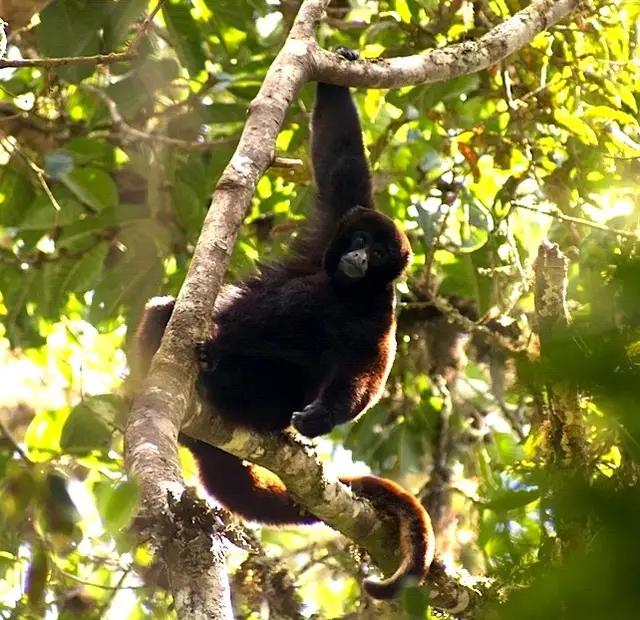
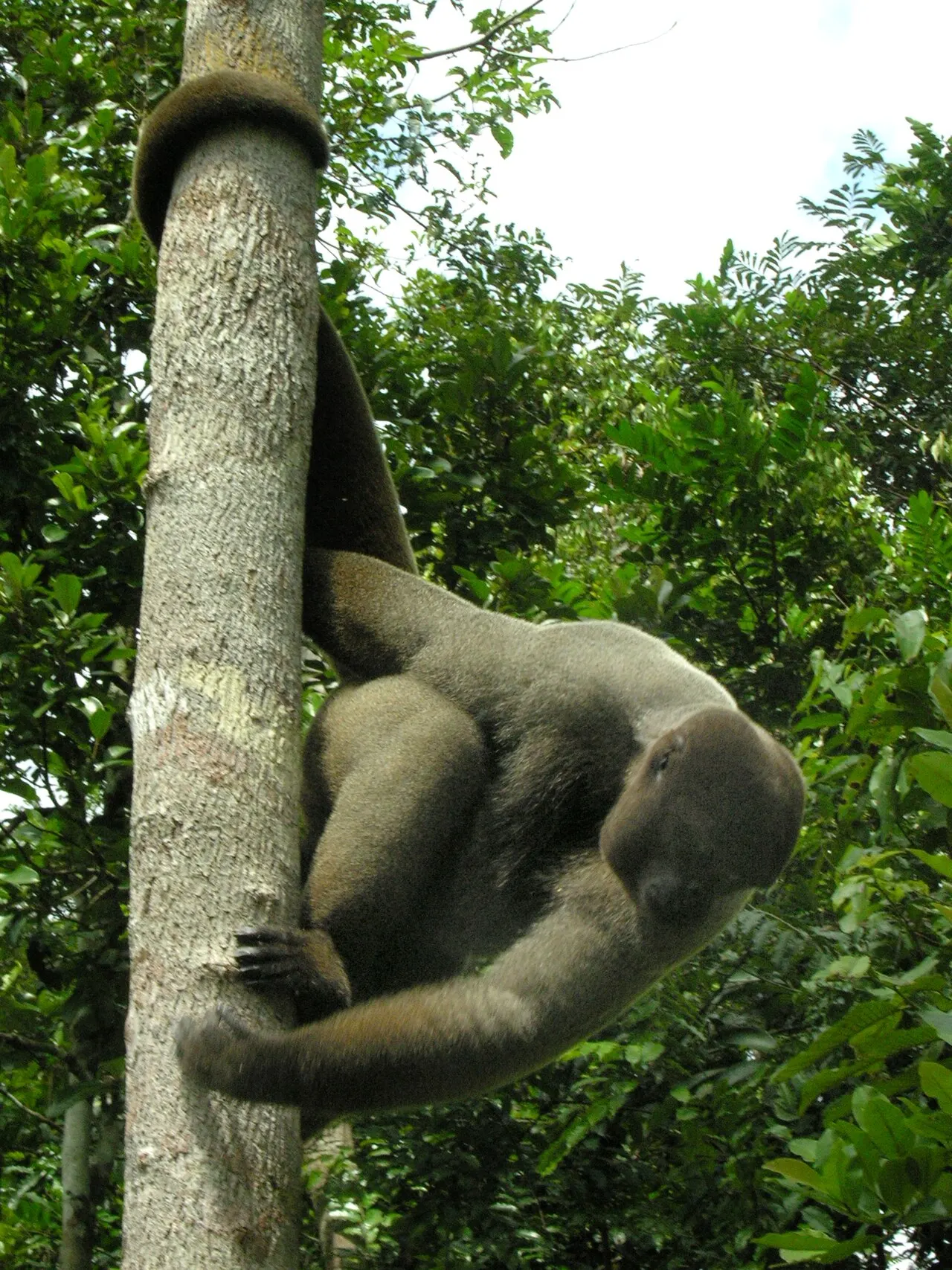
The gray or Peruvian woolly monkey (Lagothrix cana, now often treated as Lagothrix lagothricha cana) is a heavy-bodied primate of the southwestern Amazon in Brazil, Peru and Bolivia. The IUCN Red List has it as Endangered (2021 assessment, population decreasing). It eats mostly fruit and lives in large groups high in the canopy.
How to recognise it
It's a stocky, long-tailed monkey with thick gray fur and a darker face, hands, feet and inner arms. Males run about 46 to 65 cm from head to rump and average roughly 9.5 kg. Females are smaller, at 46 to 58 cm and an average of around 7.7 kg. The tail is longer than the body, at roughly 66 to 68 cm, and it grips like a fifth hand.
Where it lives
It is reported from Peru, Bolivia and Brazil, and the 2008 Red List assessment, made when it was treated as a full species, gave records from the Brazilian states of Acre, Amazonas, Mato Grosso and Para. The habitats on the assessments are lowland moist forest, swamp forest and moist savanna. Other accounts describe populations in mountain cloud forest between about 1,000 and 2,500 m, and as low as 700 m in Bolivia, so it may use a wider range of forest than the Red List summary suggests.
In Bolivia the entire known population is reported to sit inside two protected areas, Apolobamba and Madidi.
Pins are Wikidata “endemic to” fields. Orange dots, when present, are GBIF occurrence tiles — survey bias included.
How it lives
Woolly monkeys spend most of their time high in the canopy, using the tail to hang and to bridge gaps between trees. Fruit makes up most of the diet. When fruit runs short they turn to young leaves and sometimes seeds.
Groups are large, with 11 to 25 animals of mixed age and sex. Neighbouring groups are described as showing little aggression and often share good feeding trees.
Why it is in trouble
The latest Red List assessment (2021) rates it Endangered under criterion A4cd, a decline driven by loss of habitat quality and by exploitation, with the population decreasing. The earlier 2008 assessment, which treated it as its own species, also gave Endangered (criterion A2cd). A fall of about 50 percent over 45 years is often quoted, but no total number of animals has been published.
Hunting for meat and for the pet trade is the main pressure. Hunters tend to shoot adult females and sell the babies. In one reported case in the western Amazon, hunters killed more than 200 woolly monkeys in under two years, and the local population disappeared. The assessments also list farming, cattle ranching and housing, and the 2008 one adds roads, dams and mining, as ongoing pressures on the forest.
There's a naming wrinkle too. A 2014 genetic study supported placing this animal as a subspecies of the common woolly monkey, and the Red List now follows that treatment, listing it as Lagothrix lagothricha cana.
What is being done
The species is on CITES Appendix II, which controls international trade. The Red List records conservation sites identified across its whole range, and the 2008 assessment recommended site protection, site management and harvest management. Population trends, ecology, threats and taxonomy were listed as research needs. Brazil has many protected areas within its range, among them Amazonia and Mapinguari national parks.
Sources
Written for this catalog in our own words from the sources below, checked against them on 12 November 2026. Population figures are estimates and carry the year they were made. Status and assessment year: IUCN. 2026. The IUCN Red List of Threatened Species. Version 2026-1. iucnredlist.org.