Endangered
Italian bleak
Alburnus albidus
The Italian bleak, also called the southern Italian bleak, is a small, pale minnow-type fish found only in the rivers of southern Italy. It grows to about 11 cm. The IUCN Red List rates it Endangered (2024 assessment), as water abstraction, dams, pollution and interbreeding with introduced fish erode its populations.
How to recognise it
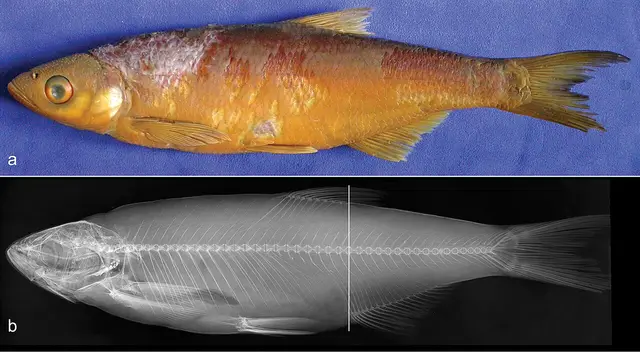
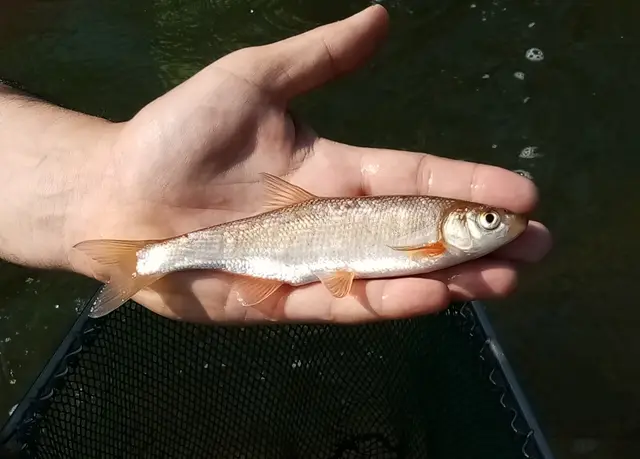
This is a slim, pale fish of the carp family Leuciscidae, reaching a maximum standard length of about 11 cm. The mouth points straight forward, and the keel along the belly is exposed between the vent and the base of the pelvic fins.
Telling it from its relatives is a job for specialists. One feature is where the anal fin starts, just behind or below the last branched ray of the dorsal fin, and the anal fin has 11 to 13 and a half rays.
Where it lives
It is endemic to southern Italy. Its native rivers drain to the Adriatic and Ionian seas from the Trigno to the Sinni systems, and to the Tyrrhenian side from the Volturno to the Alento. The Alento, in the Cilento region of Campania, is where the species was first described, by Oronzio Gabriele Costa in 1838.
It prefers moderate to slow water over gravel, stones or pebbles, in both main river channels and smaller tributaries, and it also turns up in reservoirs. Some populations are the result of introductions into other southern rivers, such as the Mingardo, Bussento, Noce, Lao, Savuto and Neto. The IUCN estimates its extent of occurrence at about 41,600 square kilometres.
Pins are Wikidata “endemic to” fields. Orange dots, when present, are GBIF occurrence tiles — survey bias included.
How it lives
It feeds on insects and other small invertebrates that drift past or fall onto the surface. Fishbase gives its habitat as clear, well-oxygenated hill streams and small rivers as well as still or slow lowland waters, in temperatures of roughly 12 to 28 degrees Celsius.
The IUCN records it as gathering in groups all year and not migrating. Little has been published on its breeding.
Why it is in trouble
The IUCN records a past population reduction of about 50 percent, and the decline is continuing. The causes it lists are mostly about water. Rivers are drained for farming and household use, groundwater is pumped, and large and small dams cut up the habitat. Sewage, nutrient runoff, pesticides, silt and drought add to the strain.
Introduced fish are the other big problem. A 2015 study in Hydrobiologia by Rossi and colleagues, covering five river populations, reported that about 39 percent of the fish examined were hybrids with introduced relatives, mainly the northern Italian bleak (Alburnus arborella). The Ofanto River population looked the most compromised, while the Agri and Trigno populations were the best preserved and were recommended for priority protection.
What is being done
The species is included in international legislation, and the IUCN notes that it occurs in at least one protected area, with conservation sites identified over part of its range. There is no species recovery plan and no systematic monitoring scheme, and invasive species control is not in place.
Sources
Written for this catalog in our own words from the sources below, checked against them on 12 November 2026. Population figures are estimates and carry the year they were made. Status and assessment year: IUCN. 2026. The IUCN Red List of Threatened Species. Version 2026-1. iucnredlist.org.