Endangered
Alburnus macedonicus
Alburnus macedonicus
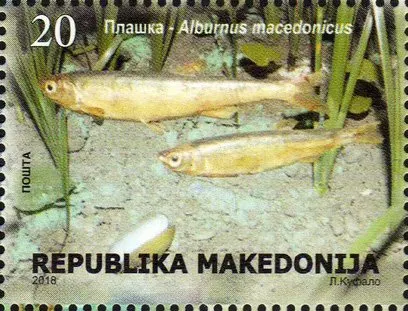
The Doiran bleak (Alburnus macedonicus) is a small freshwater fish found only in Lake Doiran (Dojran), which straddles the border of Greece and North Macedonia. The IUCN assessed it as Endangered in 2024, after a Critically Endangered rating in 2008. It has suffered from the lake's falling water level.
How to recognise it
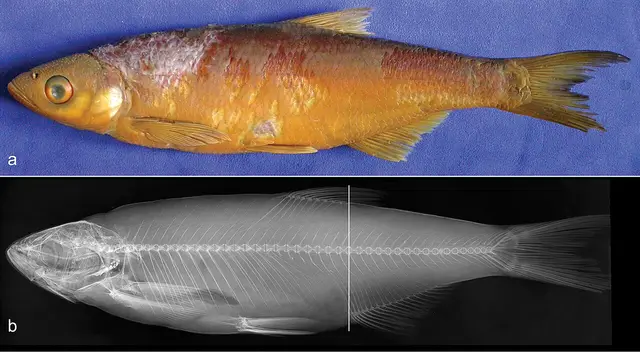
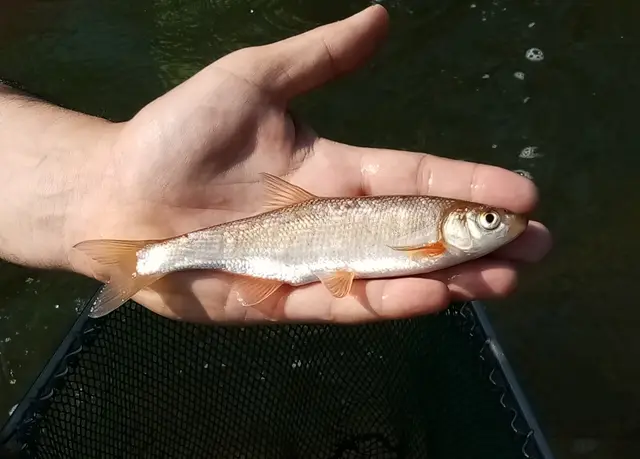
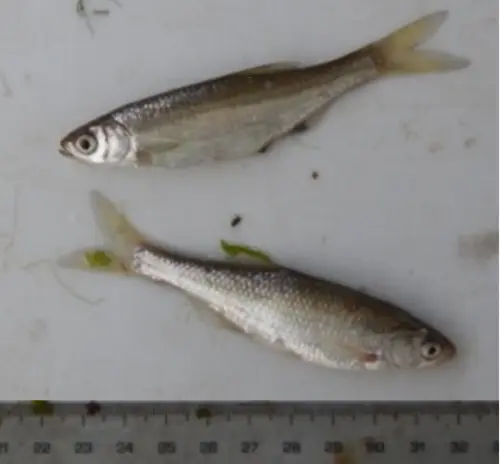
It is a slim, streamlined minnow-type fish that grows to about 14.5 cm in standard length. Its body depth is 17 to 22 percent of its length. Specialists tell it from other Balkan bleaks by its anal fin, which has 14 to 16 branched rays, and by its 20 to 26 gill rakers. It was described by the ichthyologist Stanko Karaman in 1928.
Where it lives
Nowhere else in the world. Lake Doiran covers about 43 km2, shared between North Macedonia (27.3 km2) and Greece (15.8 km2), and is shallow, with a maximum depth near 10 m. The fish lives along the near shore and spawns in the surf zone, where waves break on the lake edge. The Red List also records permanent streams among its habitats. It counts just 2 locations, a single subpopulation, and an extent of occurrence of 236 km2.
Pins are Wikidata “endemic to” fields. Orange dots, when present, are GBIF occurrence tiles — survey bias included.
Why it is in trouble
The lake lost a huge amount of water. A 2005 paper by Popovska and colleagues in the journal Vodoprivreda reported that the lake's volume fell from 262 million cubic metres in 1988 to about 80 million in 2000. Fewer plankton meant fewer fish, and tourism, once the region's main income, had almost completely stopped. FishBase says pumping for irrigation has lowered the water level by at least 4 m since 1990, which wiped out submerged plants.
The 2024 Red List assessment lists nutrient pollution, sewage, rubbish, drought, and the pumping of ground and surface water for farming among the pressures. The population trend is recorded as unknown, though the habitat area is still shrinking. It is classed Endangered under criterion B1ab(iii)+2ab(iii), which covers a small range with few locations and a declining habitat.
What is being done
Lake Doiran was reportedly designated a Ramsar wetland of international importance on 2 August 2007. The assessment lists site and area management as the one conservation action in place, with no species recovery plan or monitoring scheme, and notes the species occurs in at least one protected area.
The Popovska paper described work on the Macedonian side, including a sewage collector along the shore and a cut in irrigation pumping. It said the lake had still not recovered, and that water transfers from neighbouring catchments were considered, with the second of two planned transfers carried out.
Sources
Written for this catalog in our own words from the sources below, checked against them on 12 November 2026. Population figures are estimates and carry the year they were made. Status and assessment year: IUCN. 2026. The IUCN Red List of Threatened Species. Version 2026-1. iucnredlist.org.