Endangered
Hyphessobrycon nicolasi
Hyphessobrycon nicolasi
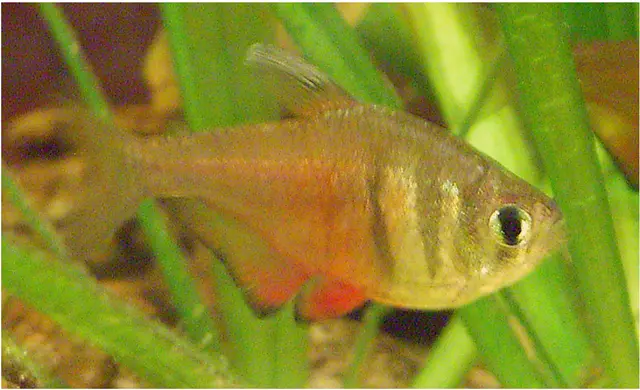
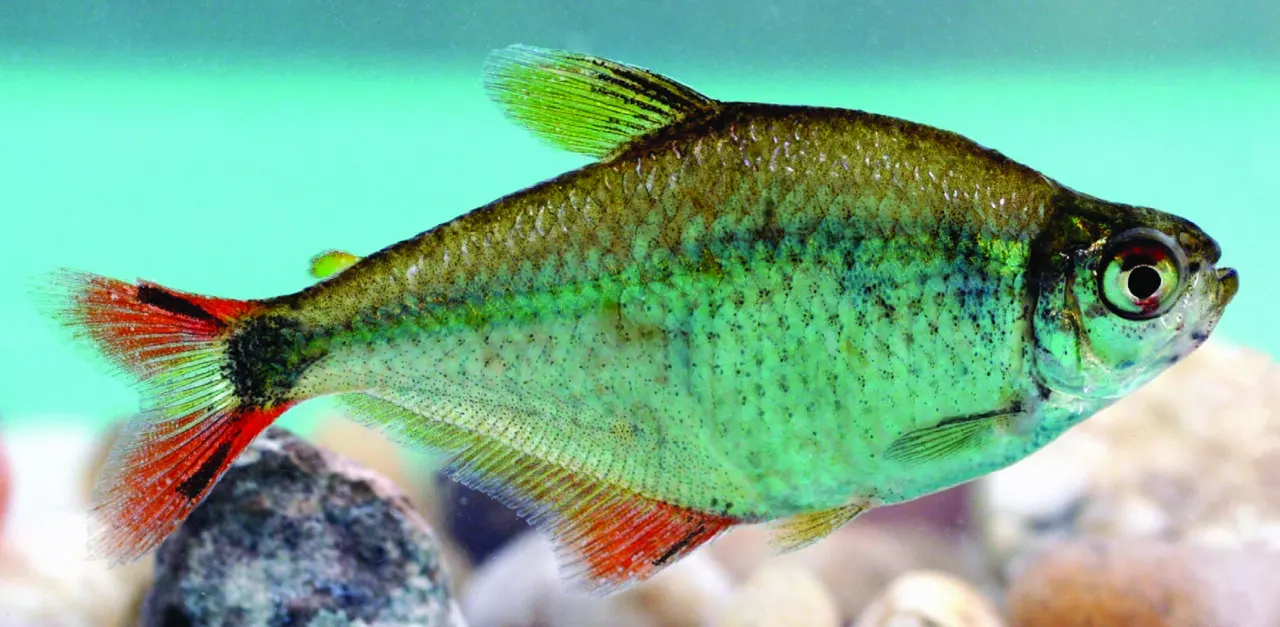
Hyphessobrycon nicolasi is a small, brightly coloured tetra known from a single stream near Colón, in Entre Ríos, Argentina, part of the Uruguay River basin. The IUCN Red List lists it as Endangered (assessed 2022). Its red tail fin carries a black diagonal stripe on each lobe.
How to recognise it
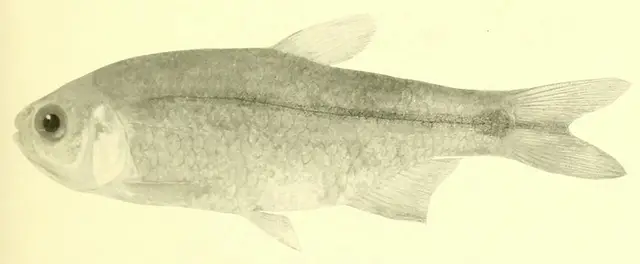
Alive, this tetra has an iridescent body with yellow and turquoise tones. Each eye has two reddish blotches, one above the pupil and one below. The dorsal fin is yellow with black on the first rays, the anal fin is reddish yellow with an intense red front third, and the tail is red with yellow tips.
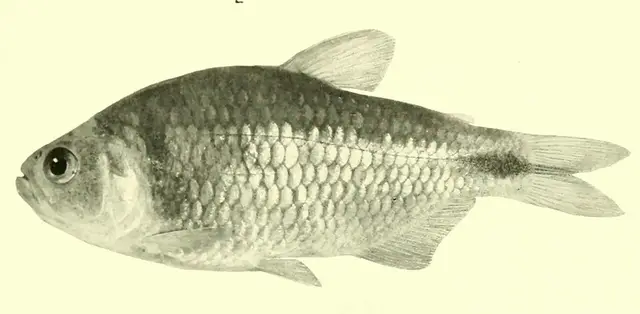
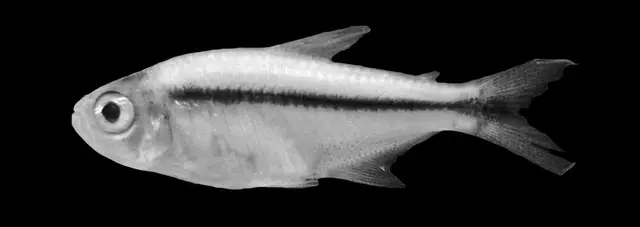
The feature that sets it apart from its relatives is the tail: each lobe has an oblique black stripe. It also has two tall, narrow dark spots on the shoulder and a rounded dark spot at the base of the tail. Mature males grow tiny bony hooks on the dorsal, anal and tail fins.
The fish described in 2010 measured 33.7 to 49.7 mm in standard length (snout to the base of the tail), averaging 43.2 mm. The largest was a 49.1 mm female, the holotype.
Where it lives
The species was described from El Pelado stream, a tributary of the Uruguay River near the city of Colón in Entre Ríos Province. The IUCN lists it from that one province, at one location, at 5 to 50 metres above sea level, in permanent rivers and streams.
At the type locality the water is clear and the bed is rock and sand with scattered stones, cobbles and boulders. Some stretches are shallow and fast, up to 60 cm deep. Others are about 2 m deep with plenty of submerged plants. The 2010 description lists 19 other fish species collected with it, among them the armoured catfish Corydoras paleatus, the Oligosarcus jenynsii and the small characin Cheirodon interruptus.
GBIF (the Global Biodiversity Information Facility) holds seven records, six of them from El Pelado in 2004 and 2005 and one preserved museum specimen with no locality given.
Pins are Wikidata “endemic to” fields. Orange dots, when present, are GBIF occurrence tiles — survey bias included.
Why it is in trouble
It is listed as Endangered under criterion B1ab(iii), which covers a very small range, few locations and a decline in habitat quality. The IUCN records the population trend as unknown and gives no population estimate.
Listed pressures are all linked to the way the surrounding land and water are used. Fertiliser run-off (nutrient loads) is rated the most serious, affecting most of the range. Herbicides and pesticides, farming and ranching, and small-scale accidental catches are also listed. Introduced fish, including common carp, are recorded as a further threat.
The assessment says it does not occur in a protected area.
What is being done
The IUCN lists resource and habitat protection and site or area management as the conservation actions needed. Research needs are population size and distribution, life history and ecology.
Its status as a species is disputed. It was described as new in 2010, and the IUCN (2022) and GBIF treat it as valid. The California Academy of Sciences Catalog of Fishes now lists it as a synonym of Hyphessobrycon meridionalis, citing a 2025 paper by Terán and colleagues. Earlier editions of the catalog (2011 to 2015) listed it as valid.
Sources
Written for this catalog in our own words from the sources below, checked against them on 12 November 2026. Population figures are estimates and carry the year they were made. Status and assessment year: IUCN. 2026. The IUCN Red List of Threatened Species. Version 2026-1. iucnredlist.org.