Critically Endangered
Hemicycla modesta
Hemicycla modesta
Hemicycla modesta is a small land snail from the Canary Islands, Spain, where it has been recorded on Tenerife. The IUCN Red List rates it Critically Endangered (2026 assessment). It was missing for well over a century before living specimens turned up again in 2015, and searches since have found few signs of it.
How to recognise it
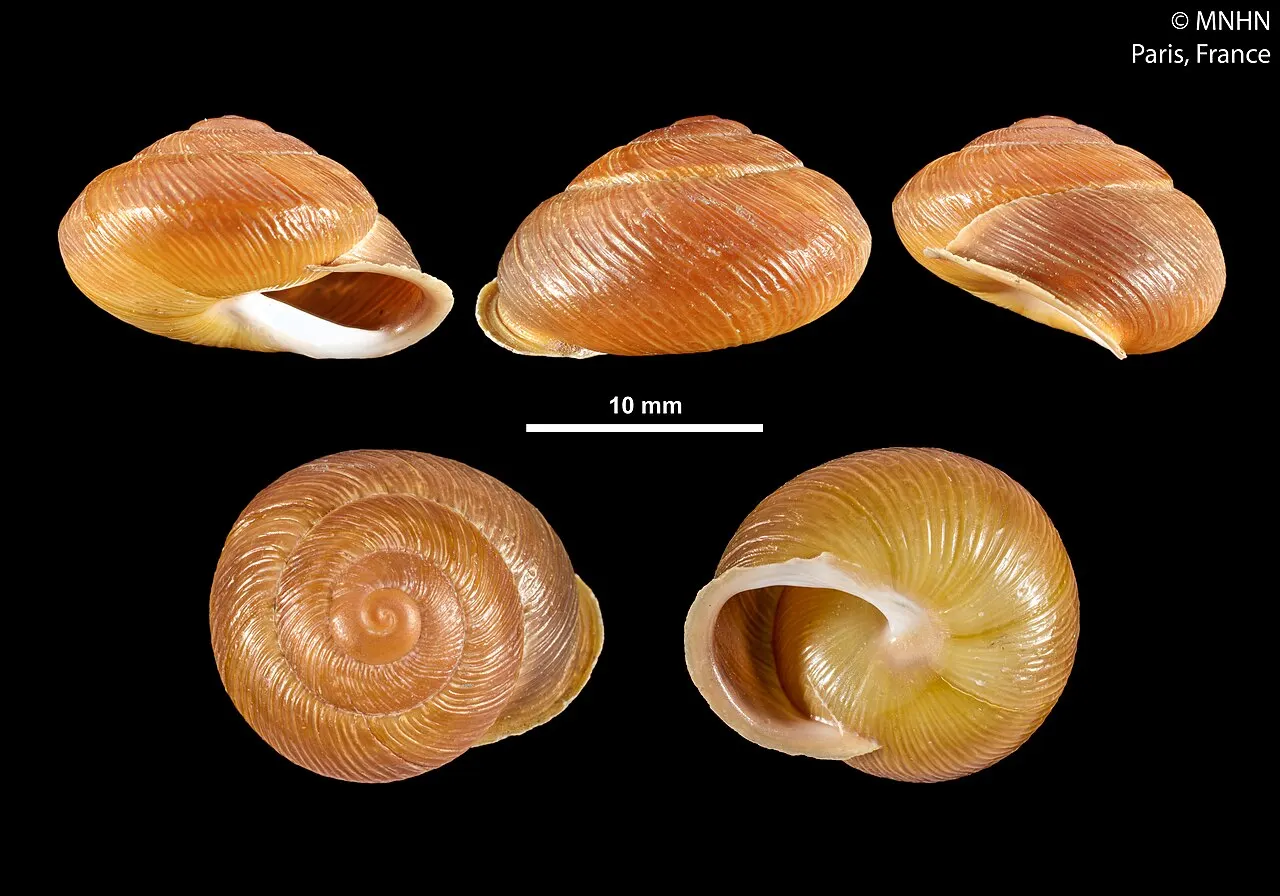
It is a shelled land snail in the family Helicidae, genus Hemicycla. The shell grows to about 16.7 mm long, a small animal even by snail standards. Little else about its looks is well documented.
Its scientific name goes back to the early 1820s, when the French naturalist Férussac described it, and a reference shell is reportedly held at the natural history museum in Paris. Sources give the year as 1821 or 1822.
Where it lives
The species is endemic to Spain's Canary Islands. The Red List treats it as a single location and records it at about 200 to 300 metres above sea level, in Mediterranean-type shrubland. Other records place it on Tenerife.
Fieldwork on 15 to 22 February 2022 by a team of ten researchers around the Barranco de Santos, in Santa Cruz de Tenerife, found no living snails, only two recent empty shells in higher ground. Gastropod experts feared the species may have disappeared from the Barranco de Santos area, and the higher ground may hold a remaining refuge.
Pins are Wikidata “endemic to” fields. Orange dots, when present, are GBIF occurrence tiles — survey bias included.
A species once presumed gone
Hemicycla modesta was described around 200 years ago and then went unrecorded for more than 150 years. Specimens were found again in 2015 in the Barranco de Santos, and Marco Neiber, Jesús Santana and Miguel Artiles reported the rediscovery in 2017 in the journal Tentacle, in a paper titled 'On the verge of extinction but not yet gone'.
No count of the population exists. The Red List says it is declining, and that it is not known whether the population is severely fragmented.
Why it is in trouble
Its range is tiny, so almost anything that damages the shrubland can matter. The Red List names housing and urban development, more frequent or intense fires, and invasive species as threats, among them introduced rodents and a Pennisetum grass, and it describes ongoing loss of habitat area and quality. It scores fire as affecting the whole known range.
A 2025 summary of a reassessment of Tenerife's snails kept this species at Critically Endangered, citing extremely restricted distribution, urbanisation, invasive species and chance events as pressures on the island's snails. The criteria used, B1ab(i,ii,iii,v) with B2ab(i,ii,iii,v), reflect a very small range, a single location and continuing decline.
What is being done
The Red List lists protection of the site and its resources, site management and control of invasive species as needed actions. At the time of assessment none of its range lay inside a protected area, and there was no recovery plan, monitoring scheme or invasive species control in place for it.
After the 2022 search, the team proposed re-evaluating its Red List status, sharing data with Canary Islands government technicians and holding an international workshop on Tenerife to draw up management recommendations.
Sources
Written for this catalog in our own words from the sources below, checked against them on 12 November 2026. Population figures are estimates and carry the year they were made. Status and assessment year: IUCN. 2026. The IUCN Red List of Threatened Species. Version 2026-1. iucnredlist.org.