Endangered
Finn's Weaver
Ploceus megarhynchus
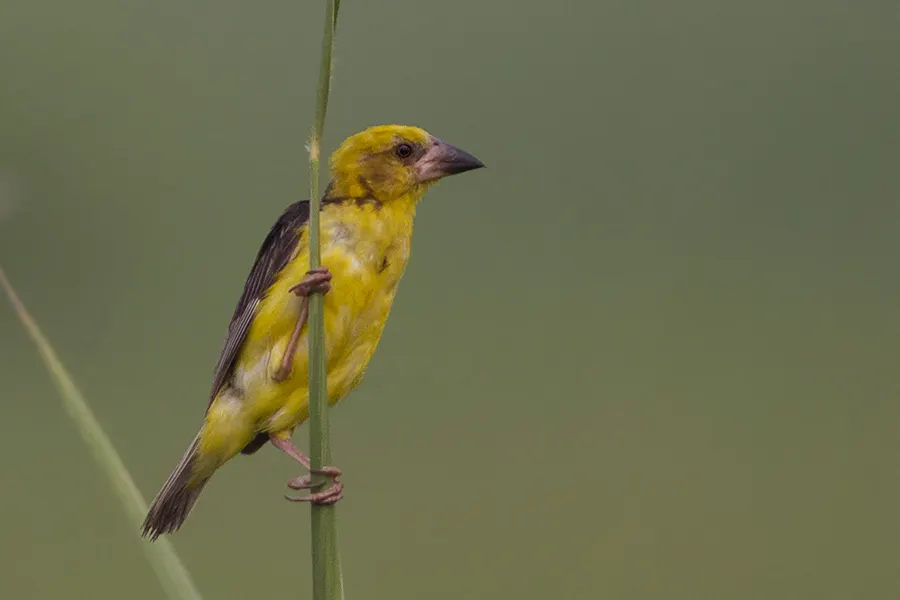
Finn's weaver (Ploceus megarhynchus), also called Finn's baya, is a yellow-headed weaver bird of the wet grasslands of northern India and Nepal. The IUCN moved it to Endangered in 2021 and puts the world population at 250 to 999 birds. It is declining, and breeding has failed at some of its last colonies.
How to recognise it
It is a fairly large weaver, given as 15 cm long in one reference and 17 cm in another. Breeding males are bright yellow on the head and underparts, with a heavily streaked back. Females are duller.
Females and non-breeding males can be mistaken for the Baya weaver, which is smaller and has a shorter, narrower bill. Allan Octavian Hume described Finn's weaver in 1869 from a specimen collected at Kaladhungi, near Nainital.
Where it lives
Finn's weaver is found only in India and Nepal, in the Ganges and Brahmaputra valleys. Two subspecies are recognised: the nominate form in the Terai of Uttarakhand, Uttar Pradesh and Nepal, and salimalii in the east, in Assam (including Kaziranga National Park). In Nepal it is confined to Shuklaphanta National Park, where it was first recorded in 1996.
It uses seasonally wet or flooded tropical grassland, often near dams, reservoirs and marshy ground, and the IUCN also lists farmland and plantations among its habitats.
Pins are Wikidata “endemic to” fields. Orange dots, when present, are GBIF occurrence tiles — survey bias included.
How it lives
The breeding season runs from about May to September. The globular nest is woven from thin strips of leaves and reeds, and unlike other Indian weavers this one reportedly lines the whole inside. Nests are often built in silk cotton trees, whose spiny trunks and branches give some protection from ground predators.
Males favour hemp seeds, and farmers clearing hemp may have removed a useful food source. The IUCN gives a generation length of about 3.5 years.
Why it is in trouble
Terai grassland has been converted to farms, plantations, housing, roads and industry, and the IUCN rates agro-industry farming, grazing and plantations among its high-impact threats. More livestock means grass is harvested before it seeds. Crows raid nests: at one Uttarakhand colony a researcher saw them take at least 8 to 10 eggs and four chicks. A 2020 news report estimated that 200 to 300 birds are trapped and traded in India each year despite a ban in place since 1991.
The numbers are small. A 2017 Bombay Natural History Society report found an 84 to 96% fall in Udham Singh Nagar between 2012 and 2017, and estimated about 200 birds in Uttarakhand and Uttar Pradesh together and about 300 in the north-east. Counts in Nepal's Shuklaphanta National Park were 300 in 2017, 174 in 2019, 254 in 2020 and 246 in 2021.
At Haripura Dam in Uttarakhand, the count peaked at 17 males and 10 females in 2021, no females were seen in 2024, and no birds were seen in 2025. Drought in 2021 and floods in 2023 hit that colony, and over five years of study a researcher recorded nests and colonies there but never an egg or chick.
What is being done
The IUCN raised the species from Vulnerable (2018) to Endangered (2021), and Nepal lists it nationally as Critically Endangered. It occurs in protected areas, but no recovery plan or monitoring scheme was in place at the 2021 assessment.
The Bombay Natural History Society has issued a species recovery plan and signed an agreement with the Uttar Pradesh government for captive breeding. As of a June 2020 report, no birds had been taken into captivity and the aviaries planned at Hastinapur Wildlife Sanctuary had not been built. A Rufford Foundation project has studied the Nepal population, with a final evaluation report dated March 2025, and the Uttarakhand Biodiversity Board has signed an agreement for a study of the Haripura birds.
Sources
Written for this catalog in our own words from the sources below, checked against them on 12 November 2026. Population figures are estimates and carry the year they were made. Status and assessment year: IUCN. 2026. The IUCN Red List of Threatened Species. Version 2026-1. iucnredlist.org.
- IUCN Red List assessment, Ploceus megarhynchus (2021)
- Wikipedia, Finn's weaver
- Mongabay India, Finn's weaver faces a risk of extinction (2020)
- Down To Earth, Extinction alert: the Finn's weaver is silently disappearing from the marshy lowlands of the Terai
- Rufford Foundation, Finn's weaver in lowland Nepal
- Himalayan Tribune, Finn's weaver population declining in Nepal (2021)
- Oiseaux.net, Finn's Weaver