Endangered
Bates's Weaver
Ploceus batesi
Bates's weaver is a small, brightly coloured forest bird found only in the lowland rainforest of Cameroon. The IUCN Red List classed it as Endangered in 2021. It was already rare when first collected in 1906, and why it is so scarce is still unexplained.
How to recognise it
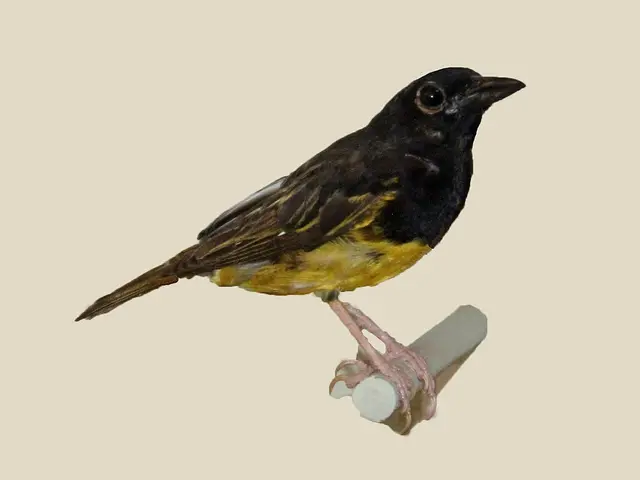
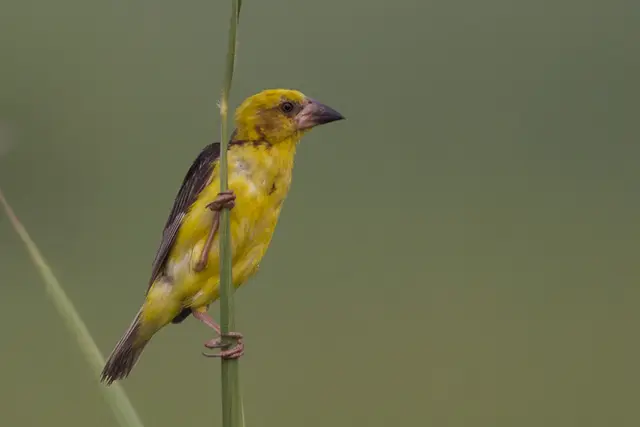
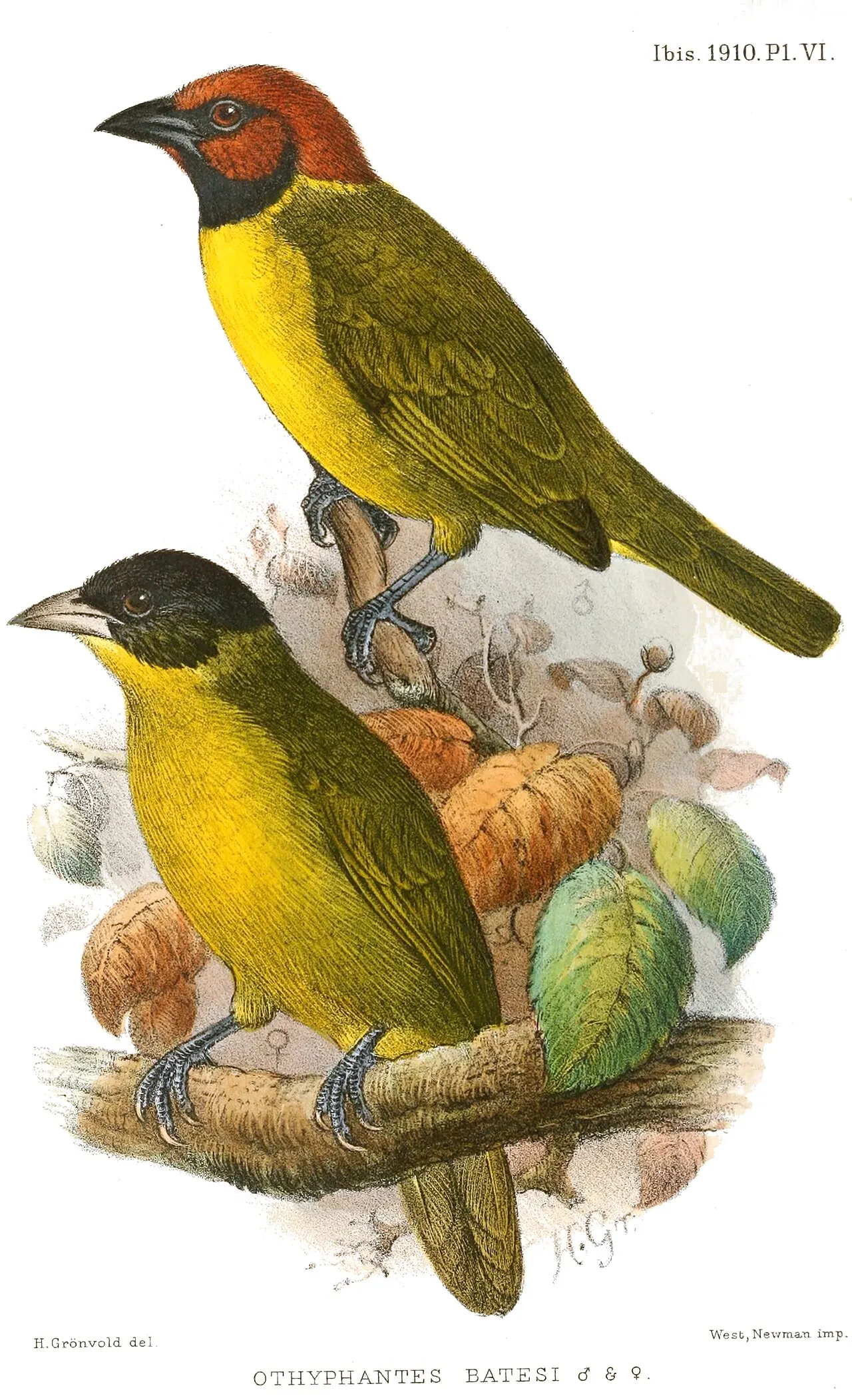
Ploceus batesi is about 13 to 14 centimetres long. The male has a bright chestnut head with a black throat and black patch between bill and eye, olive-green upperparts, and rich yellow underparts. The bill is black.
The female is similar but has a black crown and face and a yellow throat. Young birds look like females, with a pale olive-green head and a horn-coloured bill. No song has been described, and the bird seems to be mostly silent.
Where it lives
The species is restricted to southern and south-western Cameroon, in a narrow belt of lowland forest from Limbe near Mount Cameroon east to Moloundou near the Congo border. It has been recorded at only nine sites, and sightings are irregular.
It has been found up to 900 metres on Mount Kupe, where it was seen twice in 1990 and not since despite intensive searching, and near the Dja reserve in 1995 and 1996. Protected areas within its range include the Dja Faunal Reserve, Douala-Edea Wildlife Reserve and Bakossi National Park. Surveys in western and south-eastern Cameroon between 1998 and 2001 failed to find it.
Pins are Wikidata “endemic to” fields. Orange dots, when present, are GBIF occurrence tiles — survey bias included.
How it lives
Very little has been recorded. It eats insects and forages alone or in pairs, and has occasionally been seen in mixed flocks of insect-eating forest birds. It climbs tree trunks in a zigzag path. Nothing is known of its nest, and the only breeding record is a juvenile seen in March. It is presumed to stay in the same area year round.
Why it is in trouble
The 2021 assessment estimates 1,000 to 3,500 birds in five subpopulations, the largest holding perhaps 200 to 1,000, and says the population is decreasing. An older BirdLife estimate put the total below 1,000. The difference comes from separate assessments and does not necessarily mean the bird has recovered.
Loss and modification of forest is the main suspected cause of decline. The Red List also lists clearance for industrial agriculture as a future threat, and a proposed large palm oil plantation in south-western Cameroon would significantly reduce suitable habitat. Yet the bird was already rare when it was first collected in 1906, and one source suggests its scarcity may be linked to a particular habitat feature that has not been identified.
What is being done
Conservation sites have been identified across its whole range, and it occurs in at least one protected area. The assessment records no species recovery plan, no systematic monitoring scheme and no captive population. It calls for field surveys to locate populations and for study of the factors that limit the species.
Sources
Written for this catalog in our own words from the sources below, checked against them on 12 November 2026. Population figures are estimates and carry the year they were made. Status and assessment year: IUCN. 2026. The IUCN Red List of Threatened Species. Version 2026-1. iucnredlist.org.