Endangered
Collared brown lemur
Eulemur collaris
The collared brown lemur (Eulemur collaris) is a medium-sized, mostly fruit-eating primate found only in the forests of south-eastern Madagascar. The IUCN Red List rated it Endangered in 2020 (and in 2014), after Vulnerable in 2008. Males and females differ in colour, and the species is active by day and night.
How to recognise it
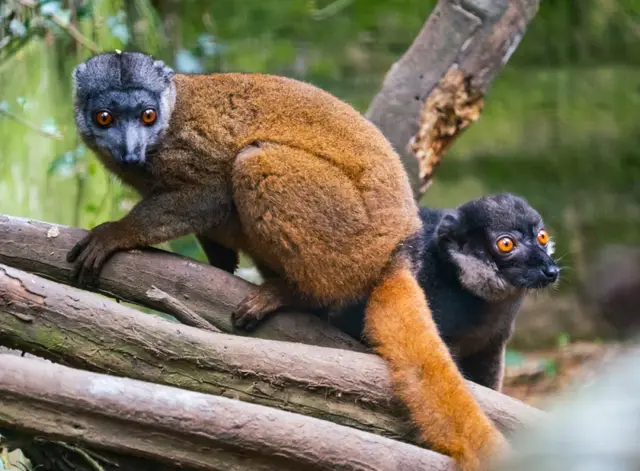
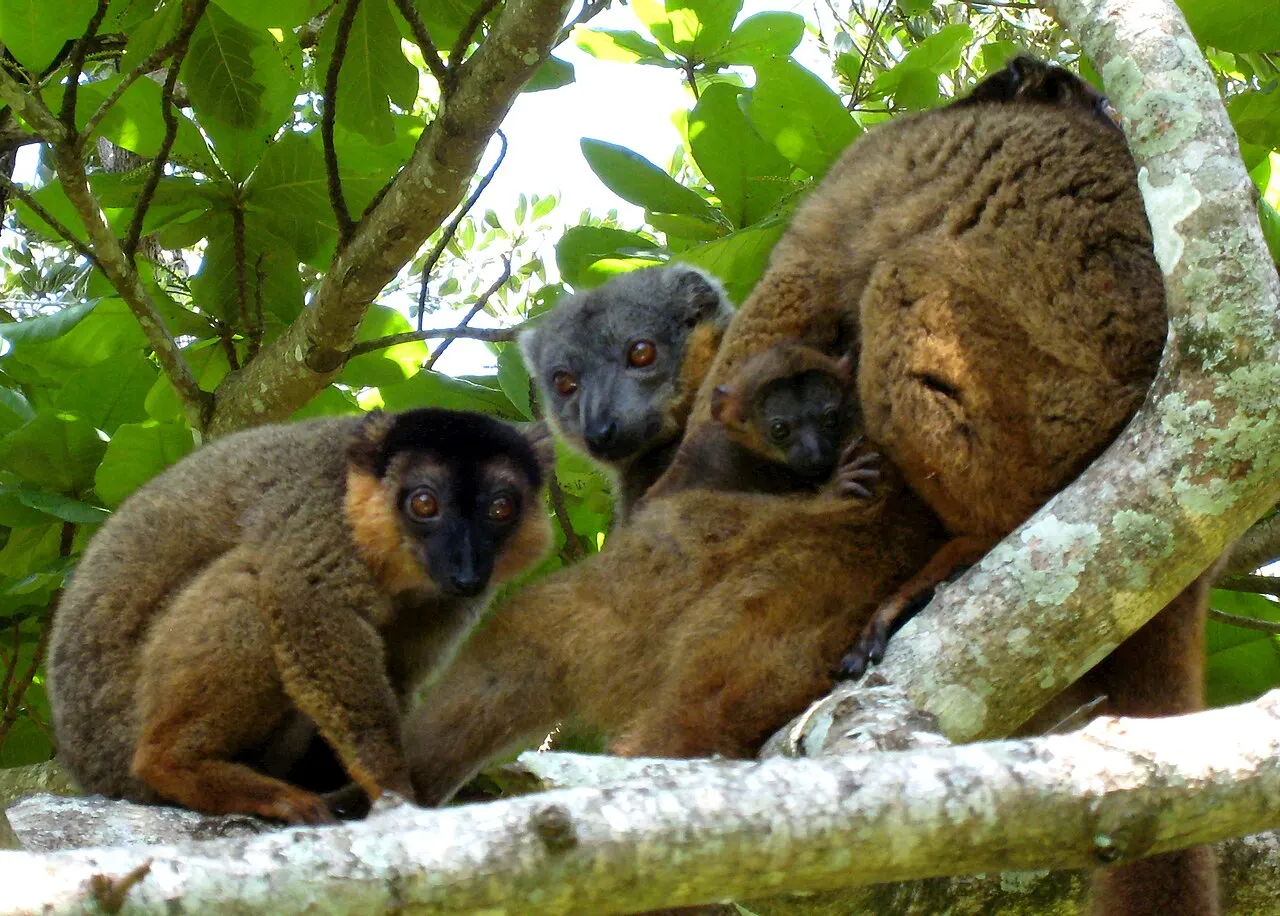
An adult weighs roughly 2.25 to 2.5 kg, with a head and body about 40 cm long and a tail of 50 to 55 cm. Both sexes have orange-red eyes and a beard.
The sexes are easy to tell apart. Males are brownish-grey above, with a dark grey to black muzzle, face and crown and cream to rusty-brown cheek and beard fur. Females are browner and more reddish on the back, with a grey head. The species is also called the red-collared lemur or red-collared brown lemur.
Where it lives
It occurs only in the south-east of the island, from around Tolanaro (Fort Dauphin) north to the Mananara River, which separates it from the grey-headed lemur. It lives in lowland and mid-altitude rainforest, including coastal littoral forest, and the IUCN gives an elevation range from sea level to about 1,875 m.
The IUCN puts its extent of occurrence at about 16,177 square km and describes the population as severely fragmented. It can be seen in Andohahela National Park and Midongy du Sud National Park, and small groups survive in forest fragments such as Mandena and Sainte Luce near the coast.
Pins are Wikidata “endemic to” fields. Orange dots, when present, are GBIF occurrence tiles — survey bias included.
How it lives
Groups contain several males and several females. Reported sizes run from 2 to 17 animals, and groups in intact rainforest can be larger. Unlike many lemurs, this species shows no clear female dominance.
It is cathemeral, meaning active in both daylight and darkness. Fruit makes up most of the diet. A 2011 study in PLoS ONE recorded 75 plant species eaten at Sainte Luce, with ripe fruit taking about two thirds of feeding time. Flowers and young leaves add variety, and in the dry season bark, sap and insects fill the gaps. It also disperses seeds, which matters most for large-seeded forest trees.
Females usually have a single infant a year. Sources place births late in the year, between September and December, after a gestation of about 120 days.
Why it is in trouble
The main cause is forest loss. Slash-and-burn farming and charcoal making clear and break up the forest, and mining for ilmenite has also been named as a threat. The IUCN estimates a population fall of about 50 percent (a generation is taken as 8 years) and expects a similar fall ahead.
Animals are also hunted for food and trapped for the local pet trade. Fragmentation hits hard. In the same 2011 study, groups in degraded Mandena forest had a median of 2 or 3 animals, against 7 at Sainte Luce, and ranged over larger areas and fed in smaller trees.
What is being done
The species is listed on CITES Appendix I, which bans international commercial trade. Captive populations in zoos and lemur centres are kept as a safeguard against extinction, and the IUCN records conservation sites identified across the whole range. Separately, the Duke Lemur Center runs a programme in Madagascar that hands out fuel-efficient stoves to families, which it says can halve wood and charcoal use.
Sources
Written for this catalog in our own words from the sources below, checked against them on 12 November 2026. Population figures are estimates and carry the year they were made. Status and assessment year: IUCN. 2026. The IUCN Red List of Threatened Species. Version 2026-1. iucnredlist.org.