Endangered
Eucobresia pegorarii
Eucobresia pegorarii
The summit glass snail (Eucobresia pegorarii) is a thin-shelled, semi-slug-like snail of high Alpine meadows and rocky ledges, living mostly above the tree line from Switzerland to Slovenia. The IUCN Red List rated it Endangered in 2025, citing a patchy range and habitat under pressure from grazing, habitat change, tourism and temperature extremes.
How to recognise it
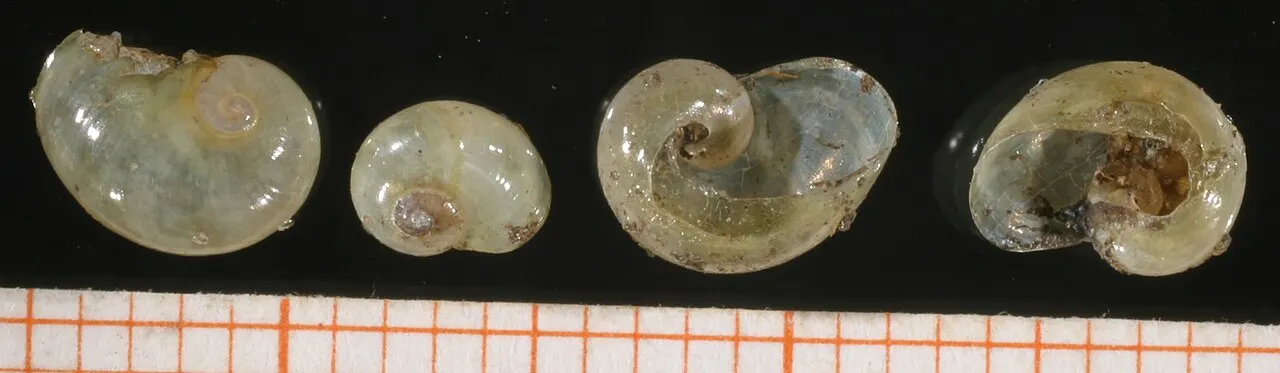
It belongs to the glass snails (Vitrinidae), a group in which the body is too large to fit inside the shell. The shell is small, thin and ear-shaped, about 4 to 6 mm across and 2.5 mm high, with a flat spire and roughly two and a half whorls. It is yellowish horn-coloured, translucent and very glossy.
The soft body is light to darker grey with a black mantle lobe and can stretch to around 18 mm. The animal can't pull itself back into the shell, which is why vitrinids are often called semi-slugs.
Where it lives
This snail is confined to the Alps. It is recorded in Switzerland, Italy, Austria, Germany (the Bavarian Alps) and Slovenia. The type locality, from Pollonera's original 1884 description as Vitrina pegorarii, is the right bank of the Dora river near Aosta in northern Italy, at about 2,000 m.
It lives high. The IUCN gives an elevation range of 1,570 to 2,900 m, and lists rocky areas such as inland cliffs and mountain peaks, and temperate grassland, as its habitats. A German-language reference gives 2,000 to 3,000 m in Switzerland and 1,240 to 3,140 m in Austria. It turns up in damp alpine meadows, on grassy ledges in rock faces, under stones and on scree.
Pins are Wikidata “endemic to” fields. Orange dots, when present, are GBIF occurrence tiles — survey bias included.
How it lives
Little is written about its day-to-day biology. Lothar Forcart reportedly found young and adult snails together on the Riffelberg in August 1943, which suggests that individuals live for more than one season.
Why it is in trouble
The 2025 assessment estimates the extent of occurrence at about 80,000 square km, but the area actually occupied is only 160 to 499 square km. The population is severely fragmented and the area of habitat is still shrinking. The overall trend is listed as decreasing, though whether the number of animals is still falling is unknown.
The threats are ongoing and spread over the high-mountain habitat, each scored as low impact. Small-holder grazing, shifting or altered habitat and temperature extremes each affect more than half of it. Tourism and recreation areas and roads and railways affect less than half. It is reportedly classed as strongly endangered in Bavaria. The assessment records that it occurs in at least one protected area and is not covered by international legislation or trade controls.
Sources
Written for this catalog in our own words from the sources below, checked against them on 12 November 2026. Population figures are estimates and carry the year they were made. Status and assessment year: IUCN. 2026. The IUCN Red List of Threatened Species. Version 2026-1. iucnredlist.org.




