Critically Endangered
Eleutherodactylus albipes
Eleutherodactylus albipes
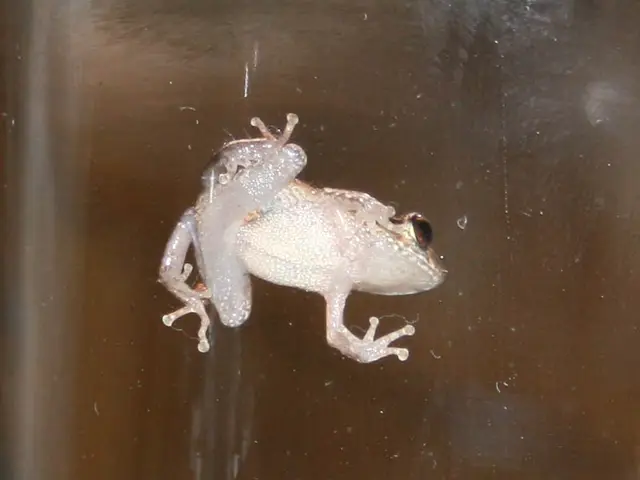
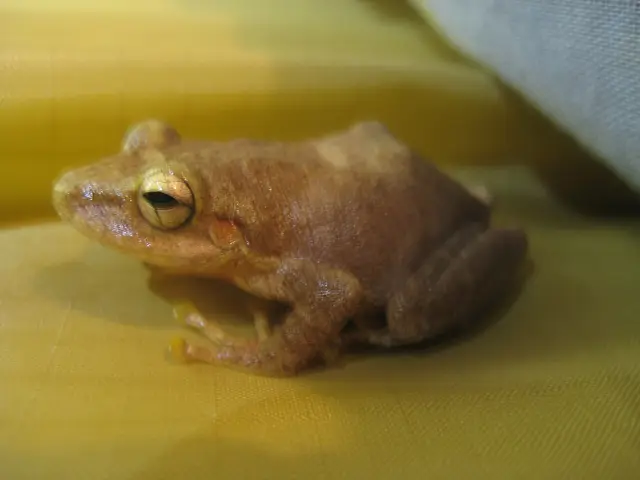
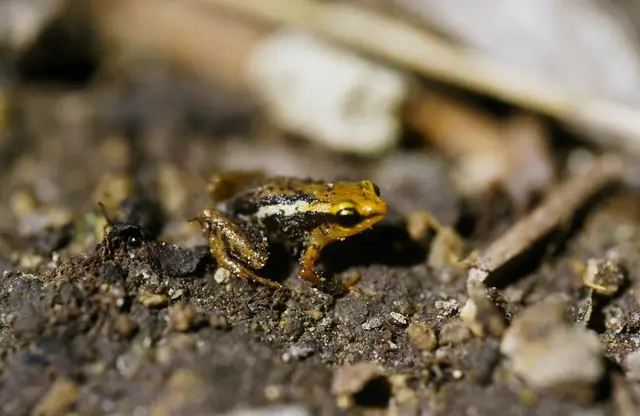
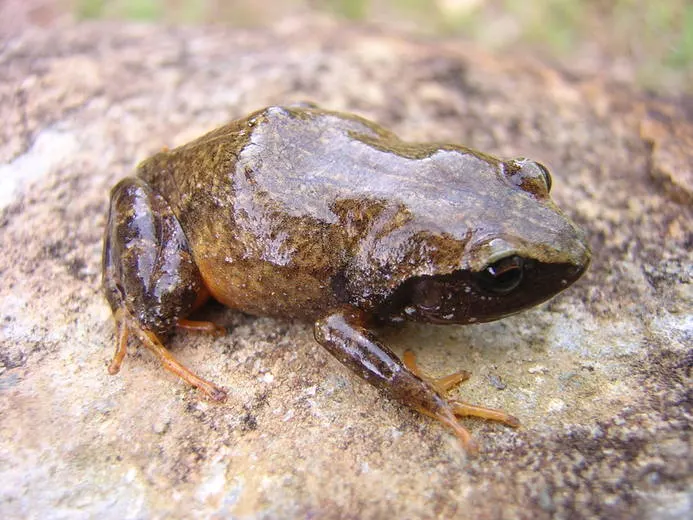
The Turquino white-footed frog (Eleutherodactylus albipes) is a small, dark brown frog with yellowish-white hands and feet, found only in the high forests of the Sierra Maestra in southeastern Cuba. The IUCN Red List rated it Critically Endangered in 2023, with a mapped range of about 68 square kilometres.
How to recognise it
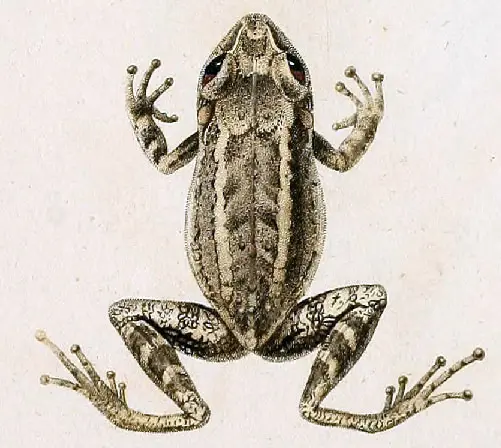
This is a small frog. The female used as the type specimen measured 33 mm from snout to vent, and the other specimens in the original series were smaller. The back is dark brown, grayer in young animals, with darker bars across the hind legs. The thighs are whitish yellow, and the hands and feet are yellowish white above and below, which gives the frog its common name.
Some animals also have a whitish streak down each side or a dark spot near the groin. The skin of the back is smooth, the sides are granular, and the toes are almost unwebbed. The original description separates it from its relative Eleutherodactylus emiliae partly by an obsolete fold along the side of the back, and notes that it grows slightly larger.
Where it lives
The species is endemic to Cuba and restricted to the higher parts of the Sierra Maestra, in Granma and Santiago de Cuba provinces. The original specimens were collected in June 1936 by Philip Darlington on Turquino Peak, at sites from about 1,500 to 6,000 feet. It is now known from other peaks too, including Pico La Bayamesa, Pico Cuba and Pico Suecia.
The Red List gives an elevation range of 1,200 to 1,974 m, with most records above 1,700 m, and an extent of occurrence of about 68 square kilometres. The known localities fall within an area of less than 20 square kilometres in Turquino National Park and Pico La Bayamesa National Park. All of the population lies within protected areas.
Pins are Wikidata “endemic to” fields. Orange dots, when present, are GBIF occurrence tiles — survey bias included.
How it lives
The frog lives in high-elevation moist forest with a closed canopy and has not been recorded from disturbed forest. It is found among leaf litter and under stones and logs. Females lay up to 42 white eggs in ground crevices and guard them, and the young develop directly without a tadpole stage. Its calls and diet are undocumented, and it is found only sporadically even after thorough searches.
Why it is in trouble
The assessment (criteria B1ab(iii,iv)) records a decreasing population, continuing decline in habitat area and in the number of subpopulations, and a severely fragmented range, with small isolated groups on separate mountain tops. Most recent records date from 2002 to 2004, and the frog was not detected during a 2015 to 2016 survey at Aguada de Joaquín.
The pressures it lists are small-scale farming, shifting agriculture, recreational activities, small-scale harvesting that catches frogs unintentionally, droughts and temperature extremes. The assessment also cites deforestation for farming, logging and fires in La Bayamesa park, and climate projections that predict the frog's extinction by 2050.
What is being done
The whole range lies within two national parks, but the assessment says they need better management. It calls for site management, awareness programmes in nearby communities, control of non-native species, and stronger enforcement against illegal farming and logging in La Bayamesa. Cuba's national Red Book lists the frog as Vulnerable.
No systematic monitoring scheme exists, and the assessment recommends population monitoring and research on its natural history in case captive breeding is needed.
Sources
Written for this catalog in our own words from the sources below, checked against them on 12 November 2026. Population figures are estimates and carry the year they were made. Status and assessment year: IUCN. 2026. The IUCN Red List of Threatened Species. Version 2026-1. iucnredlist.org.