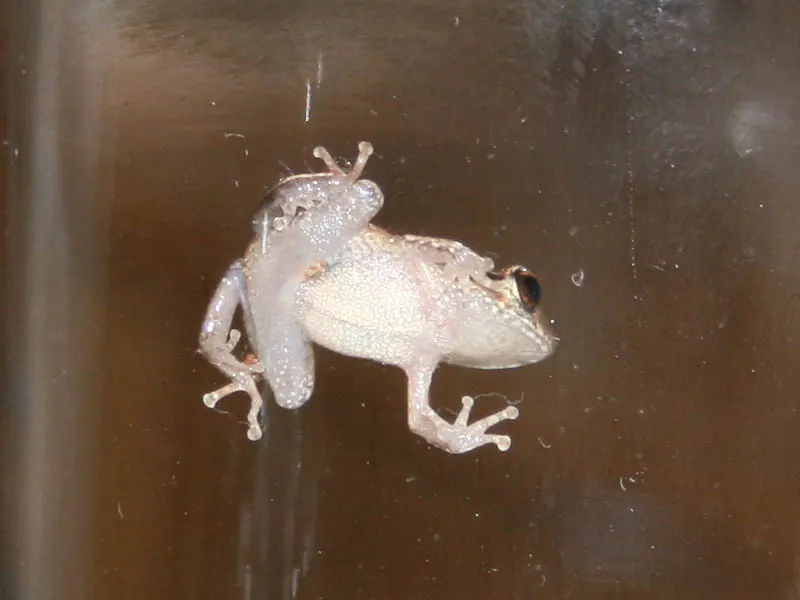
Critically Endangered
Dwarf coqui
Eleutherodactylus unicolor
The dwarf coqui (Eleutherodactylus unicolor), also called the elfin coqui or coqui duende, is a small frog found nowhere but Puerto Rico. The IUCN Red List rated it Critically Endangered in 2021 and records its population as decreasing. Its call has been likened to a fingernail drawn along a comb.
How to recognise it
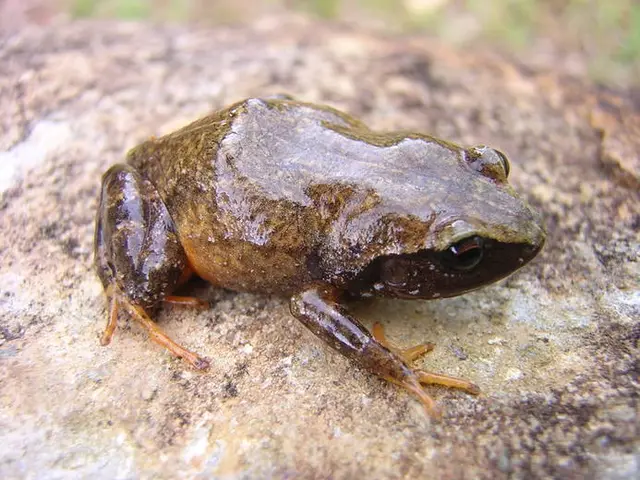
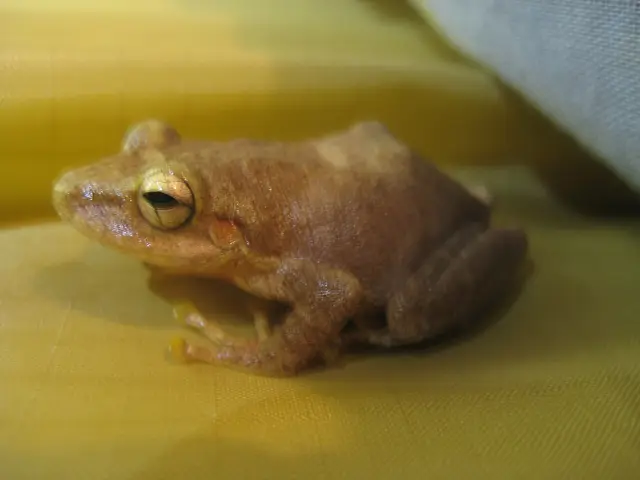
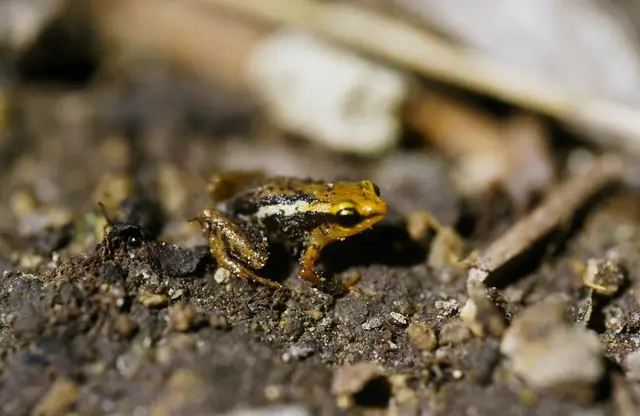
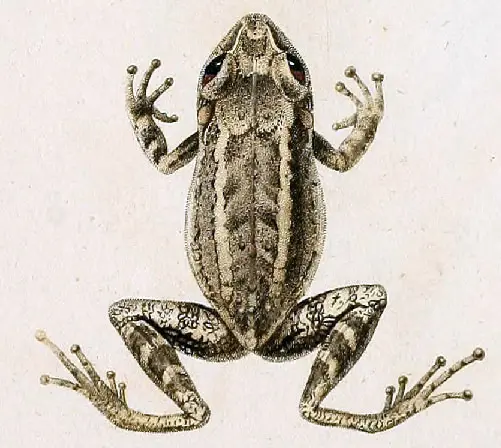
This is a small, grayish-brown frog with a black, mask-like pattern on the face and a series of light dots running toward the rear of the body. Females have a light line across the eyelids and often white dots along the face, flanks, forelimbs and thighs.
The feet aren't webbed, and the toes end in small, round, disc-like tips. The call is often compared to a fingernail dragged across the teeth of a comb, or to a watch being wound. Stejneger described the species in 1904.
Where it lives
The dwarf coqui is endemic to Puerto Rico. The Red List assessment records it from moist forest, both lowland and montane, at elevations of about 523 to 1,200 m. It treats the frog as occurring at a single location, with an extent of occurrence of about 74 square km, and as present in at least one protected area.
Pins are Wikidata “endemic to” fields. Orange dots, when present, are GBIF occurrence tiles — survey bias included.
Why it is in trouble
The assessment's criterion is B1ab(iii), used for species with a small range, few locations and continuing decline in habitat quality. It lists ongoing threats from a named problem species, droughts, storms and flooding, and one other threat, and records ecosystem conversion and degradation among the stresses on the animals.
The wider picture for Puerto Rican frogs is sobering. A 2009 overview in 10,000 Birds noted that the island had possibly lost three endemic amphibian species in about 30 years, and that Puerto Rico ranked fifth among countries for its share of threatened amphibians (72.2 percent, per a 2006 IUCN figure). It suggests that climate change acting together with a pathogenic fungus lies behind declines and local extinctions on highlands above 600 m, while lowland species are not affected in the same way. That is a suggested cause, not a proven one, and the article gives no figures for the dwarf coqui itself.
What is being done
Conservation actions listed for the species include site and area management, national and international law and policy, and captive breeding. The assessment gives no population count, so how many dwarf coquis remain is not known.
Sources
Written for this catalog in our own words from the sources below, checked against them on 12 November 2026. Population figures are estimates and carry the year they were made. Status and assessment year: IUCN. 2026. The IUCN Red List of Threatened Species. Version 2026-1. iucnredlist.org.