Endangered
Four-spotted tree cophyline frog
Cophyla tetra
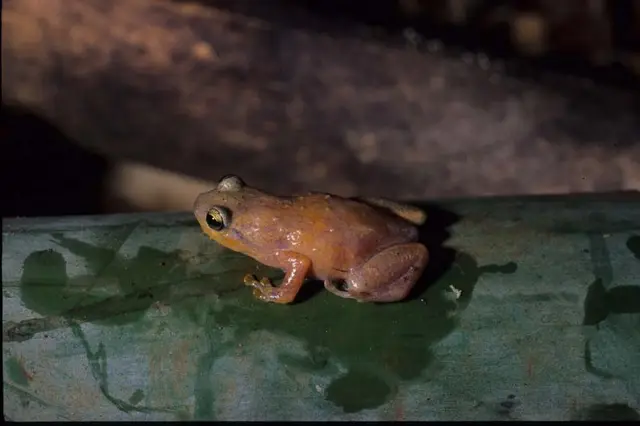
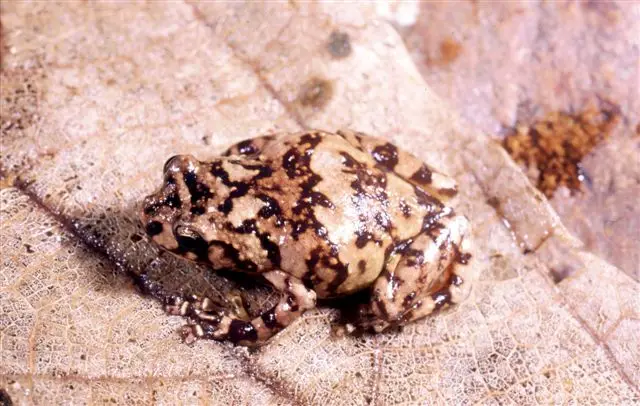
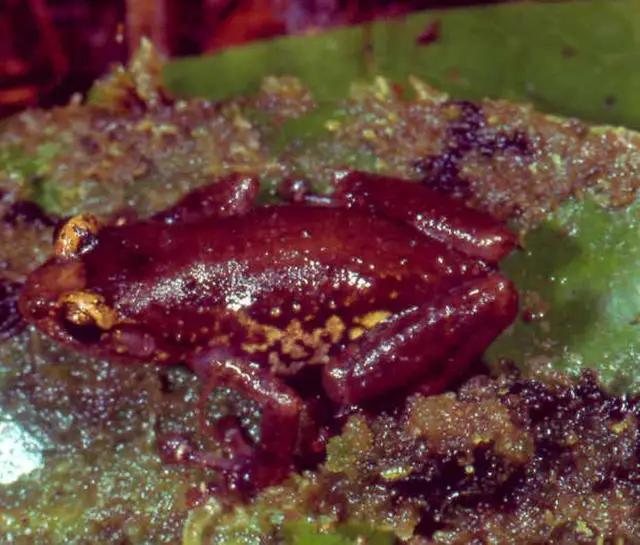
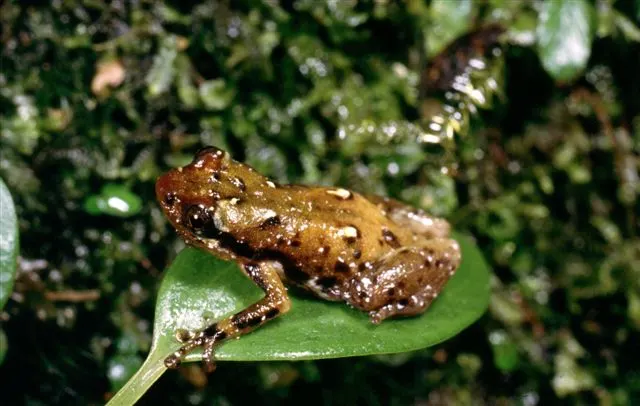
Cophyla tetra, listed by the IUCN as Four-spotted tree cophyline frog (its original name), is a thumbnail-sized frog of the rainforests of northeastern Madagascar. It lives in pools held by screw pines. The IUCN Red List rated it Endangered in 2016, and its forest home keeps shrinking.
How to recognise it
This is a very small frog, reaching only about 20 mm from snout to vent. It belongs to the narrow-mouthed frogs (family Microhylidae), in the subfamily Cophylinae, a Malagasy group of mostly tree-dwelling frogs.
Its small size and a series of whitish spots on the back set it apart. Four of the spots stand out more than the rest, which fits the name tetra and the IUCN's English name, four-spotted tree cophyline frog.
The advertisement call is a long string of separate notes pitched at roughly 3.5 to 4 kHz, delivered at about three notes per second.
Where it lives
The species is endemic to Madagascar. It was described in 2003 from rainforests in the northeast, and known sites include Anjanaharibe-Sud, Besariaka, Tsararano and the Masoala Peninsula. It occurs in lowland and mid-altitude moist forest, and also in heavily degraded former forest. The IUCN gives an elevation range of 13 to 1,250 m.
The IUCN estimates its extent of occurrence at about 4,759 square kilometres but counts only two locations, with the population severely fragmented. It occurs in at least one protected area.
Pins are Wikidata “endemic to” fields. Orange dots, when present, are GBIF occurrence tiles — survey bias included.
How it lives
Its home is the phytotelm, a small pool held in the leaf bases of Pandanus screw pines. The frog is tied to forest that still has these plants growing in it.
Why it is in trouble
The IUCN reports a decreasing population and a continuing decline in the area of suitable habitat. The pressures it lists are small-holder farming and grazing, plus housing and urban expansion, all ongoing. Forest cleared for crops, cattle or houses also removes the screw pines the frog depends on.
A 2025 study in Zootaxa added a complication. DNA work showed that a lineage once grouped with this species is distinct, and it was named Platypelis efatra. The study also found at least two more lineages that differ from the true P. tetra and need further work. A population from Ambodivoangy was tentatively kept with P. tetra. Where the species' limits lie is still being settled, so the IUCN's range and threat figures may cover more than one lineage.
What is being done
The IUCN lists site protection and site management as the conservation actions needed, and part of the range already falls inside a protected area.
Sources
Written for this catalog in our own words from the sources below, checked against them on 12 November 2026. Population figures are estimates and carry the year they were made. Status and assessment year: IUCN. 2026. The IUCN Red List of Threatened Species. Version 2026-1. iucnredlist.org.