Endangered
Cheilosia morio
Cheilosia morio
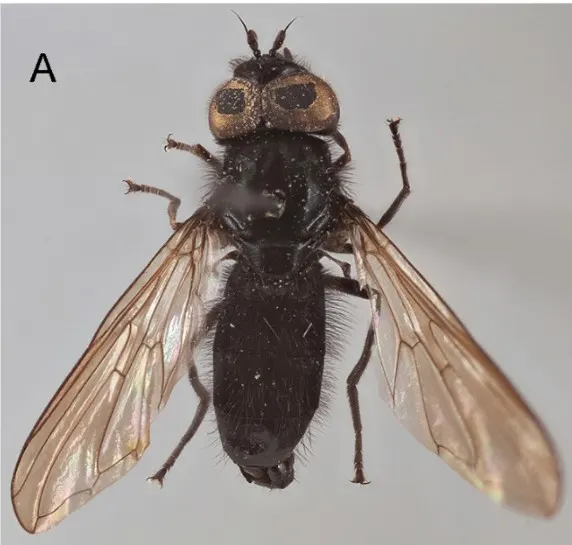
Cheilosia morio is a hoverfly of European forests, first described from Lapland by Zetterstedt in 1838. The IUCN Red List rated it Endangered in 2021, based on a patchy range of 17 known locations and a shrinking forest habitat. Its identity has been revised recently, and little of its life is documented.
What kind of fly it is
Cheilosia is one of the most species-rich hoverfly genera, and most of its members are black or plainly coloured rather than wearing the bold yellow stripes people expect of a hoverfly. Larvae in the genus live and feed in plant stalks or inside fungi. Specific details of this species' larvae and adult habits are scarce.
The species was first named Eristalis morio by Zetterstedt in 1838, in his Insecta Lapponica. The Swedish name is kådblomfluga and the Finnish name is pihkakeilanen.
A name with a tangled history
This is a hard species to pin down. A 2025 revision of the subgenus Neocheilosia in the European Journal of Taxonomy, by Bot and colleagues, found that many authors had been applying the name morio to a different fly. The name Cheilosia luteicornis was revived for that fly, C. scanica (described by Ringdahl in 1937) was established as a junior synonym of the true C. morio, and both species were redescribed.
The consequence is that older records and field guides may not refer to the species now carrying the name. A 2024 Serbian checklist, for instance, reported that specimens once recorded there as C. morio actually belonged to other taxa. The 2021 Red List assessment came before the 2025 revision.
Where it lives
The Red List assessment lists Austria, Czechia, France, Germany, Greece, Italy, Montenegro, Norway, Poland, Slovakia and Sweden. It records the habitat as temperate forest, with an upper elevation limit of about 1,723 m. The assessment estimates the area it actually occupies at about 116 square kilometres, scattered over 17 locations, and counts the population as severely fragmented, even though the overall extent of occurrence spans roughly 1.8 million square kilometres across Europe.
Pins are Wikidata “endemic to” fields. Orange dots, when present, are GBIF occurrence tiles — survey bias included.
Why it is in trouble
The assessment records continuing decline in the area occupied. The one threat named is agro-industry plantations, which convert or degrade forest. Listed effects include loss of pollinators, disturbance and reduced reproductive success. Population size and trend are unknown, and the assessment marks most protection measures, such as protected-area occupancy, as unknown too.
Recommended actions are site and area protection and protection of resources and habitat.
Sources
Written for this catalog in our own words from the sources below, checked against them on 12 November 2026. Population figures are estimates and carry the year they were made. Status and assessment year: IUCN. 2026. The IUCN Red List of Threatened Species. Version 2026-1. iucnredlist.org.




