Endangered
Rhinoceros agama
Ceratophora tennentii
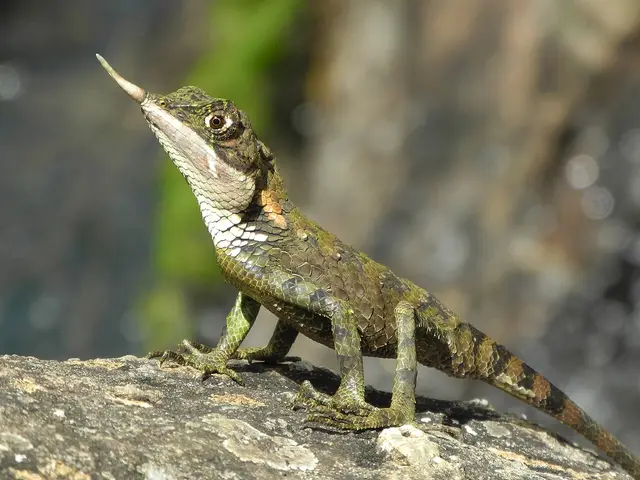
The rhinoceros agama (Ceratophora tennentii), also called Tennent's leaf-nosed lizard, is a slow, tree-dwelling lizard found only in the cloud forests of Sri Lanka's Knuckles hills. The IUCN Red List rated it Endangered in 2021. Its most striking feature is a soft, leaf-shaped growth on the tip of the snout.
How to recognise it
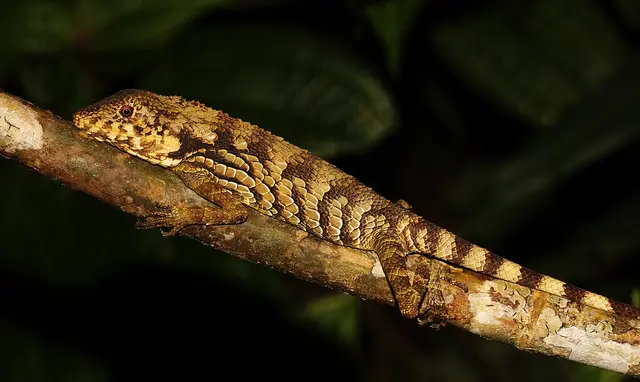
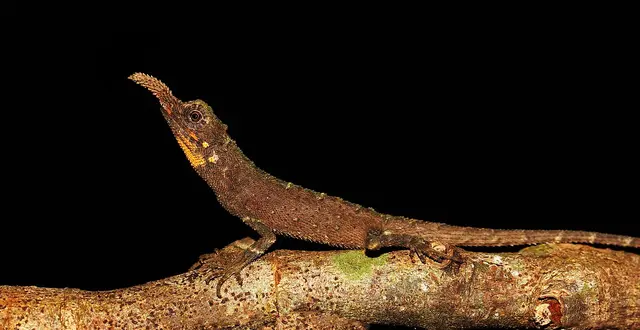
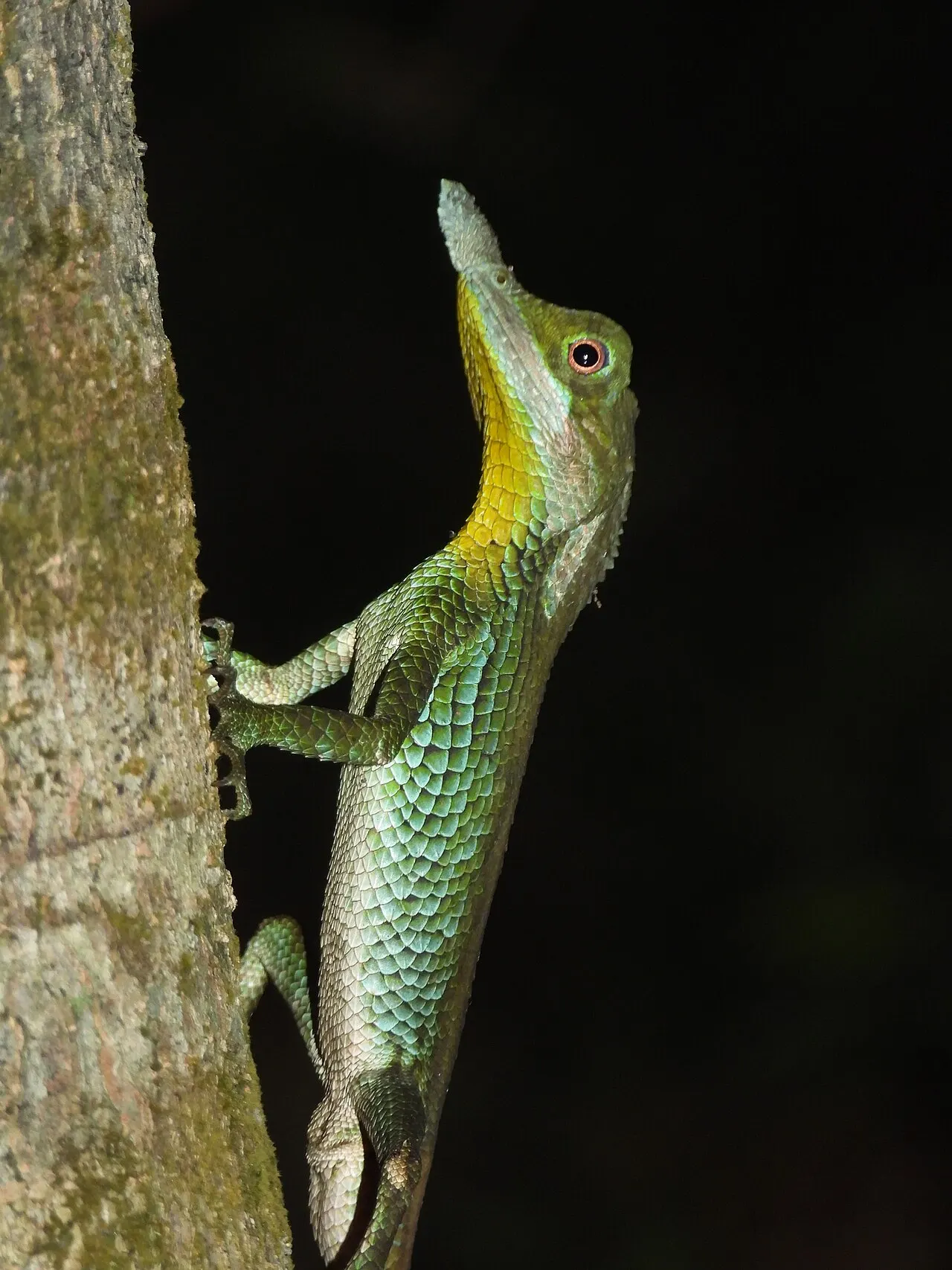
This is a small agama, roughly 20 cm long in total. The body is only 55 to 70 mm of that, and the tail makes up the rest (130 to 145 mm). The back ranges from reddish brown to olive green, with larger, often greener scales on the flanks, dark markings around the eyes and sides of the neck, dark bands across the tail and a pale belly.
The snout carries a flexible, flattened, leaf-like appendage, usually shorter in females. Males usually show more green than females, though both sexes can shift toward reddish brown. When disturbed, the lizard may open its mouth wide to show a bright orange lining.
Where it lives
The species is endemic to Sri Lanka and known only from the Knuckles range in the central highlands, mostly between about 700 and 1,200 m above sea level. The IUCN counts two locations and gives an extent of occurrence of 327 square kilometres (2021). An older account puts the range at roughly 175 square kilometres, so the true figure is uncertain.
Its main habitat is misty montane forest in a wet zone with more than 2,000 mm of rain a year. Surveys have also found it in modified plantations, mostly where a forest canopy remains overhead.
Pins are Wikidata “endemic to” fields. Orange dots, when present, are GBIF occurrence tiles — survey bias included.
How it lives
It is active by day but not quick. Rather than outrunning predators it relies on camouflage. It is a sit-and-wait hunter that perches on mossy trunks, low bushes and vines and takes insects, caterpillars, earthworms and other small invertebrates that pass within reach, sometimes dropping to the ground to catch prey.
Males are territorial and use head-bobs and body lifts to see off rivals, and may attack them. Females lay eggs, reportedly 2 to 4 at a time. Little else is known about its breeding.
Why it is in trouble
Habitat loss is the core problem. Over the past two centuries much of the Knuckles forest was cleared for cardamom, coffee, tea and rubber, and cardamom was planted widely there in the 1960s. Only about 5 percent of Sri Lanka's original wet-zone rainforest is reported to survive, much of it fragmented.
The IUCN lists the population as decreasing and the area of habitat as still shrinking. Small-holder farming, tourism and recreation areas, landslides, drought, fire and accidental harvest are each rated low in impact. Use in the international pet and display trade is also recorded.
What is being done
In 2000, forest above about 1,067 m in the Knuckles was protected as conservation forest and cardamom growing there was abandoned. Rather than regrowing naturally, parts of the old plantations were then taken over by invasive weeds such as lantana and mistflower. The IUCN lists invasive species control, area management and habitat protection among the needed actions.
The lizard is on CITES Appendix I, which bans international commercial trade, and the IUCN records it in at least one protected area. A 2015 study in the Journal of Natural History surveyed the Knuckles, found lizards in natural forest and in plantation patches that keep a forest canopy, and tested whether microhabitat, prey or human threats explain where they occur.
Sources
Written for this catalog in our own words from the sources below, checked against them on 12 November 2026. Population figures are estimates and carry the year they were made. Status and assessment year: IUCN. 2026. The IUCN Red List of Threatened Species. Version 2026-1. iucnredlist.org.