Endangered
Hadramaut himri
Carasobarbus exulatus
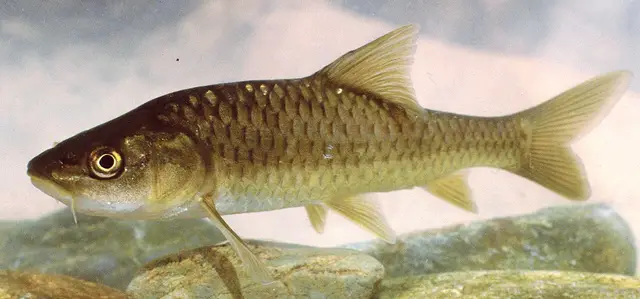
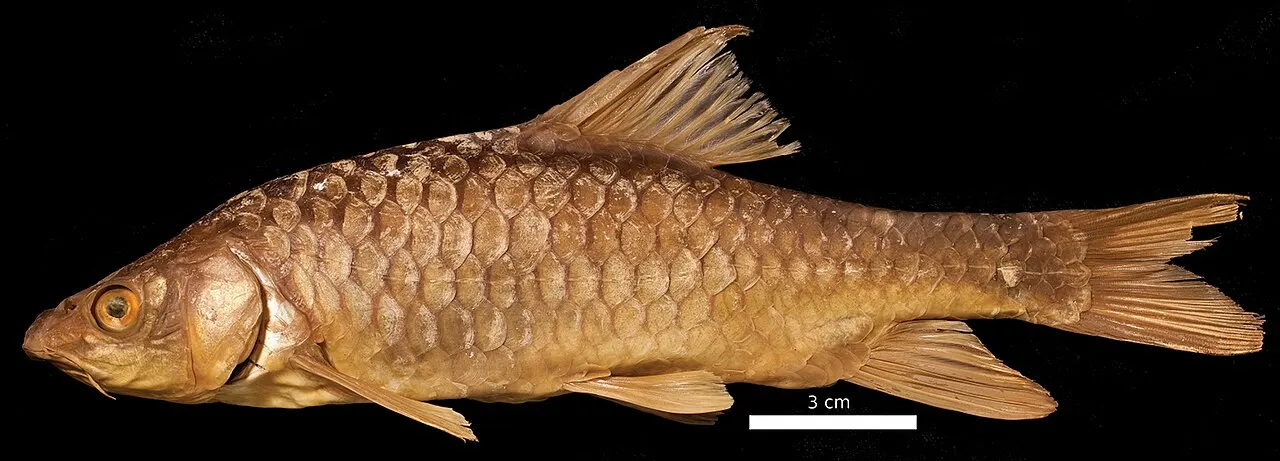
The Hadramaut himri (Carasobarbus exulatus) is a barbel, a carp relative, found only in the wadis of Yemen's Hadramaut region. It reaches at least 29 centimetres. The IUCN Red List rated it Endangered in 2015, with a very small range, a single location and a falling water supply.
How to recognise it
This is a barbel of the carp family, with two pairs of barbels on the mouth. A 2025 handbook of West Asian freshwater fishes separates it from its relatives by a few counts and proportions: usually 9 and a half branched rays in the dorsal fin, 6 and a half in the anal fin, a body depth of 26 to 36 percent of standard length, and a head shorter than the deepest part of the body. It grows to at least 290 millimetres in standard length, and probably larger.
Banister and Clarke described it in 1977 as Barbus exulatus, and it was later moved to the genus Carasobarbus.
Where it lives
The species is endemic to Yemen. A 2025 handbook of West Asian freshwater fishes places it in the Wadi Hajr and upper Wadi Hadhramaut drainages. The IUCN counts a single location, with an area of occupancy of about 200 square kilometres and an extent of occurrence somewhere between 101 and 5,000 square kilometres.
It lives in wadis, desert valleys whose water level swings widely between seasons. The IUCN lists springs and oases, small permanent pools and permanent streams as its habitats. The handbook records it in deep pools over gravel, bare rock or soft bottoms, and says the larger fish are usually found in the deep pools.
Pins are Wikidata “endemic to” fields. Orange dots, when present, are GBIF occurrence tiles — survey bias included.
How it lives
Almost nothing is recorded. The handbook has no data on its biology, and the IUCN classes it as not a migrant. People fish it for food.
Why it is in trouble
The two drainages it lives in are under pressure from water abstraction, meaning surface water is taken for use before it can fill pools and streams. The IUCN also lists droughts as a threat. The 2015 assessment found the population decreasing and the area it occupies continuing to shrink. The handbook agrees that the species appears to be declining within its very small range.
What is being done
The assessment lists the actions needed as site protection and management, awareness work, a genome resource bank and captive breeding as insurance. It records no conservation actions in place at the time of assessment.
Sources
Written for this catalog in our own words from the sources below, checked against them on 12 November 2026. Population figures are estimates and carry the year they were made. Status and assessment year: IUCN. 2026. The IUCN Red List of Threatened Species. Version 2026-1. iucnredlist.org.