Endangered
Arabian himri
Carasobarbus apoensis
The Arabian himri (Carasobarbus apoensis) is a freshwater barbel found only in the Hijaz Mountains of western Saudi Arabia, where it lives mainly in the upper reaches of seasonal desert streams called wadis. The IUCN Red List assessed it as Endangered in 2026, citing a shrinking area of occupancy and ongoing habitat decline.
How to recognise it
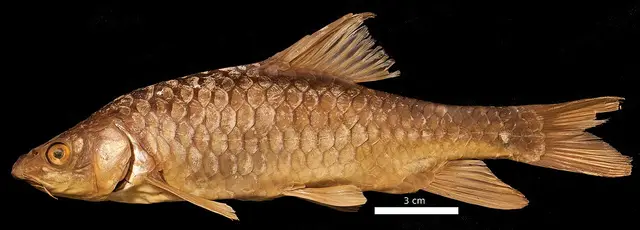
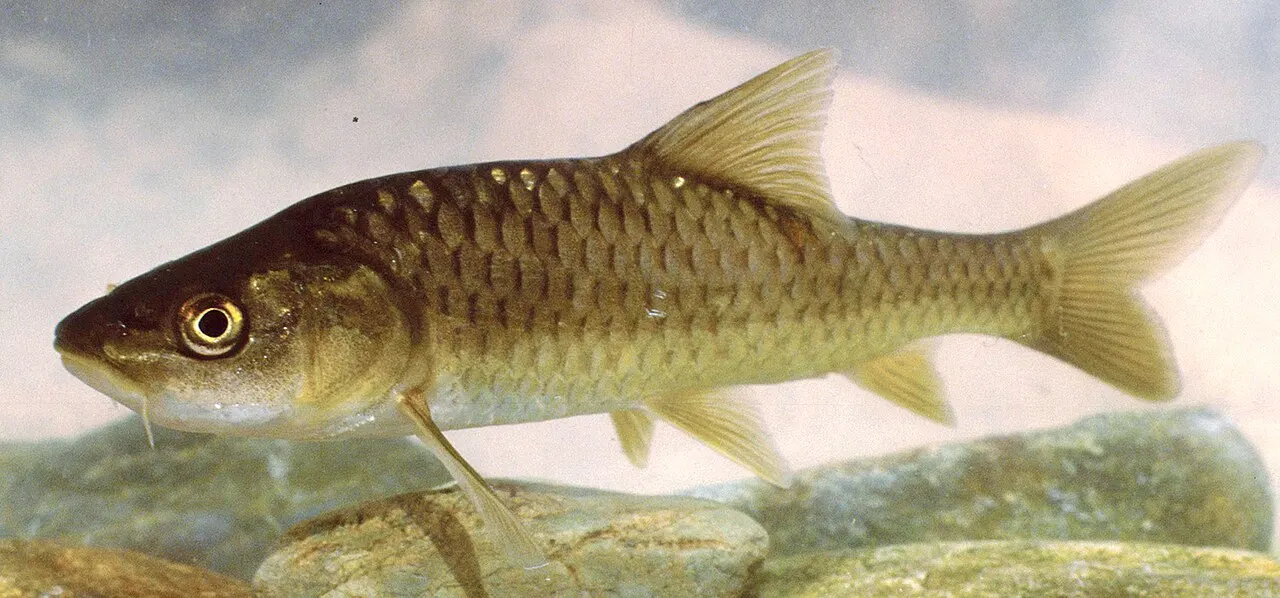
It's a carp relative (family Cyprinidae) with one pair of barbels, the whiskers near the mouth. Typical fish have about 10 branched rays in the dorsal fin and 27 to 32 scales along the lateral line. The largest recorded measured about 29 cm in standard length.
The species was first described in 1977 by Banister and Clarke as Barbus apoensis and was later moved to the genus Carasobarbus, a group found in western Asia and northwest Africa.
Where it lives
The Arabian himri is endemic to Saudi Arabia, meaning it occurs nowhere else. Known localities include Khamis Mushayt, where the type specimen came from a permanent stream, along with Wadi Turabah near At Taif, Wadi Adamah, Wadi Habayaba and Wadi Buwah. A 2022 study also sampled it in Wadi Khadrah near Medina. Some of these wadis drain to the Red Sea and others run inland.
It lives in the upper courses of wadis, where water level and temperature swing sharply from season to season. The Red List lists seasonal streams, permanent streams, small permanent pools, and freshwater springs and oases as its habitats. It has been recorded up to about 1,950 m above sea level.
Pins are Wikidata “endemic to” fields. Orange dots, when present, are GBIF occurrence tiles — survey bias included.
How it lives
Little has been published on this fish's diet or breeding. A 2022 study in the Journal of King Saud University: Science measured 53 fish, 10.5 to 24.5 cm long, in Wadi Khadrah across the seasons. Body condition peaked in winter and was lowest in fall, and growth was fastest in the first two years of life, slowing as the fish aged. The oldest fish sampled were 7 years old.
People eat it locally, but it has no commercial importance. The Red List lists subsistence and small-scale harvest as an ongoing use.
Why it is in trouble
The Red List counts three to ten separate locations and records continuing declines in its area of occupancy, its extent of occurrence and its subpopulations. Past decline is put at about 20 percent. The area of occupancy is estimated at 11 to 500 square kilometres. Its habitat is small and water-dependent, so anything that takes water from the streams matters.
The listed threats are removal of surface water for domestic and other uses, other ecosystem modification, small-scale harvesting, and future droughts. The severity of each is recorded as unknown, or in the case of harvesting as likely to cause fluctuations, so the pressure is real but poorly measured.
What is being done
Some of the species is held in captivity (ex situ conservation). The Red List records habitat and site protection and management, harvest management, national-level action, captive breeding, a genome resource bank and awareness work among its conservation actions, though only the captive holding is marked as in place.
Sources
Written for this catalog in our own words from the sources below, checked against them on 12 November 2026. Population figures are estimates and carry the year they were made. Status and assessment year: IUCN. 2026. The IUCN Red List of Threatened Species. Version 2026-1. iucnredlist.org.
- IUCN Red List assessment, Carasobarbus apoensis
- Arabian himri (encyclopedia article)
- FishBase summary
- Inland fishes of the Arabian Peninsula, treatment of Carasobarbus apoensis (Zenodo)
- Biological studies of Cyprinion acinaces and Carasobarbus apoensis from Wadi Khadrah (J King Saud Univ Sci 2022)
- GBIF species record
- Carasobarbus (genus article)
- Journal of King Saud University Science 2022 paper (full text)