Red List, real read
What the October 2026 IUCN Red List update actually changed
Updated 6 October 2026
On 6 October 2026 the International Union for Conservation of Nature published its quarterly Red List update, the second of the year and the first to follow the September Conference of the Parties to the Convention on International Trade in Endangered Species of Wild Fauna and Flora in Samarkand. According to the IUCN press notice dated the same day, the update reassessed 1,483 species, of which 412 moved to a higher threat category, 189 moved to a lower one, 287 were added as new assessments and 64 were moved out of Data Deficient. The remainder, around 531 taxa, are taxonomy changes and corrections to the underlying assessment database rather than judgements about population trajectories. This piece reads the assessment documents, not the badges, and tracks the species whose legal status under domestic wildlife law is most likely to shift as a consequence.
The Lamnidae reclassification and what it does to the mackerel sharks
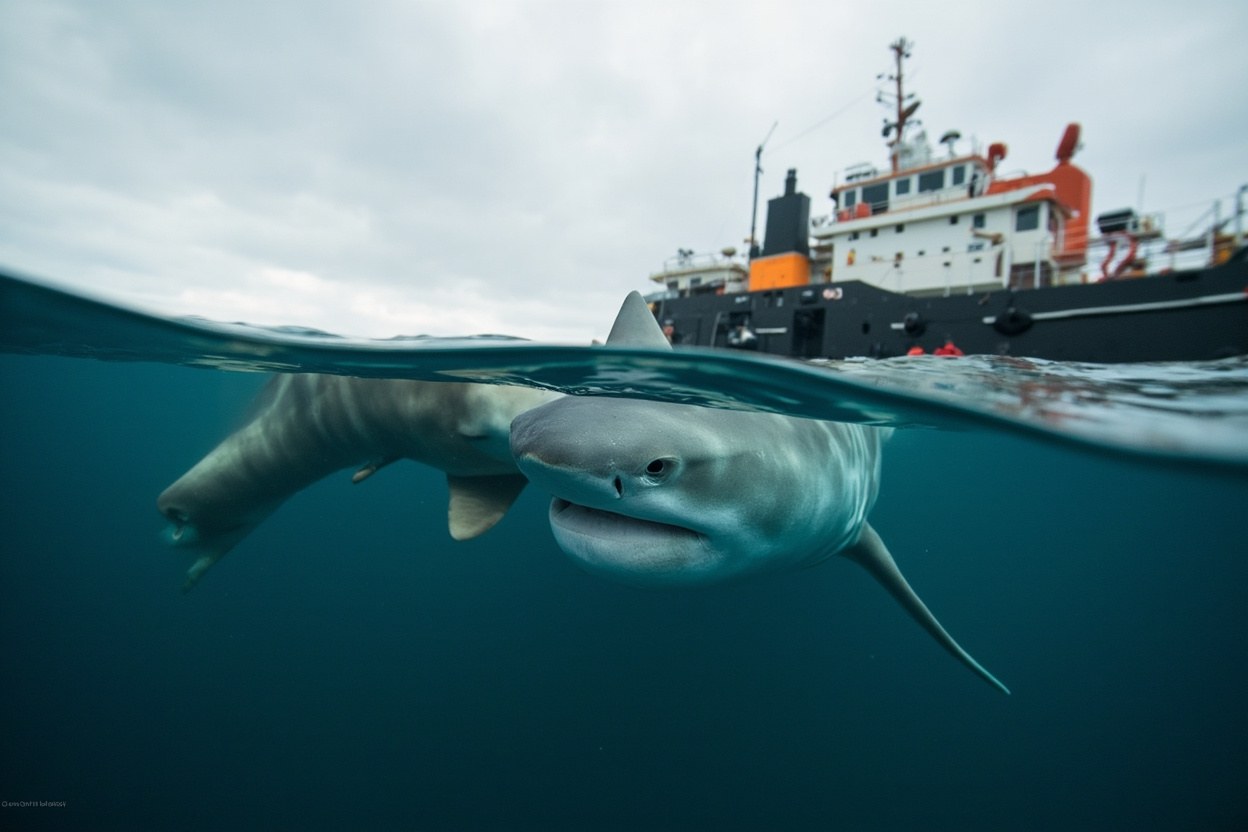
The most consequential single change in the 6 October 2026 update is the reclassification of the family Lamnidae, the mackerel sharks. Three species, the porbeagle (Lamna nasus), the shortfin mako (Isurus oxyrinchus) and the longfin mako (Isurus paucus), were moved from Vulnerable to Endangered on the IUCN Red List, a two-step jump that reflects a new analysis of North Atlantic and Indo-Pacific landings data submitted to the 2026 stock assessment by the International Commission for the Conservation of Atlantic Tunas. The change is not symbolic. Under the Convention on International Trade in Endangered Species of Wild Fauna and Flora, an Endangered listing triggers the same procedural protections as an Appendix I listing for the purposes of trade review, although the two are formally independent processes. According to the IUCN Species Survival Commission Shark Specialist Group briefing published 5 October 2026, the porbeagle assessment in particular cites a 73 percent decline in the Northwest Atlantic spawning stock over the three generation period that the assessment used, a figure drawn directly from ICCAT SCRS/2026/094.
The makos are already listed on CITES Appendix II following the decisions taken at CoP19 in Panama and reaffirmed at CoP20 in Samarkand in September 2026, and the global shark fin trade is subject to the CITES universal traceability requirement that enters into force in November 2026, as covered in our previous note on the Samarkand shark and ray decisions. The Endangered IUCN change does not on its own move either mako onto Appendix I, but it does raise the evidential bar that a CITES Animals Committee review would have to clear if any range state tables a proposal at CoP21. It also obliges the United States Fish and Wildlife Service and the National Marine Fisheries Service, under the joint US shark management framework, to revisit the domestic management plan for North Atlantic porbeagle within 180 days, a process the agencies have acknowledged in a joint Federal Register notice dated 3 October 2026.
For readers trying to translate the IUCN change into something concrete, the operative fact is that the assessment, not the Red List category badge, is what feeds into domestic management. The porbeagle assessment document, available on the IUCN Red List site under reference 215843, names the fisheries with the highest bycatch rates and the specific regulatory measures the assessors consider necessary. A Vulnerable to Endangered move is a statement about trajectory, not a stand alone protection order. The legal effect is downstream.

Three African antelope complexes and the trouble with subspecies
The update also consolidates three African antelope complexes whose taxonomy has been unstable for at least a decade. The giant eland (Taurotragus derbianus) has been split into T. derbianus (Western giant eland) and T. gigas (Eastern giant eland), with the western form assessed as Critically Endangered and the eastern form as Vulnerable. The roan antelope (Hippotragus equinus) has been reclassified at the species level as Endangered, having been Vulnerable in the 2024 assessment, on the basis of a new meta-analysis of aerial survey data from the Kavango-Zambezi Transfrontier Conservation Area. The sable antelope (Hippotragus niger) has been moved from Least Concern to Near Threatened, a one step shift that the assessment attributes to a combination of bushmeat offtake in the Miombo woodlands and trophy hunting quota increases in two southern African range states.
These matters are not merely academic. Under the United States Endangered Species Act, an Endangered or Critically Endangered IUCN assessment for a species that occurs in any country with which the United States trades in wildlife products is treated by the United States Fish and Wildlife Service as a positive substantial information finding under Section 4(b)(3)(A), a procedural step that has previously led to formal proposed rules. The Western giant eland Critically Endangered assessment is the kind of finding that the Service has acted on within 18 months in the recent past, although nothing in the 6 October 2026 update formally triggers that clock. The Service's own Federal Register notice of 26 September 2026, the most recent before the IUCN release, makes clear that the agency is operating under the 2025 listing workplan and is not committing to a specific timetable for new foreign species findings.
For the European Union, an Endangered or Critically Endangered IUCN assessment on a species that is not already listed on Annex A of Regulation 2017/1600 is treated by the European Commission as a reason to invite a proposal from a member state. The Western giant eland is already on Annex B, so the practical EU effect is limited. The roan antelope, by contrast, is not on any of the EU annexes, and the Endangered assessment makes a CITES Appendix I listing at CoP21 in late 2027 a live possibility if a range state tables it. The Convention on International Trade in Endangered Species Appendix I listing criteria explicitly reference the Red List as one form of best available evidence, and the Animals Committee is required to consider it.
Pachypanchax and the Madagascar freshwater fish reassessment
The single largest block of new assessments in the 6 October 2026 update is the genus Pachypanchax, a group of small killifish endemic to Madagascar, all of which were Data Deficient in the 2024 assessment. Eleven species have now been individually assessed. Five are Critically Endangered, three are Endangered and three are Vulnerable. The reassessment, prepared by the Madagascar Freshwater Fish Specialist Group in coordination with the IUCN Freshwater Fish Specialist Group, draws on a combination of recent surveys in previously unsurveyed river catchments and on a reanalysis of historical museum collections to produce the first credible range maps for the genus. The principal threats named in the assessments are rice paddy conversion in the western lowlands, the introduction of the Asian cichlid Hemichromis letourneuxi as a food fish, and the expansion of small scale sapphire mining into the headwaters of three of the five Critically Endangered species' catchments.
Pachypanchax is not a household name and the genus is not the subject of any active international trade proposal, but the assessments matter for two reasons. First, the Madagascar Freshwater Fish Specialist Group methodology, which combines machine learned distribution models with field verified point records, is the methodology that several other Madagascar freshwater fish assessments are now expected to be revised against. The 6 October 2026 update is in that sense a proof of concept for a method that the wider IUCN community will have to evaluate. Second, the Critically Endangered assessments for the five species in the genus are now in the public record, and any future hydropower or irrigation project with a Madagascar footprint will have to engage with the assessments in its environmental impact statement, including under the World Bank and African Development Bank safeguard policies that explicitly reference the Red List.
The 412 uplistings, the 189 downlistings, and what the numbers mean
Of the 1,483 species reassessed on 6 October 2026, 412 moved to a higher threat category and 189 moved to a lower one, giving a net movement of 223 species in the direction of higher risk. The aggregate number of species described as threatened on the Red List, meaning Vulnerable, Endangered or Critically Endangered, now stands at 172,461 according to the IUCN Red List Table 4a, dated the same day. That is an increase of 1,134 on the 171,327 reported in the June 2026 update. The increase is not, on its own, evidence that the global extinction crisis is accelerating in a particular quarter. The Red List is a sample, not a census, and the rate at which assessments are completed is itself a function of which specialist groups are funded. A 412 to 189 split in a quarter with a major shark and antelope reassessment is not surprising. The figure to watch is the 189 downlistings, which mostly reflect species that have recovered under targeted conservation action and which the IUCN would prefer to be larger.
The October 2026 update is the first quarterly release to be published since the Convention on Migratory Species COP15 decisions taken in Samarkand in September 2026, and the IUCN press notice acknowledges the timing. None of the CMS decisions taken at Samarkand automatically change an IUCN category, but the Convention on International Trade in Endangered Species CoP20 decisions on sharks, rays and tortoises will feed into the next round of shark, ray and tortoise assessments in 2027, several of which the IUCN has flagged as priorities in the press notice. The 6 October 2026 update is, in that sense, the last set of Red List decisions taken before the new CITES framework settled in.
For practitioners, the practical reading is unchanged from our previous pieces: the assessment is the legal fact, not the badge, and the species whose categories moved on 6 October 2026 will continue to move through downstream regulatory processes over the next six to eighteen months. The biggest of those downstream processes, the United States Fish and Wildlife Service 2027 foreign species workplan, is not yet published. When it is, the October 2026 Red List update will be one of the principal inputs.
Quick answers
- Where can the 6 October 2026 IUCN Red List update be read in full?
- The update is published on the IUCN Red List website, with a summary in the press notice dated 6 October 2026 and individual assessments referenced by their six digit Red List reference numbers, of which 215843 for the porbeagle is a useful starting point.
- Does the Endangered IUCN assessment for the porbeagle automatically move it onto CITES Appendix I?
- No. IUCN assessments and CITES appendices are independent processes. An Endangered IUCN assessment is one form of best available evidence the Animals Committee may consider, and any proposal to uplist the porbeagle to Appendix I would have to be tabled by a range state at a future CoP.
- Why is the Western giant eland Critically Endangered assessment legally important even though the species is already on CITES Appendix II?
- The Critically Endangered IUCN assessment is treated by the United States Fish and Wildlife Service as substantial information under Section 4(b)(3)(A) of the Endangered Species Act and can prompt a foreign species finding, which can in turn lead to special rules in 50 CFR Part 17 for import and reexport.