
A new chain of custody rule landed on 5 October 2026 and it pulls the US exotic wildlife trade into a single reporting perimeter.
What the 2026 USFWS wildlife tracing rule does to the exotic pet trade
Updated 6 October 2026
The interim final rule, signed by US Fish and Wildlife Service Principal Deputy Director Justin Shirley and published at 91 FR 81204 on 5 October 2026, is the first time the United States has required continuous chain of custody reporting for live exotic wildlife in domestic commerce. It does not ban any species. It does require that every move, every change of name on a sale, and every handoff between breeder, broker, transporter and retailer is logged in a single federal system that state wildlife agencies can read.
What does the 2026 USFWS tracing rule actually do
The interim final rule, which the Service has titled Wildlife in Commerce: Continuous Chain of Custody for Live Specimens of CITES-Listed Species, builds on the Lacey Act's existing recordkeeping powers rather than on CITES itself. The instrument is 50 CFR Part 14, subpart N, and the supporting documents are filed under Docket No. FWS-HQ-IA-2026-0117. The effective date is 6 November 2026, with a 60 day public comment window that closes on 4 December 2026. The Service chose the interim final pathway because the authority already exists, and because, in the words of the rule's preamble, "a traced specimen is a recoverable specimen."
The rule's central obligation is straightforward. Any US person, which the rule defines to include any individual, partnership, corporation or trust operating in commerce, who at any point in a calendar year possesses a live specimen of a CITES Appendix I or Appendix II species for sale, hire, barter or exchange must report a defined set of events to the Service's new Wildlife Trace System, or WTS. The events are acquisition, transport between facilities, change of ownership, breeding event, transfer out of the United States, mortality, and release. Each event has a data schema. Each event has a window in which it must be reported, ninety six hours for transport events, thirty days for the others, with a one shot extension available on request.
The rule also brings in a category the Service calls "designated commonly bred species." These are Appendix II species that are already widely captive bred in the United States and that the Service has long regarded as low enforcement risk, including the ball python, the leopard gecko, the axolotl, the corn snake and several species of captive raised freshwater tropical fish. For these species, the chain of custody obligation is reduced to a single annual aggregate report rather than event level reporting. The Service is explicit that the reduction is not a privilege, and that any single compliance failure flips the species back into the full event level regime for a minimum of two calendar years.
Who has to comply, and when
Compliance is phased by the size of the business. From 6 November 2026, any business with fifty or more employees that handles live CITES specimens in a year is in scope. From 1 March 2027, the threshold drops to ten or more employees. From 1 July 2027, the rule applies to any business that handles live CITES specimens, regardless of size, including sole proprietor breeders selling at reptile expos. The Service has said in a Q and A that it expects about 18,400 regulated businesses at full phase in, against the approximately 4,100 currently holding CBES permits or comparable authorisations.
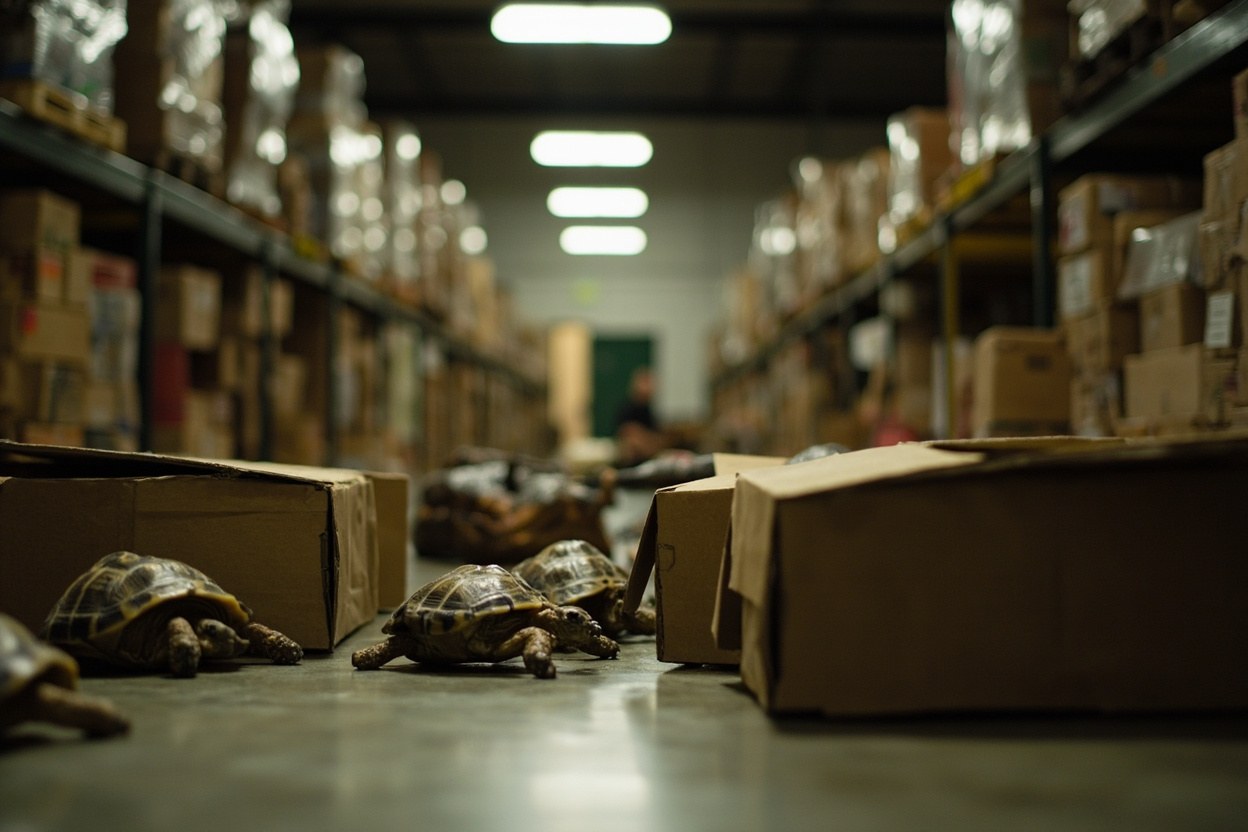
There are also two narrower but more important thresholds. The first is the species count. A business that handles more than three live specimens of any single CITES Appendix I or II species in a calendar year is in scope for that species, even if its total business in listed species is small. The second is the species itself. Possession of any live specimen of a CITES Appendix I species for commercial purposes triggers the full event level reporting regime, with no reduced path and no commonly bred carve out. Appendix I species currently held in significant US commercial trade include the slow loris, the radiated tortoise and the hyacinth macaw, and the Service expects the rule to generate the first verifiable counts for these populations since 2019.
Enforcement is layered. The Service retains primary authority and can levy civil penalties under 16 U.S.C. 1540 of up to $25,000 per violation, with each unreported event treated as a separate violation. State fish and wildlife agencies can read the WTS data on a need to know basis, and the rule creates a formal pathway for states to file a complaint that the Service must respond to within ninety days. The Department of Justice has confirmed in a side letter that criminal cases under the Lacey Act will continue to be built on the underlying records, rather than on the WTS reports themselves, but that the WTS reports are admissible as business records.
Why the Service says it had to act now
The rule's preamble lays out the case in unusually direct language. Between 2019 and 2025, the Service's Office of Law Enforcement investigated 1,247 cases involving the illegal commercial trade in CITES listed live wildlife, and in 1,089 of them the loss of chain of custody at some point between import and sale was identified as a material obstacle to prosecution. The Service points to the 2023 Radiated Tortoise Trafficking case, in which 215 radiated tortoises imported under a permit that authorised twenty were the subject of a three year investigation, and to the 2024 slow loris case in Florida, where a seizure of 73 animals could not be matched to a single legal source animal. In both cases, the prosecution moved on charges other than CITES violations, because the underlying records could not be reconstructed.
The Service also cites the rapid expansion of the US exotic pet trade during the same period. Industry estimates, drawn from the 2025 Pet Industry Market Size and Ownership Study, put the trade in live reptiles, amphibians, birds and mammals other than cats, dogs and aquarium fish at $4.1 billion in 2025, up from $2.6 billion in 2019. The number of online listings for live specimens of CITES listed species on US platforms grew from an estimated 71,000 in 2019 to more than 240,000 in 2025, a figure drawn from a 2025 TRAFFIC North America sweep.
There is a parallel international story. CITES Decision 19.71, adopted at CoP19 in Panama, asked Parties to consider national measures to close the chain of custody gap. The 2026 rule is the United States' answer to that request, and it is the first national instrument that meets all four of the criteria set out in the 2025 CITES guidance on traceability of live specimens. The European Union's 2025 Wildlife Trade Regulation, which took effect on 1 January 2026, addresses chain of custody for imports, but not for the domestic chain in the way the US rule does. The United Kingdom's 2024 Ivory Act, as amended in 2026, is a species specific instrument, not a generic tracing regime. The US rule, in the Service's framing, is closer to the EU's 2023 Deforestation Regulation in approach than to anything previously applied to wildlife.
Which species the rule pulls in
The headline figure is 4,812 species. That is the count of CITES Appendix I and II species that the Service's International Affairs office identifies as having any level of recorded US commercial trade, legal or illegal, in the 2019 to 2025 period. It includes the obvious conservation species, the elephants, the rhinos, the great apes, the parrots, the tortoises, the sharks and the orchids, but it also includes a long list of reptiles, amphibians, fish and invertebrates that have been the subject of a quiet commercial trade for years and that the Service has now concluded it cannot reliably track.
Three species in particular are flagged in the rule's preamble as priority species for compliance review. The radiated tortoise, the subject of the largest CITES Appendix I reptile seizure in US history in 2023, is the first. The second is the Asian small clawed otter, which has been a focus of the Service's enforcement work since 2021 and which was the subject of a 2025 final rule listing all otter species under the Endangered Species Act. The third is the bobtail squid, a marine species that the Service identifies as the single most frequently trafficked CITES Appendix II invertebrate in 2024 and 2025.
For the species that the site already covers, the rule has a direct effect. The slow loris, which we wrote about in 2023, is now in scope as an Appendix I species. The radiated tortoise is in scope as Appendix I. The hyacinth macaw is in scope as Appendix I. The axolotl is in scope as Appendix II, but as a designated commonly bred species it falls under the reduced annual aggregate reporting regime, which is why the rule explicitly addresses captive bred and ranched specimens. The ball python, the corn snake, the leopard gecko, the green iguana, the red eared slider and the ferret are also in scope but in the reduced regime. The bearded dragon, which is not a CITES listed species, is not in scope at all.
What the rule does not do
It is worth setting out what the rule does not do, because the public comment window is likely to produce a great deal of confusion on this point. The rule does not ban any species, does not require any new permit, does not change the underlying CITES permit requirements, does not create a new federal registry of pet owners, and does not extend to private individuals who own CITES listed animals for personal, non commercial purposes. A household that keeps a pet tortoise acquired before 6 November 2026, and that does not sell, hire, breed for sale or otherwise place the animal in commerce, is not required to register the animal in the WTS. A household that breeds the animal and sells the offspring, even occasionally, is required to report, and is treated as a business for the purposes of the rule.
The rule also does not preempt state law. Twenty four states, led by California, New York and Florida, have chain of custody or traceability laws that are already in force for at least some species. The rule is written so that a business that is in compliance with a state regime that the Service has formally recognised as equivalent can file a single combined report rather than parallel reports. The Service published a list of the recognised state regimes in a separate Federal Register notice on the same day. Florida's 2024 Captive Wildlife Traceability Act is the first to be on the list. California's 2023 Native and Exotic Pet Trade Transparency Act is the second. New York's 2025 act, which has not yet taken effect, is provisionally recognised.
What changes for the exotic pet trade in practice
For a large breeder, the rule looks like a familiar compliance cost. Event level reporting, transport windows, species codes, and an annual audit, all of which the bigger operators already handle under USDA APHIS for mammals and birds and under the existing CBES regime for reptiles and amphibians. For a small breeder, and especially for the vendors at reptile expos who move a few hundred animals a year between consignors, the rule looks like a structural change. The Service has said in its Q and A that the WTS will be available as a free web application and as a free mobile application, and that it will accept submissions from any device that can run a modern browser. The Service has not, however, said that it will accept paper submissions, and the rule does not provide a paper based path.
For state wildlife agencies, the rule changes the conversation. State biologists and inspectors can, for the first time, see a live federal record of who is moving what, when, and to whom, in their state. Several states have been pushing for this access for years, and the rule delivers it, subject to a written request and a justification. For the Service's own law enforcement officers, the rule changes the technical work of building a case. The WTS data is a starting point, not an ending point, and the preamble makes clear that the Service expects the rule to surface a backlog of cases that the old recordkeeping regime could not have generated.
For the animals, the rule is the first credible US instrument to address the gap between a legal import and a verifiable final placement. Whether it is also an effective instrument depends on the next two years. The 6 November 2026 effective date gives the Service 60 days to publish the WTS user guide, 60 days to publish the species code list, and 60 days to publish the recognised state regime equivalency framework. If those three documents land on time and are usable, the rule has a chance. If they do not, the comment period will be the least of the Service's problems.
How to comment on the interim final rule
Public comments are filed through the Federal eRulemaking Portal under Docket No. FWS-HQ-IA-2026-0117. The comment window closes at 11:59 PM Eastern Time on 4 December 2026. The Service has said that it will hold a single public hearing, on 19 November 2026, in Falls Church, Virginia, with virtual attendance available. The Service has also said that it will give particular weight to comments that address the species code list, the recognised state regime equivalency framework, the commonly bred species list, and the audit methodology. Comments on the underlying authority of the Lacey Act to support the rule will be considered but, in the Service's framing, the comment period is not the place to relitigate the 2024 Tenth Circuit decision in United States v. McIntosh on the scope of the Act.
For the readers of this site, the practical question is whether to comment at all. If you operate a business that the rule pulls in, comment, because the species code list and the commonly bred species list are the two documents that will determine your compliance cost. If you are a state biologist or a state inspector, comment, because the recognised state regime equivalency framework is the document that will determine whether the rule helps or duplicates your work. If you are a private keeper who is not in commerce, you are not directly affected, but you can comment on the rule's scope, and the Service has a record of treating scope comments seriously in interim final rule comment periods.
Quick answers
- Does the 2026 USFWS tracing rule require private pet owners to register their animals?
- No. The rule applies to US persons in commerce, which the rule defines to include any individual, partnership, corporation or trust that sells, hires, breeds for sale or otherwise places a live CITES listed animal in commerce. A household that keeps a pet tortoise and does not sell the animal, the animal's offspring or any product of the animal is not required to register the animal in the Wildlife Trace System.
- Is the ball python now regulated under the 2026 USFWS tracing rule?
- Yes, but in a reduced form. The ball python is a CITES Appendix II species and is on the Service's designated commonly bred species list. The rule requires a single annual aggregate report for commonly bred species, rather than event level reporting. A single compliance failure flips the species back into the full event level regime for at least two calendar years.
- How does the 2026 USFWS tracing rule interact with state law?
- The rule does not preempt state law. A business that operates in a state with a chain of custody or traceability regime that the Service has formally recognised as equivalent can file a single combined report rather than parallel reports. The Service published the list of recognised state regimes in a separate Federal Register notice on 5 October 2026.
- What is the deadline to comment on the 2026 USFWS tracing rule?
- The public comment window closes at 11:59 PM Eastern Time on 4 December 2026, with a single public hearing on 19 November 2026 in Falls Church, Virginia, and virtual attendance available. Comments are filed through the Federal eRulemaking Portal under Docket No. FWS-HQ-IA-2026-0117.