
CoP20 fallout
What the 2026 Asian Tortoise CITES Listing Rewrite Actually Changes
Updated 6 October 2026
Decisions adopted at the twentieth meeting of the Conference of the Parties to CITES, held in Samarkand, Uzbekistan from 23 November to 5 December 2025, took effect on 22 May 2026 under Notification No. 2026/038, and are the operative trade controls for Asian tortoises from the second half of 2026 onward. The package touches Cuora, Heosemys, Indotestudo, Manouria and the chelonian genus that almost everyone calls the ploughshare, Astrochelys, with one species written out of the uplisting vote altogether.
Which Asian tortoises were moved at CITES CoP20 in Samankand, and what do the new Appendix labels mean for trade?
Four working documents carried the substance. The United States, Vietnam, Bangladesh and India jointly proposed CoP20 Prop. 32 to transfer Cuora galbinifrons, the Indochinese box turtle, from Appendix II to Appendix I. A second proposal, CoP20 Prop. 33, from Malaysia and Indonesia, sought a similar Appendix I listing for Cuora bourreti, Bourret's box turtle, and a third, CoP20 Prop. 34, addressed Indotestudo forstenii, Forsten's tortoise, which had been on Appendix II since 2000. A consolidated Asian tortoise package from the range states also rewrote the annotation for Astrochelys radiata, the radiated tortoise, to close a captive-bred loophole that the Standing Committee had flagged repeatedly since 2022.
Appendix I under CITES means commercial trade in wild taken specimens is prohibited. Appendix II permits commercial trade when an export permit is issued and a non detriment finding from the Scientific Authority of the exporting country is positive. The shift for Cuora galbinifrons is therefore the most consequential, because the species was the single most commonly traded Asian box turtle at the Hong Kong centred wholesale level between 2019 and 2024, according to seizure data compiled by TRAFFIC and reviewed in CoP20 Inf. 51. The Appendix I vote passed 88 in favour, 12 against and 9 abstentions, on a recorded vote requested by Madagascar.
Bourret's box turtle was kept in Appendix II after a long debate in Committee II, with Indonesia, Malaysia and Thailand asking for further population studies before tighter controls. The Secretariat was directed to commission a range state consultation in 2026 and report back to the Standing Committee. Forsten's tortoise, on the other hand, was moved to Appendix I by consensus after the Animals Committee's Indotestudo review concluded that all four species in the genus were being exported at rates inconsistent with any plausible wild production scenario. Indotestudo elongata and Indotestudo travancorica were already in Appendix I; the genus is now uniformly listed.
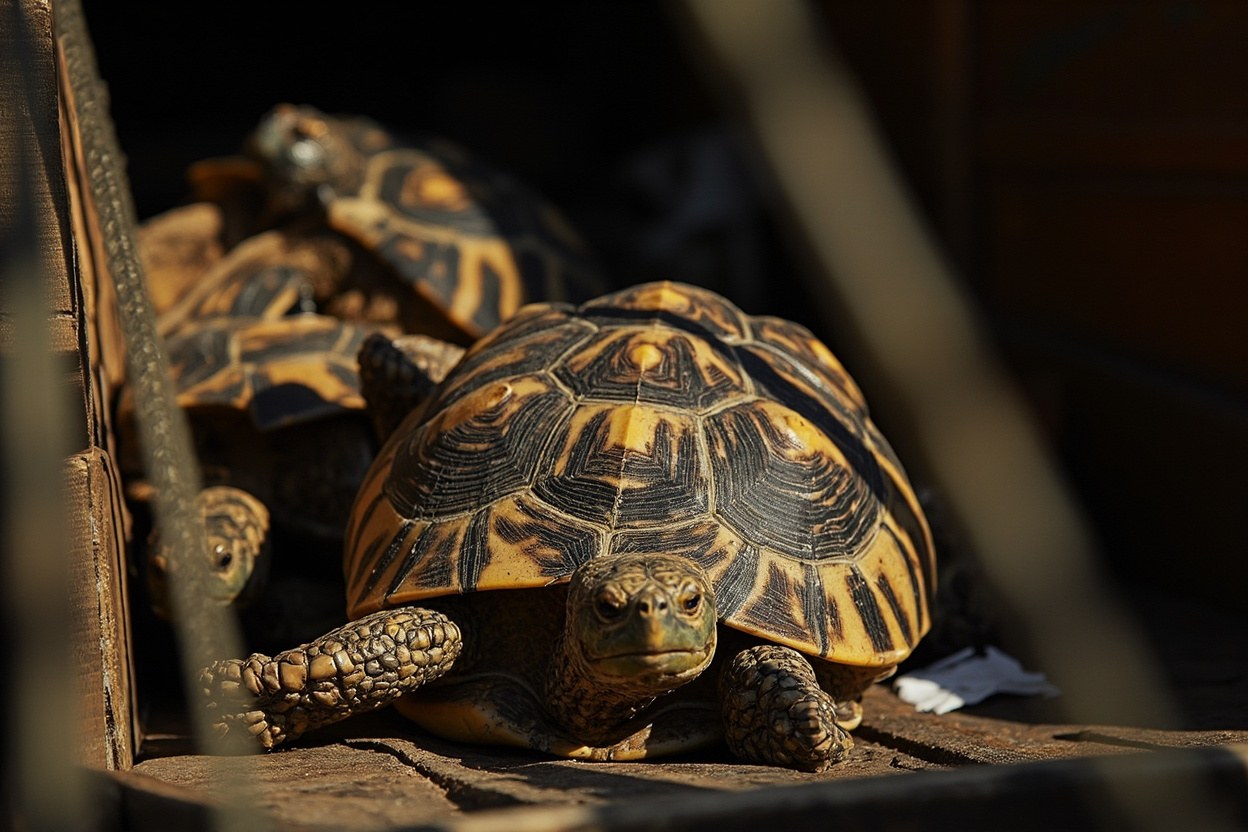
What did the Standing Committee actually write about radiated tortoises, and how does the new annotation work?
The radiated tortoise vote was the most technical. Astrochelys radiata has been in Appendix I since 1975. The problem was never the Appendix, it was the annotation. The pre CoP20 annotation read that the species was included in Appendix I, with a footnote allowing trade in ranched specimens under specific conditions. The footnote had become, in practice, a back door for specimens of uncertain origin, because the ranch definition in Resolution Conf. 11.16 (Rev. CoP19) was narrow on paper and elastic at the border. CoP20 Prop. 35, presented by Madagascar and cosponsored by the European Union, rewrote the annotation to delete the ranching carve out and to add a source code Y requirement for any commercial purpose transaction.
Source code Y is the standard CITES trade term for captive bred specimens, as defined in Resolution Conf. 10.16 (Rev. CoP19). It is the strictest of the source codes, requiring that the parental stock was established in accordance with the Convention, that breeding is managed in a manner that prevents hybridization and that the specimens are bred for commercial purposes at a facility registered with the Management Authority. The radiated tortoise rewrite also added an explicit exclusion of source code R, ranched, for the species. The change took effect on 22 May 2026 alongside the rest of the CoP20 amendments, per Notification No. 2026/038.
For the United States, the rewrite aligns Appendix I status with a stricter domestic permitting regime under 50 CFR 17.32, which had already been treating Astrochelys radiata as an Appendix I species for CITES purposes since the species was listed as endangered under the U.S. Endangered Species Act in 2021. For the European Union, the change required an Implementing Regulation amendment, which the Commission published on 14 March 2026 as Commission Implementing Regulation (EU) 2026/412, amending Regulation (EC) No 338/97. The implementing regulation also added Cuora galbinifrons to Annex A, the EU's stricter of two CITES listed species lists, from 22 May 2026.
How do these CITES changes interact with national endangered species laws in the United States, the European Union and China?
CITES is a treaty, not a national law, so the operative legal instrument is always domestic. In the United States, the U.S. Fish and Wildlife Service publishes the CITES Appendices in 50 CFR 23.91 through 50 CFR 23.94, and the Service's Office of Law Enforcement uses the Appendix label as the starting point for permit issuance. The Service's January 2026 Federal Register notice, 91 FR 4117, formally adopted the CoP20 amendments, including the radiated tortoise annotation and the Cuora galbinifrons transfer, for U.S. permitting purposes from 22 May 2026. ESA listing is a separate track: Cuora galbinifrons remains a candidate species under the U.S. ESA, with the next status review scheduled for the Service's 2027 candidate notice of review.
In the European Union, Regulation (EC) No 338/97 already applies stricter Annex A treatment to most Appendix I species. Commission Implementing Regulation (EU) 2026/412 added Cuora galbinifrons to Annex A and confirmed the Astrochelys radiata annotation. The European Commission also referred the Indotestudo forstenii transfer to the Scientific Review Group for an opinion under Article 4(7) of the regulation, and the Group's positive opinion, dated 18 April 2026, resulted in Annex A listing of the species from the same 22 May 2026 date. For private keepers in EU member states, the practical effect is that any Annex A specimen acquired after the listing date must be registered and any cross border movement requires a permit.
China's CITES Management Authority, the Endangered Species Import and Export Management Office of the People's Republic of China, issued a public notice on 8 June 2026 to align the country's domestic identification documents for the affected species. China has, since 2020, operated a parallel identification system for tortoises and freshwater turtles, the so called molecular barcoding scheme administered by the Beijing Zoo and the Chinese Academy of Sciences' Institute of Zoology. The June 2026 notice confirmed that barcoded specimens of Cuora galbinifrons, Indotestudo forstenii and Astrochelys radiata will be subject to the stricter Appendix I trade controls even when the shipment is described as Appendix II in origin documentation. The notice is the practical answer to the long running problem of Asian box turtles being laundered through the legal captive bred trade.
What does the 2025 IUCN Red List update say about the status of the affected species, and why does it matter for permit decisions?
The IUCN Red List update released on 9 October 2025, ahead of CoP20, was the evidentiary backbone for the Asian tortoise package. Cuora galbinifrons was uplisted from Endangered to Critically Endangered under criterion A2d, an observed, estimated, inferred or suspected population reduction of 80% or more over the last 10 years, where the reduction is due to actual or potential levels of exploitation. Indotestudo forstenii was assessed for the first time at the global level, and listed as Endangered under criterion B1ab(iii), with an extent of occurrence under 5,000 km² and continuing decline in area, extent and quality of habitat.
Astrochelys radiata retained its Critically Endangered listing from 2008, but the 2025 update revised the population trend from Decreasing to Stable, on the basis of a five year monitoring programme led by the Turtle Survival Alliance and the Madagascar Biodiversity Partnership. The stable trend, paradoxically, did not weaken the case for an annotation rewrite, because the rewrite was responding to trade data, not population data. The Secretariat's briefing for Committee II noted that 1,200 radiated tortoises had been seized in 2023 and 2024 alone, almost all in shipments bearing source code R paperwork.
For permitting decisions, the practical point is that a non detriment finding for any of these species is now very hard to issue in good faith. U.S. Scientific Authority letters of concurrence under 50 CFR 23.85 are unlikely to be forthcoming for wild specimens, and the European Union's Scientific Review Group has indicated, in its April 2026 opinion, that it will treat any import permit application for an Appendix I Asian tortoise as a presumption of denial unless the applicant can demonstrate captive breeding at a registered facility going back at least two generations.
Which Asian tortoise proposals did not pass at Samarkand, and what happens to them next?
Two proposals were withdrawn and one was voted down. The proposal to transfer Heosemys annandalii, the yellow headed temple turtle, from Appendix II to Appendix I was withdrawn by Vietnam and Cambodia after the Animals Committee noted that the species' range state management had improved since 2023. A second proposal, to add Manouria phayrei, the Asian brown tortoise, to Appendix II for the first time, was withdrawn by Bangladesh pending a range state workshop in 2026.
The proposal to transfer Cuora bourreti from Appendix II to Appendix I was the subject of a recorded vote that fell short of the two thirds majority required for a listing change under Rule 20 of the Rules of Procedure. The final tally was 61 in favour, 43 against and 12 abstentions, and the Secretariat was directed to keep the species under review through the Animals Committee. In the meantime, the European Union and the United States are expected to use their stricter domestic endangered species regimes to constrain trade, and TRAFFIC has flagged the species as a priority for seizure monitoring in its 2026 East Asian and Pacific regional implementation plan.
For anyone keeping or trading Asian tortoises in the United States, the European Union, the United Kingdom, Canada, Australia, Japan, Switzerland, Singapore or Hong Kong, the operative rule for the rest of 2026 is the same as it has been since 22 May 2026. Appendix I is Appendix I. An annotation is an annotation. The CoP20 package did not create new offences. It removed ambiguities that the trade had learned to exploit, and it did so in the year when a wave of new identification tools, including DNA barcoding, AI assisted shell pattern recognition and stable isotope origin work, are finally cheap enough to deploy at the border.
Quick answers
- When did the CoP20 amendments to the CITES Appendices take effect?
- The amendments adopted at CITES CoP20 in Samarkand took effect on 22 May 2026, 90 days after the close of the meeting, per Notification No. 2026/038.
- Is Bourret's box turtle now an Appendix I species?
- No. The proposal to transfer Cuora bourreti from Appendix II to Appendix I was voted down in Committee II at CoP20, and the species remains in Appendix II pending a range state consultation commissioned by the Secretariat in 2026.
- Does the radiated tortoise rewrite ban captive breeding?
- No. The 2026 annotation rewrite for Astrochelys radiata removed the ranching source code R for the species but left source code Y, captive bred, intact, and added stricter parental stock and facility requirements to match Resolution Conf. 10.16 (Rev. CoP19).