Endangered
Yellowcheek darter
Etheostoma moorei
The yellowcheek darter (Etheostoma moorei) is a small perch relative found only in the Little Red River system of Arkansas. The IUCN Red List rated it Endangered in 2013, with a decreasing population. It is also federally listed in the United States, and a dam flooded much of its original range.
How to recognise it
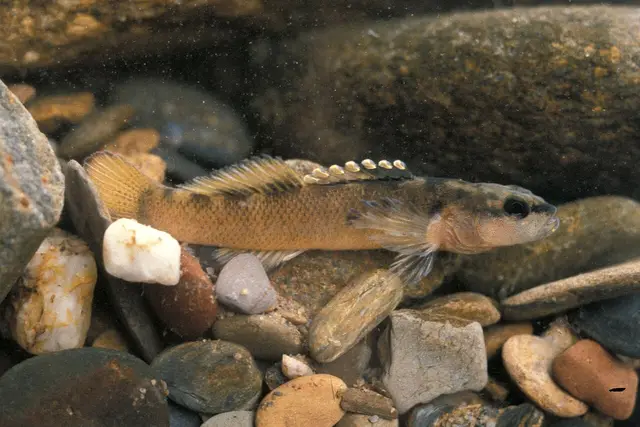
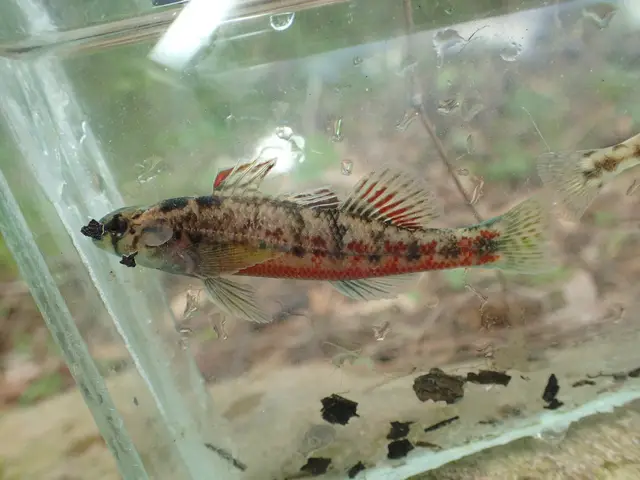
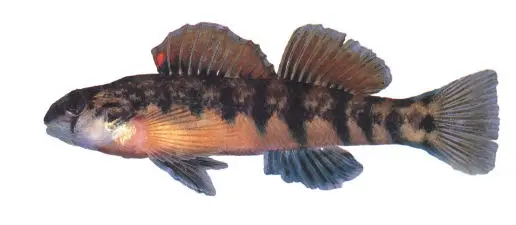
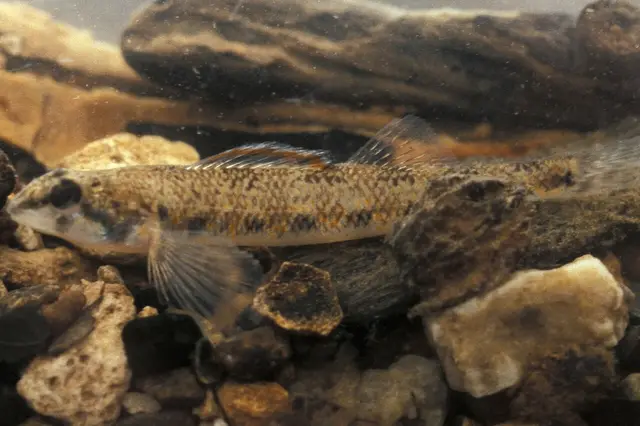
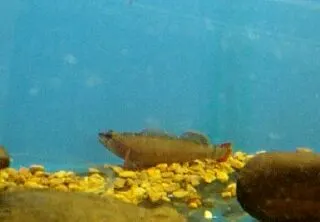
It's a small, laterally compressed fish with a deep body and a moderately sharp snout, grayish brown with darker saddles and bars on the back and sides. Breeding males are the showy ones, with a bright blue or turquoise throat and breast and a light green belly. Breeding females have orange or red-orange spots but are duller.
Size depends on the source and on how the fish is measured. The U.S. Fish and Wildlife Service gives a maximum standard length of about 6.4 cm (2.5 in), while another reference gives up to 7.2 cm (2.8 in) total length, with most fish around 4.9 cm. Edward Raney and Royal Suttkus described the species in 1964 from Devils Fork in Cleburne County, and it is named for the ichthyologist George A. Moore.
Where it lives
This darter occurs nowhere else in the world but Arkansas. It lives in the Little Red River and its four main forks: Devils, Middle, South and Archey, in Cleburne, Searcy, Stone and Van Buren Counties. It wants clear, high-gradient headwater streams with year-round flow, moderate to strong riffles, and loose gravel, rubble or boulder bottoms with little silt. Seasonal drying seems to limit where it can live. The IUCN put its extent of occurrence at 1,000 to 2,000 square kilometres in 2013.
Dam construction in 1962 flooded much of the historic range as Greers Ferry Lake, leaving the fish in isolated reaches above it. It disappeared from the lower reaches of Devils, Middle and South forks, and cold water released below the dam removed it from the river downstream.
Pins are Wikidata “endemic to” fields. Orange dots, when present, are GBIF occurrence tiles — survey bias included.
How it lives
Yellowcheek darters feed on the larvae of aquatic flies and stoneflies, mayfly nymphs and caddisfly larvae. Males and females mature at about one year old. Spawning runs from mid-May through June in swift to moderately swift riffles. The eggs hatch within 16 days of being laid, and the longest-lived fish reach roughly five years.
Why it is in trouble
The IUCN gave the species a decreasing trend in its 2013 assessment. It names sediment from soil erosion and nutrient loading as ongoing threats affecting most of the range (50 to 90 percent). Dams, surface water abstraction (including for agriculture) and oil and gas drilling are also listed, with the scale unknown. The U.S. Fish and Wildlife Service adds contaminants from ranching, forestry, natural gas operations and development, plus gravel mining and channel instability. Climate change may alter headwater stream flows, though the extent has not been quantified.
What is being done
The U.S. Fish and Wildlife Service listed the darter as endangered on August 9, 2011, and on October 16, 2012 designated critical habitat covering 102 river miles (164 km) in Cleburne, Searcy, Stone and Van Buren Counties. A draft recovery plan was published for comment in March 2017. It would reclassify the fish as threatened once natural, self-sustaining populations in the Middle, South and either Archey or Devils Fork stay stable or increasing for 15 years, with surveys every three years, and once a captive breeding, augmentation and reintroduction plan is in place.
Sources
Written for this catalog in our own words from the sources below, checked against them on 12 November 2026. Population figures are estimates and carry the year they were made. Status and assessment year: IUCN. 2026. The IUCN Red List of Threatened Species. Version 2026-1. iucnredlist.org.