Endangered
Cherokee darter
Etheostoma scotti
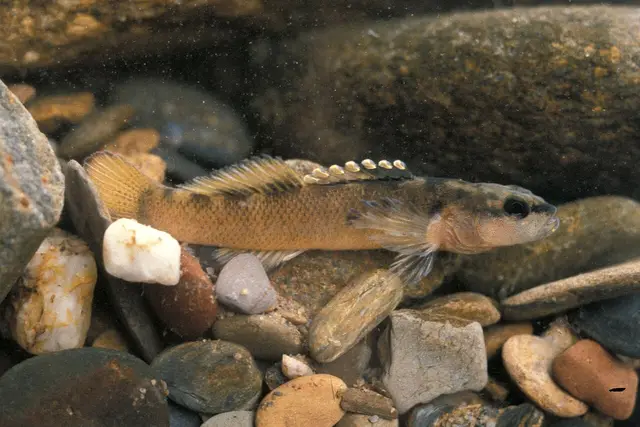
The Cherokee darter (Etheostoma scotti) is a small, speckled stream fish found only in the Etowah River system of north Georgia. The IUCN Red List rated it Endangered in 2013, with a decreasing population. It lives in clear, rocky creeks and seldom lives past two years.
How to recognise it
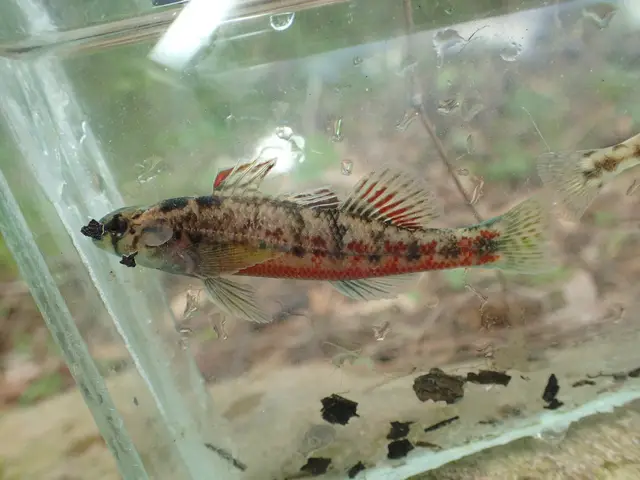
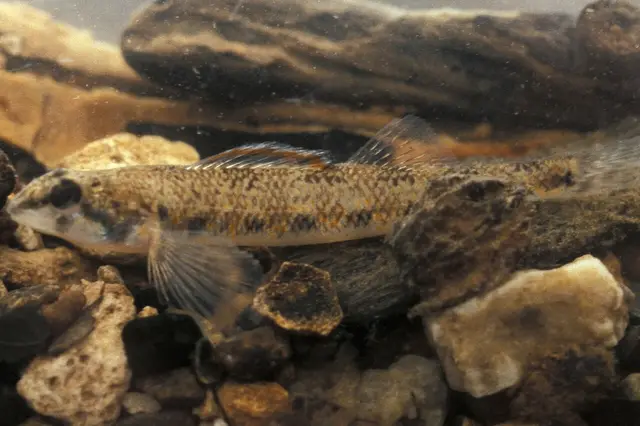
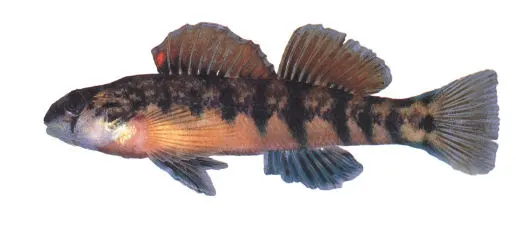
This is a slim, whitish to yellowish fish, and males top out at about 5 cm. Its sides carry olive-green and black blotches that stretch into short bars in breeding fish, and its back has about eight dark saddle-shaped marks.
It was long mistaken for the Coosa darter. One difference is that breeding Cherokee darter males never show five separate colour bands in the first dorsal fin. The species was formally described in 1995.
Where it lives
Nowhere outside the Etowah River basin in Georgia. It occurs in about 20 small to moderately large tributary systems of the middle and upper river in the north of the state.
It favours warm, clear creeks with gravel, cobble and small boulders, usually in runs just above and below riffles. It is rarely found over bedrock or sand and does not tolerate heavy silt or still water. Allatoona Reservoir splits the range in two, and the largest populations sit in northern tributaries above the lake.
Pins are Wikidata “endemic to” fields. Orange dots, when present, are GBIF occurrence tiles — survey bias included.
How it lives
A study of Hickory Log Creek sampled the fish monthly from February 2007 to January 2008. Midge larvae made up about 80 percent of the food items found in guts, with snails, small crustaceans, mayfly larvae and caddisfly larvae making up much of the rest.
Spawning peaks in April and appears to run from March to May. Females carried between 2 and 256 mature eggs each (average 69), and the eggs are laid in gravel. Fish mature at about one year and the oldest in that study was two. Of 228 fish caught, 82.5 percent were one year old, so a poor breeding year could hit a local population hard.
Why it is in trouble
Dams and impoundments have removed flowing habitat. Silt from erosion, farming and urban growth smothers the clean gravel it needs, and nutrient loads and pollution add to the pressure. The Red List records these threats as ongoing and the population as decreasing.
Few of the remaining populations are large or healthy. When the Hickory Log Creek study was published in 2010, the population there was due to be lost to a water-storage reservoir.
What is being done
The U.S. Fish and Wildlife Service listed the species as threatened under the federal Endangered Species Act on 20 December 1994. The Red List records a recovery plan and conservation sites identified over part of the range, and names habitat protection, restoration and species recovery as needed actions.
A 2008 review by Jelks and colleagues treated the fish as three distinct populations, each considered endangered.
Sources
Written for this catalog in our own words from the sources below, checked against them on 12 November 2026. Population figures are estimates and carry the year they were made. Status and assessment year: IUCN. 2026. The IUCN Red List of Threatened Species. Version 2026-1. iucnredlist.org.