Endangered
Koyna toad
Xanthophryne koynayensis
The Koyna toad is a small toad with yellow patches on its flanks, known only from the Koyna area of Maharashtra, in India's Western Ghats. The IUCN Red List rated it Endangered in 2023. It breeds in rain-filled pools on rock, and tourism, quarrying and renewable energy projects threaten its habitat.
How to recognise it
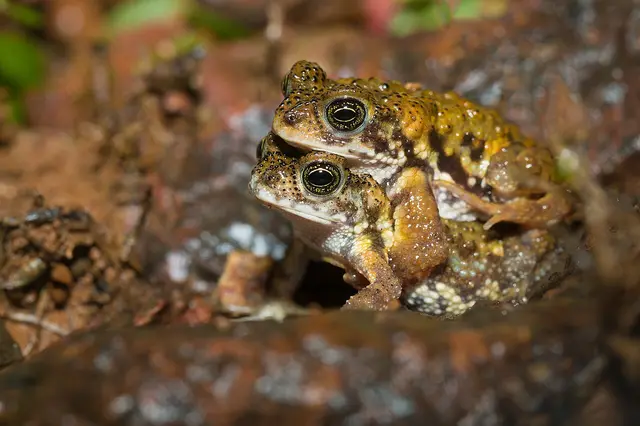
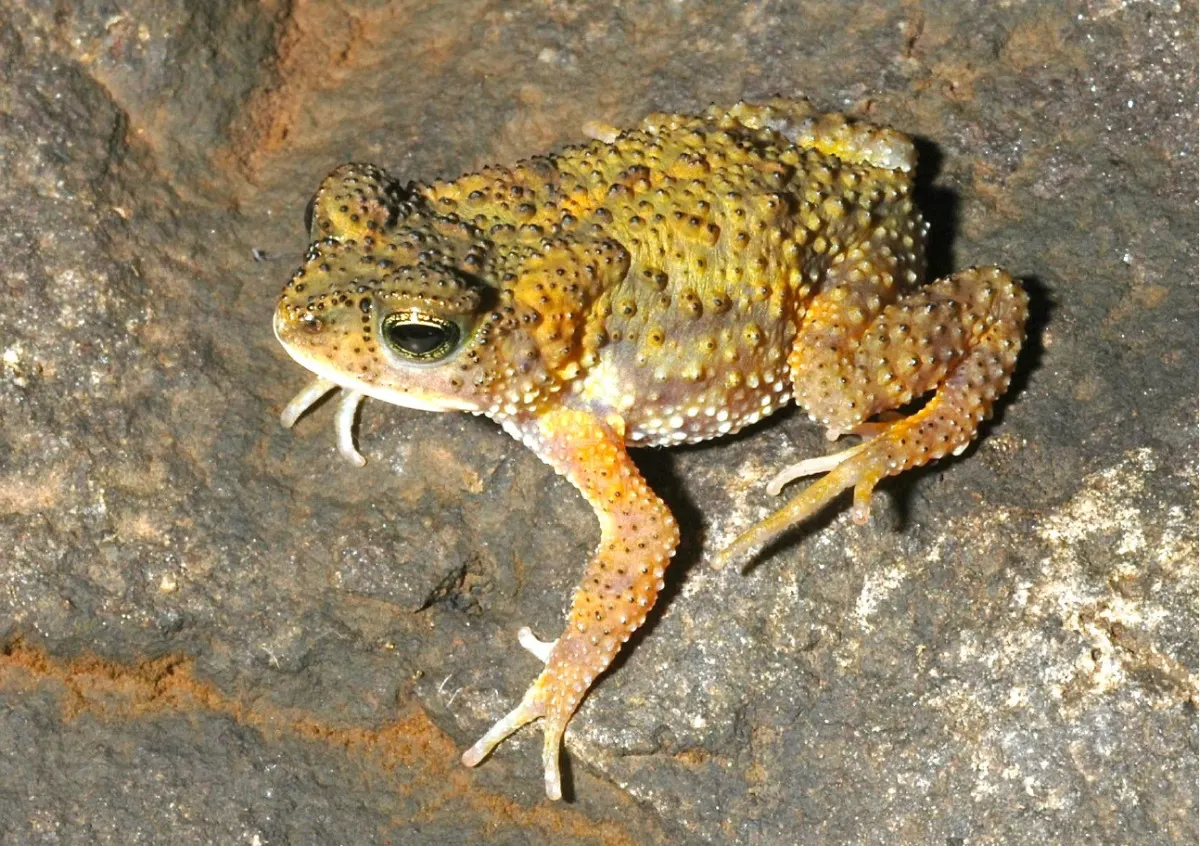
This is a small toad. Adult males measure roughly 24 to 33 mm from snout to vent, and the few females measured in the original genus study were slightly larger, at 33 to 35 mm. The back is brown, with a dull chrome-yellow wash, and bright yellow patches show on the flanks and sides of the belly. Small black-tipped warts cover the skin, the eardrum is hard to see, and the fingers and toes have no webbing.
It has gone by several names. It was first described as Bufo koynayensis in 1963, and the same museum material was described again in 1964 as Bufo sulphureus, which is now treated as a junior synonym. Later it sat in the genus Xanthophryne, and it is now the type species of Beduka.
Where it lives
The species is endemic to the Western Ghats of India and is known only from the Koyna area of Maharashtra, including Koyna Wildlife Sanctuary. The type locality is at Shivaji Sagar lake, near Humbarli village. The IUCN counts six locations, lying between about 800 and 1,300 m above sea level, and puts the extent of occurrence at roughly 722 square km.
Its Red List habitats are moist evergreen forest at lower and higher elevations, plus rocky ground such as cliffs and outcrops.
Pins are Wikidata “endemic to” fields. Orange dots, when present, are GBIF occurrence tiles — survey bias included.
How it lives
A 2016 study in the Journal of Natural History looked at this toad and its only living relative in the genus, Xanthophryne tigerina of Amboli. It found that both are tied to lateritic rock outcrops at mid elevations in high-rainfall country. Breeding comes in sporadic bouts of 2 to 4 days in the early monsoon. Males were seen using a pelvic thrusting display that the study called new to frogs and toads.
Females lay in shallow pools in hollows of the rock, where the tadpoles also develop. The pools dry out fast when the rain breaks, so females may spread their eggs across several clutches and the tadpoles metamorphose quickly.
Why it is in trouble
The IUCN lists tourism and recreation areas, mining and quarrying, renewable energy projects and habitat alteration as ongoing threats. It describes the population as decreasing and severely fragmented, with the habitat still shrinking. No total population count has been published.
What is being done
The species occurs inside at least one protected area, and the IUCN calls for site protection and wider resource and habitat protection. Population trends and habitat trends are listed as research needs.
Sources
Written for this catalog in our own words from the sources below, checked against them on 12 November 2026. Population figures are estimates and carry the year they were made. Status and assessment year: IUCN. 2026. The IUCN Red List of Threatened Species. Version 2026-1. iucnredlist.org.