Endangered
White-winged Guan
Penelope albipennis
The white-winged guan is a large, dark game bird found only in the dry forests of northwestern Peru. The IUCN Red List rated it Endangered in 2018, down from Critically Endangered, with about 200 mature birds. It carries a white slash on each wing and a bare orange throat.
How to recognise it
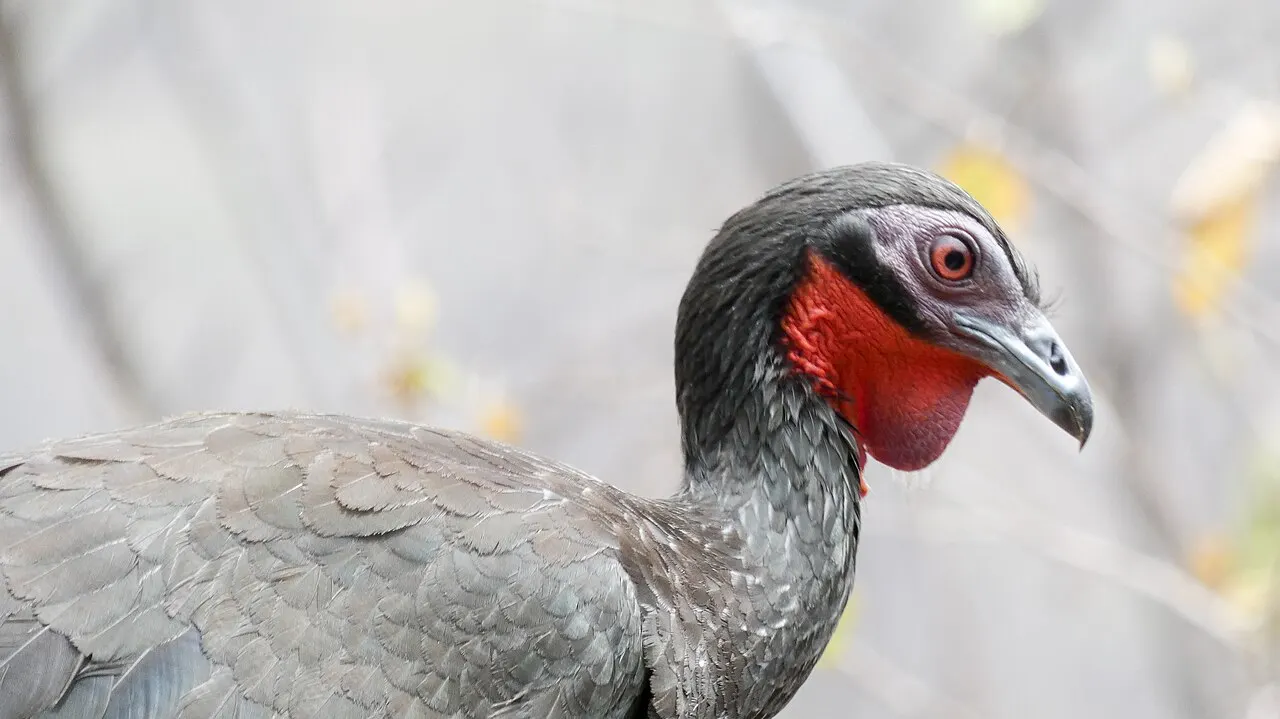
This is a big, long-tailed bird, around 85 cm from bill to tail and roughly 1.6 kg. The plumage is blackish brown with a green sheen, and the neck and upper breast have pale flecks. The bare skin around the reddish eye is purple, the throat is orange-red with a double-lobed dewlap, and the bill is blue-grey with a black tip.
The name comes from the white flight feathers, which show as a white slash along the folded wing. Its voice is a very deep, hoarse call at dawn and in the breeding season, and a sharper repeated call that can carry for about 3 km.
Where it lives
The species is endemic to northwestern Peru and is recorded in the regions of Lambayeque, Cajamarca and Piura. The Red List puts its extent of occurrence at about 4,400 square km and counts 6 to 10 locations, split between 2 severely fragmented subpopulations.
It lives in tropical dry forest, mostly in small wooded ravines and on the slopes beside them on the Pacific side of the Andes. Records run from about 300 to 1,385 m above sea level.
Pins are Wikidata “endemic to” fields. Orange dots, when present, are GBIF occurrence tiles — survey bias included.
How it lives
Guans are usually seen in pairs or family groups. They feed on fruit, flowers, leaves and seeds, and fig trees and the fruit of Cordia lutea are key foods because they are available through most of the year. The birds call before dawn, feed until about 9 am, rest through the day, then feed again in the late afternoon before roosting.
Pairs hold territories and stay together across years. Nesting runs from November to May, during the rains. The nest is a platform of twigs and leaves in a vine-covered tree about 2.5 m up, and the clutch is one to three eggs, usually two.
Why it is in trouble
The Red List records small-holder farming as an ongoing pressure on the dry forest and mining as a threat expected in future. It also records use of the bird for food and for the pet and display trade. The species was known from three specimens collected in 1876 and 1877 and was not positively seen again until 1977.
Population estimates have varied a lot. A 1987 census counted 82 birds and a 1997 estimate gave fewer than 300. A 2003 article on one community reserve claimed 350 wild birds, while the 2018 Red List assessment puts the total at about 200 mature individuals and calls the trend stable. It was listed as Critically Endangered from 1994 until 2016.
What is being done
A captive breeding centre at Olmos, Lambayeque, supplies birds for release. Between September 2001 and July 2003, 20 captive-bred guans were released in the Chaparrí Private Conservation Area (34,412 hectares of land owned by the Santa Catalina de Chongoyape community). Two years after release, 55 percent had survived and three chicks had hatched in the wild to released parents.
The Red List records a recovery plan, protected-area coverage and community education as actions in place. Awareness campaigns, captive breeding, site protection and livelihood alternatives are listed as conservation actions. The guan is also on CITES Appendix I, the strictest trade category.
Sources
Written for this catalog in our own words from the sources below, checked against them on 12 November 2026. Population figures are estimates and carry the year they were made. Status and assessment year: IUCN. 2026. The IUCN Red List of Threatened Species. Version 2026-1. iucnredlist.org.