Critically Endangered
Vieira's titi
Plecturocebus vieirai
Vieira's titi (Plecturocebus vieirai) is a small, long-tailed monkey from the southern edge of the Amazon in north-central Brazil. Scientists described it only in 2012. The IUCN rated it Critically Endangered in 2022, because the forests it depends on are being cleared and burned at speed.
How to recognise it
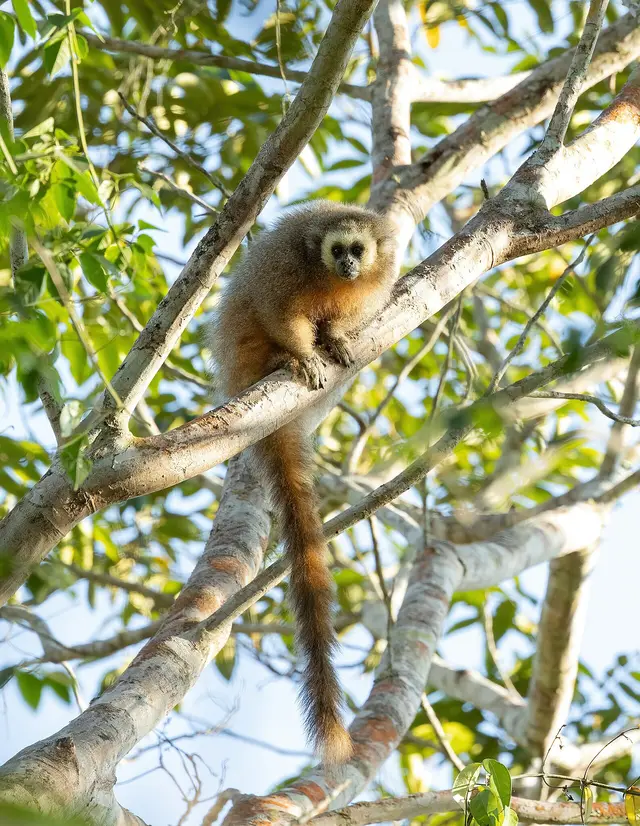
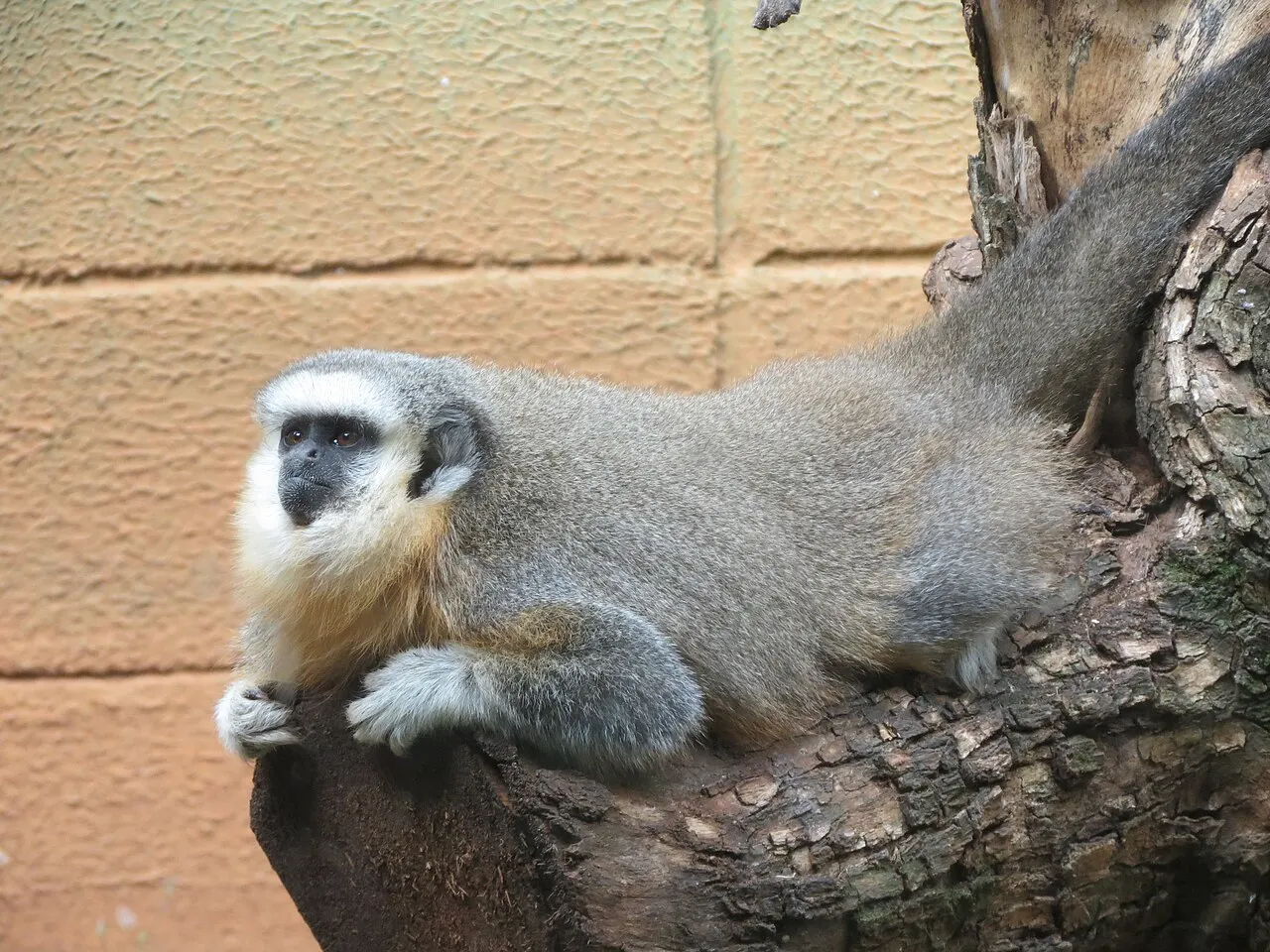
It's a stocky titi with thick, grizzled grey fur flecked with rust. The chest, belly and inner limbs are pale orange, and the hands, feet and tail tip are white. The face is black and hairless, framed by a white ruff.
Adults weigh just under 1 kg, with a head and body about 30 to 45 cm long and a tail of roughly 41 to 51 cm. Males and females look alike.
Where it lives
The species is found only in the Brazilian states of Mato Grosso and Pará. It was described in 2012 by Gualda-Barros, Nascimento and Amaral. A 2022 study in Oryx put its range at about 226,000 square kilometres, with the Xingu River as the eastern limit and the Cristalino and Teles Pires rivers to the west.
It lives in lowland moist forest at roughly 200 to 370 metres, including mature, secondary and degraded forest and Amazonia-Cerrado transition forest. It's often found near streams where moriche palms grow.
Pins are Wikidata “endemic to” fields. Orange dots, when present, are GBIF occurrence tiles — survey bias included.
How it lives
Very little has been studied about this species, and much of what is known is drawn from other titis, so read these details as typical rather than fully documented. Titis are tree dwellers active by day. Groups are small, usually a mated pair and their young and no more than four animals, and they defend territories with loud calls.
Fruit makes up most of the diet, with leaves, flowers and some insects. Titi monkeys generally have one infant after about five months of gestation, and the father does most of the carrying and caregiving after nursing.
Why it is in trouble
Vieira's titi lives in the Arc of Deforestation, where forest is converted to crops and cattle pasture. The Oryx study, led by Rodrigo Costa-Araújo, found forest cover in its range was about 90 percent in 1985 and projected it to fall to about 30 percent by 2044. It also modelled suitable habitat, with about 56 percent of the original area remaining and a projected 14 percent by 2044. Climate change is expected to degrade habitat further, including inside protected areas.
The IUCN assessment rates it under criterion A3, a projected population decline of about 80 percent, and lists a decreasing population with continuing declines in area and subpopulations. Housing and roads are also named as threats. Transect surveys covering 1,192 km found 78 groups, but no total population has been estimated.
What is being done
The Oryx authors recommend giving priority to the southern part of the range, where most forest is on private land. They also call for demarcating Indigenous lands, creating more protected areas, enforcing the legal requirement that private landowners keep 80 percent of their forest, and developing primate-watching tourism as an alternative to farming and ranching. The IUCN lists site protection, habitat restoration and awareness as needed conservation actions.
Sources
Written for this catalog in our own words from the sources below, checked against them on 12 November 2026. Population figures are estimates and carry the year they were made. Status and assessment year: IUCN. 2026. The IUCN Red List of Threatened Species. Version 2026-1. iucnredlist.org.