Endangered
Verlorenvlei redfin
Pseudobarbus verloreni
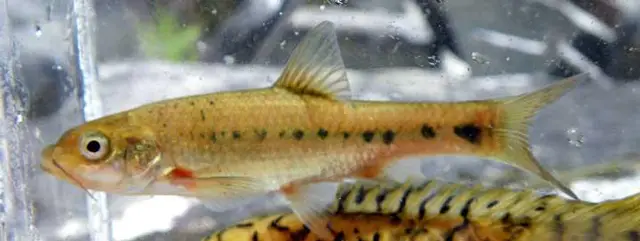
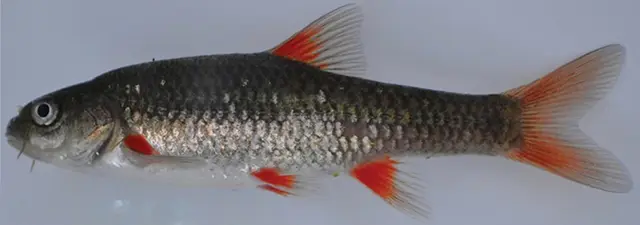
The Verlorenvlei redfin (Pseudobarbus verloreni) is a small, golden-tan barb found only in the Verlorenvlei river system on South Africa's west coast. It was described as its own species in 2014 and rated Endangered by the IUCN Red List in 2017. It has probably disappeared from part of its original range.
How to recognise it
It is a small barb. The largest fish in the original study was 70.8 mm long (standard length), and the smallest was 34 mm. In life the body is golden tan on the back and sides and silver underneath, and some adults have pale red or yellow-orange at the base of the fins. Preserved fish show fine linear speckles above and below the lateral line.
Two pairs of mouth barbels place it among the redfins, but the front pair is minute, much smaller than the eye. It also has a deeper body, a shorter snout and a longer gut than its close relatives, and the gut is the longest of any Pseudobarbus species examined.
Where it lives
The fish is confined to the Verlorenvlei system on the Western Cape coast. The IUCN counts one location, three subpopulations, an extent of about 329 square km and an area actually occupied of roughly 40 square km (2017 assessment).
This is lowland river country with a gentle gradient. Flow is slow to moderate, the water is turbid in winter, and in the dry season the river breaks up into separate pools over sand, silt and mud.
Pins are Wikidata “endemic to” fields. Orange dots, when present, are GBIF occurrence tiles — survey bias included.
How it lives
Very little is recorded about its habits. Spawning is possibly from October to December, an inference drawn from related redfins, because only one fish in the original study showed breeding tubercles (just four) and nobody has sampled during the breeding season.
The fish was long treated as part of the Berg River redfin. A 1988 study reportedly found differences in gut and body proportions, and DNA work published in 2000 reportedly put the isolation at roughly 0.5 to 2.3 million years. A 2014 paper in ZooKeys by Chakona, Swartz and Skelton described it as a new species from 47 specimens, with the type collected on 13 March 2012 near the Het Kruis bridge.
Why it is in trouble
Two juvenile redfins from the Langvlei River, another part of the system, were collected in 1986, but none turned up in surveys between 2001 and 2012, and the species is probably gone there. The remaining range is small and holds a single location.
The IUCN lists introduced species, groundwater abstraction, sediment washing into the river, and damage from recreation and tourism development. The 2014 paper names black bass as predators and banded tilapia, Mozambique tilapia and common carp as competitors in the system. It also identifies water withdrawal for farming as a major threat and cites proposed mining in the catchment.
By early 2021 the Verlorenvlei itself held only a few small patches of open water, according to Daily Maverick. A conservation group blamed excessive abstraction for agriculture, while the conservation authority CapeNature pointed mainly to drought.
What is being done
The IUCN reports that conservation sites have been identified over part of the fish's range. Its list of conservation actions includes habitat restoration, species recovery, a genome resource bank, site protection and management, and awareness and training. The describers note that most protected areas in the region cover uplands where the redfin does not live, and they suggest sanctuaries, removal of alien fish and barriers to stop them returning.
Sources
Written for this catalog in our own words from the sources below, checked against them on 12 November 2026. Population figures are estimates and carry the year they were made. Status and assessment year: IUCN. 2026. The IUCN Red List of Threatened Species. Version 2026-1. iucnredlist.org.