Endangered
Eastern Cape Redfin
Pseudobarbus afer
The Eastern Cape redfin (Pseudobarbus afer) is a small minnow with bright red fin bases, living in three river systems that run into Algoa Bay in South Africa. The IUCN Red List rated it Endangered in 2017. Introduced predatory fish are its biggest problem.
How to recognise it
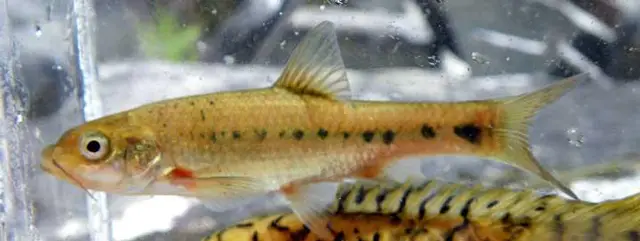
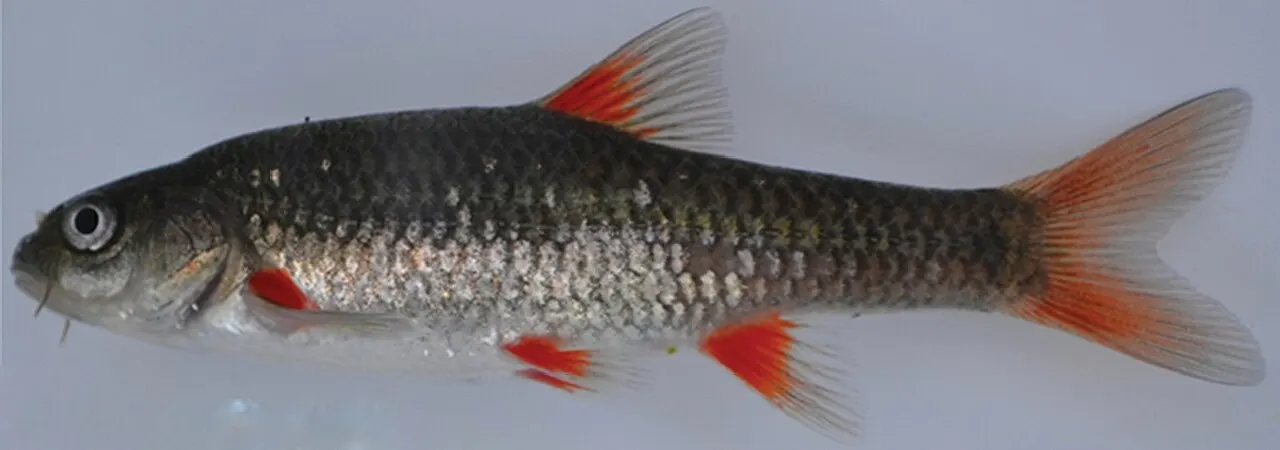
Live adults have a dark grey-black back, silvery white sides and belly, and red at the base of the fins. A faint dark band runs along each side, and each scale carries a net-like pattern of pigment. There is one pair of short barbels, no stripe down the back and no heavy black spotting.
Specimens measured in the 2017 review ranged from 43 to 82 mm, and the original type specimens were roughly 78 to 92 mm. Breeding males grow small conical tubercles on the snout and head, usually two to four in each snout cluster.
Where it lives
A 2017 ZooKeys review by Chakona and Skelton found four deeply divergent lineages inside what was called Pseudobarbus afer. The name now applies only to fish of the Sundays, Swartkops and Baakens river systems, which drain into Algoa Bay near Port Elizabeth. Redfins from other rivers are treated as different species, including the Gamtoos redfin (P. swartzi) and the Krom redfin (P. senticeps).
The remaining populations are fragmented and persist mostly in a few less degraded upland tributaries. Specimens for the redescription came from the Swartkops system, in the Groendal Wilderness, among other sites. The IUCN estimates an area of occupancy of 56 square km, an extent of occurrence of 2,183 square km and eight subpopulations, and lists permanent rivers and streams, and seasonal marshes and pools, as habitat.
The streams where the three related redfins live are clear, acidic and rocky, with big swings in temperature and flow between winter and summer.
Pins are Wikidata “endemic to” fields. Orange dots, when present, are GBIF occurrence tiles — survey bias included.
How it lives
Young fish reportedly form large shoals while adults gather in smaller groups. The redfin is described as an omnivore that grazes algae from the bottom and takes small invertebrates. It reportedly breeds in summer, laying eggs in riffles above pools.
Why it is in trouble
The IUCN counts only three locations, calls the population severely fragmented and records a continuing decline. The 2017 review names invasion by alien fish as the single most important threat, with worsening water quality and loss of critical habitat adding to it. The IUCN also lists drought. Introduced bass of the genus Micropterus are reportedly among the predators and competitors.
The Baakens catchment is heavily urbanised and holds non-native fish such as Tilapia sparrmanii and Pseudocrenilabrus philander. The review calls the redfin's long-term survival there uncertain and asks for urgent surveys to find out whether it still lives there.
What is being done
The IUCN lists site management, action at provincial and national levels, awareness work and species recovery as conservation measures, and records no formal recovery plan in 2017. The 2017 review calls for immediate intervention for the group of related redfins and for fine-scale surveys of the remaining rivers.
Sources
Written for this catalog in our own words from the sources below, checked against them on 12 November 2026. Population figures are estimates and carry the year they were made. Status and assessment year: IUCN. 2026. The IUCN Red List of Threatened Species. Version 2026-1. iucnredlist.org.