Critically Endangered
Burchell's Redfin
Pseudobarbus burchelli
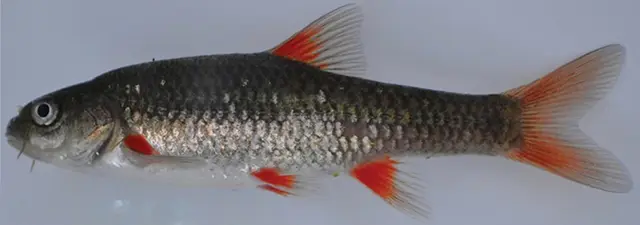
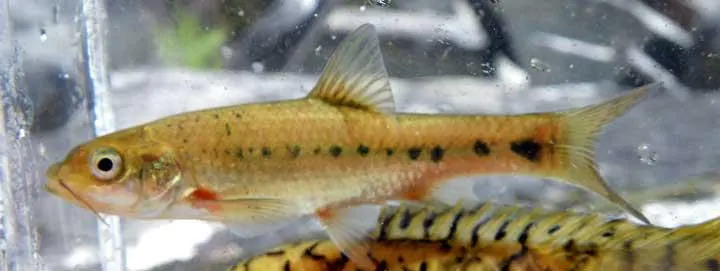
Burchell's redfin (Pseudobarbus burchelli) is a small minnow-family fish from rivers of South Africa's Western Cape. The IUCN Red List rated it Critically Endangered in 2017, under the name Barrydale redfin, for the form confined to the Tradouw River catchment. Introduced predatory fish are its biggest problem.
How to recognise it
It's a small minnow in the carp family (Cyprinidae). FishBase gives a maximum length of 13.5 cm (standard length) for males of the species as a whole, and a maximum age of 6 years.
It is the type species of the genus Pseudobarbus and, like its relatives, is tetraploid, carrying four sets of chromosomes. The Berg River redfin (P. burgi) is a very close relative. The species name honours the English explorer-naturalist William John Burchell. It has also been called the Tradouw, Tradou or Breede redfin.
Where it lives
The Red List assessment records the fish only from South Africa's Western Cape, in permanent rivers and streams, from a single location. It gives an extent of occurrence of about 40 square km, an area of occupancy of about 20 square km, and two to three subpopulations. Two populations are known with certainty: one in the Moeras River at Barrydale and one in the Tradouw River at Tradouws Pass.
Taxonomy is unsettled. A 2024 paper in the African Journal of Aquatic Science describes the Tradouw fish as a novel, range-restricted lineage within the Breede River redfin. Whether similar fish in the Breede and Heuningnes rivers are the same species is undetermined, so older accounts that place the species across the wider Breede system may describe other lineages.
Pins are Wikidata “endemic to” fields. Orange dots, when present, are GBIF occurrence tiles — survey bias included.
How it lives
Redfins live in pools and deeper flowing stretches of rivers, often where the water is slightly peat-stained. They feed on detritus and small organisms, usually taken from the bottom. Young fish form large shoals, while adults occur in small groups. Breeding takes place in summer. The diet, shoaling and breeding details come from FishBase and describe the species broadly, not only the Tradouw fish.
Low summer water levels cut off the Moeras and Tradouw populations from each other, so little or no gene flow passes between them.
Why it is in trouble
Introduced fish are the main threat. Smallmouth bass are expanding through the region and reportedly wipe out redfin stocks as they spread. In the Witte River, another Breede tributary, a preliminary study led by Jeremy Shelton compared sites above and below a 2 m waterfall that stops bass moving upstream. Breede River redfin were abundant above it and nearly absent below. Banded tilapia and bluegill sunfish are also reported in the redfin's range.
A study that monitored the Tradouw fish each year from 2012 to 2016, published in 2024, found the population highly fragmented, mainly because of invasive fish and poor land use. Redfin numbers stayed stable only in a river section the alien fish had not reached. Water abstraction and pollution are described as widespread threats whose effects on the redfin still need investigation.
The IUCN's threat list includes housing and commercial development, sewage, soil erosion and sedimentation, and surface water taken for farming. It records the population trend as decreasing, with extreme fluctuations in numbers and in the area occupied.
What is being done
The Red List assessment records an action recovery plan and a systematic monitoring scheme as in place, along with recent education and awareness programmes. It lists site protection and management, habitat restoration and a genome resource bank among the actions needed. The 2024 study notes that the taxon's long-term survival is uncertain.
Sources
Written for this catalog in our own words from the sources below, checked against them on 12 November 2026. Population figures are estimates and carry the year they were made. Status and assessment year: IUCN. 2026. The IUCN Red List of Threatened Species. Version 2026-1. iucnredlist.org.