Endangered
Tympanocryptis wilsoni
Tympanocryptis wilsoni
The Roma earless dragon (Tympanocryptis wilsoni) is a small to medium-sized grassland lizard known only from native grassland around the town of Roma in Queensland, Australia. It was described as a species in 2014. The IUCN's 2017 assessment lists it as Endangered.
How to recognise it
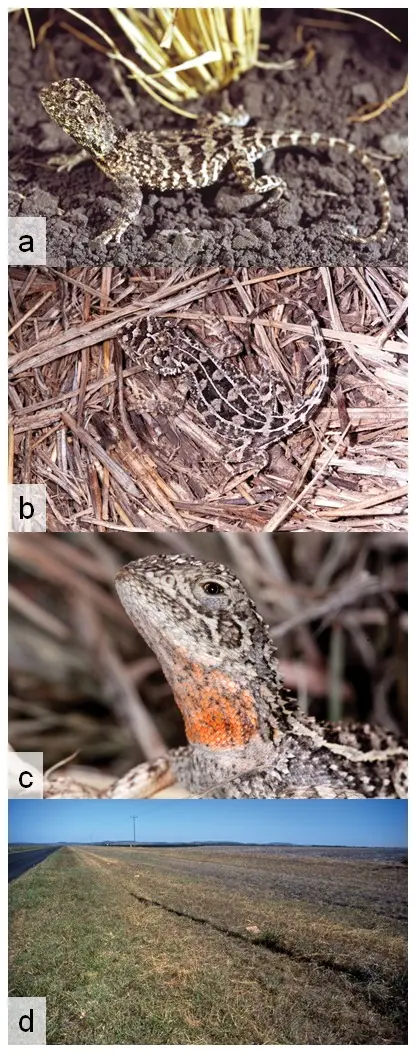
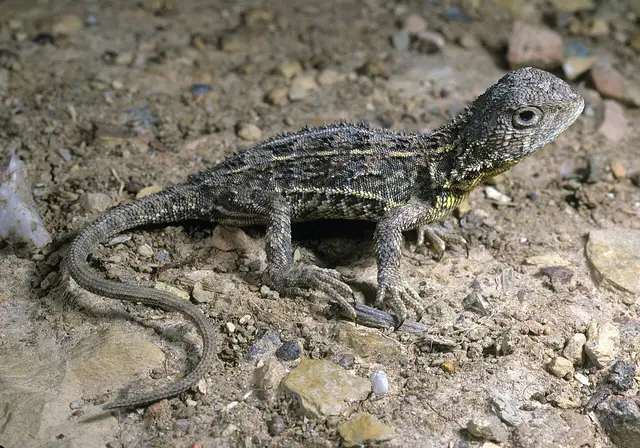
It's one of the earless dragons, a group of small Australian lizards with no visible ear opening, and it was separated from its relatives by scale counts and body patterning. The Roma species is heavily flecked with brown-black on its sides and underside, most densely on the head, throat and upper chest. It lacks the pale stripe along the flank seen in some relatives, and three pale spots sit on top of the snout.
Its back scales are a mix of smooth, weakly keeled and strongly keeled ones. It has no femoral pores (small pores on the thighs) and two preanal pores.
Where it lives
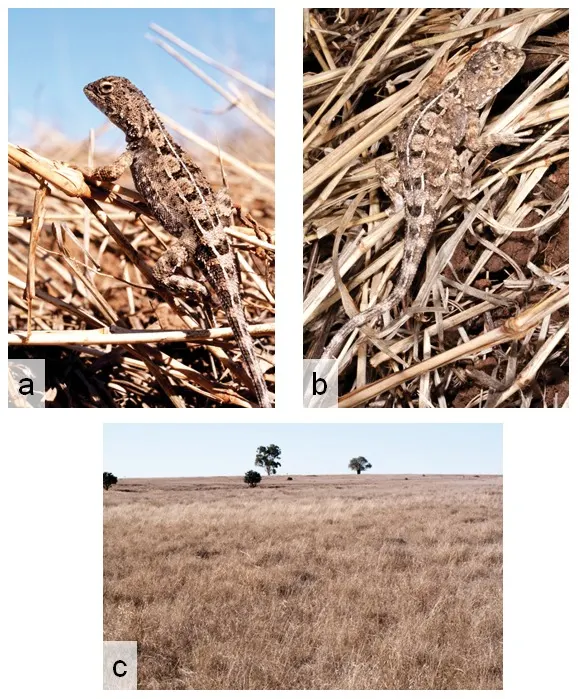
The known range runs from Hodgson, about 20 km west of Roma, to Mount Abundance, about 50 km south-west. The type locality is on Mount Abundance Road, roughly 40 km south-west of Roma. The lizard lives in grassland on sloping ground in the western Darling Downs, where Mitchell grasses dominate.
The IUCN estimates its extent of occurrence at about 1,820 km2 and counts the whole population as a single location. It lists subtropical and tropical dry grassland as the habitat, and also arable land.
Pins are Wikidata “endemic to” fields. Orange dots, when present, are GBIF occurrence tiles — survey bias included.
A species recognised late
Earless dragons on the Darling Downs were first assigned to the grassland earless dragon (Tympanocryptis pinguicolla). A 2014 study in PLOS One combined DNA from about 100 new museum tissue samples with published sequences, plus measurements of specimens, and showed they were something else. It described three new species, including this one. Mitochondrial DNA diverged by about 7.2 percent between the eastern and western Darling Downs lineages.
The Roma species is named for the Australian herpetologist Steve Wilson, who found it on a survey, photographed it alive and collected the only voucher specimens. Only two vouchers and two tissue-only samples were known at the time of description, so very little was recorded about it.
Why it is in trouble
The Red List assessment qualifies it as Endangered on its small range, a single location and a continuing decline in the area it occupies. The threats listed are industrial-scale farming, and grazing and ranching. The 2014 study that described it noted that very little native grassland remains in the region, making it one of the most threatened ecosystems in Queensland, and judged the species likely to be of significant conservation concern. The Reptile Database also cites a national review that ranks it among Australia's most threatened reptiles.
The population trend is recorded as unknown, and no population estimate exists.
What is being done
The assessment says no recovery plan is in place, and whether any part of the range lies in a protected area is recorded as unknown.
A University of Queensland project announced in April 2024 covers four threatened Queensland reptiles, including the Roma and Condamine earless dragons. It uses remote cameras, ink pads and trained detection dogs, and works closely with landholders. In early trials a dog found dragons hidden under grass. The effect of invasive cats and foxes on earless dragons is poorly understood, and researchers don't yet know why the dragons survive in some cropped areas and not others.
Sources
Written for this catalog in our own words from the sources below, checked against them on 12 November 2026. Population figures are estimates and carry the year they were made. Status and assessment year: IUCN. 2026. The IUCN Red List of Threatened Species. Version 2026-1. iucnredlist.org.