Endangered
Condamine earless dragon
Condamine earless dragon
The Condamine earless dragon is a small to medium-sized grassland lizard found only on the black clay plains of the eastern Darling Downs in Queensland, Australia. The IUCN Red List classed it as Endangered in 2017. Most of its native grassland is gone, and the lizards now persist on road verges and farmland.
How to recognise it
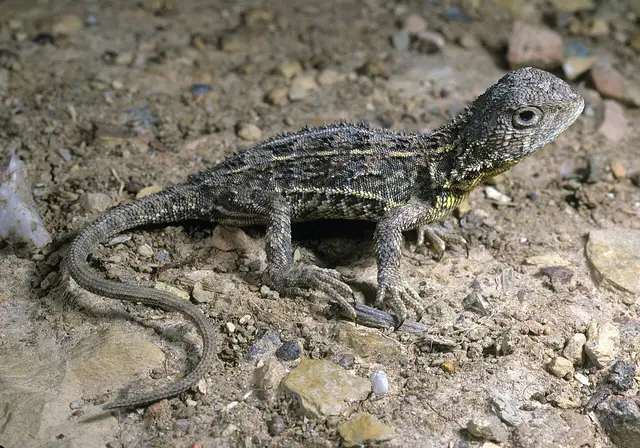
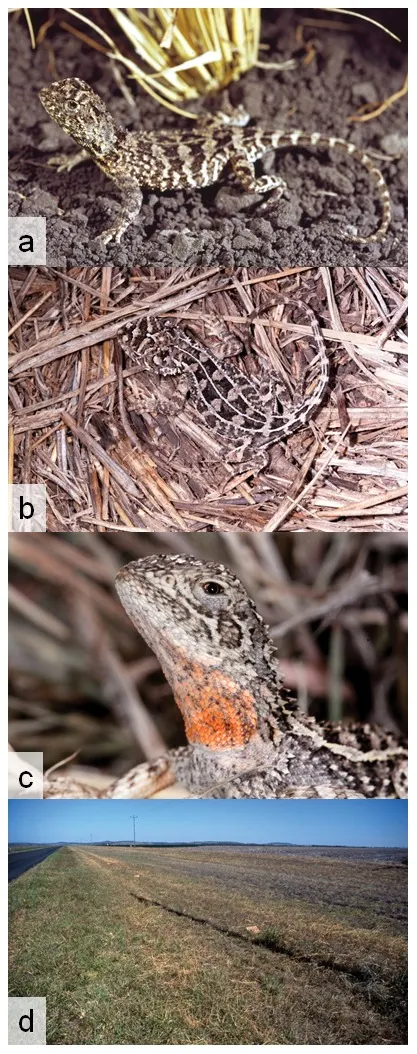
It's a small to medium-sized earless dragon. The animals in the type series measured about 45 to 63 mm from snout to vent. The sides and underside carry strongly contrasting brown-black and white banding and speckling, with the dark speckling heaviest on the head, throat and upper chest.
A narrow white stripe runs along each flank from armpit to groin, another follows the back of the thigh onto the base of the tail, and three pale spots sit on the snout: one above each nostril and one at the tip.
Where it lives
The species is endemic to Queensland. It occurs on the eastern Darling Downs, from the Pirrinuan and Jimbour area in the north to Clifton in the south, west to Dalby and east to the western edge of Toowoomba. Recorded localities include Oakey, Mount Tyson, Brookstead, Bongeen and Bowenville.
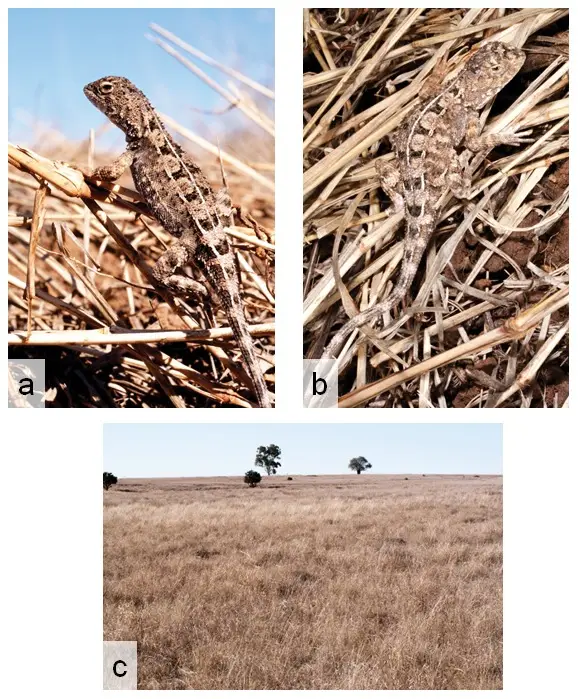
Its home is the black cracking clay of the Condamine River floodplain. Today it's found in patches of surviving native grassland, on road edges and on farmland. The IUCN counts it as occupying a single location, with an extent of occurrence of about 3,219 square kilometres.
Pins are Wikidata “endemic to” fields. Orange dots, when present, are GBIF occurrence tiles — survey bias included.
A species that was overlooked
Wildlife experts first noticed the dragons in the early 2000s while surveying remnant grassy road verges. They were first thought to be a northern outlier of the grassland earless dragon of New South Wales and the Australian Capital Territory. A 2014 study in PLoS ONE by Jane Melville and colleagues used body measurements and DNA to show the Darling Downs animals were a separate species, and named it for the Condamine River.
Its closest relative in that analysis was the Roma-area species Tympanocryptis wilsoni, which differed by about 7.2 percent in a mitochondrial gene. Neither species is thought to overlap with any other earless dragon, and both appear to be restricted to grasslands.
Why it is in trouble
Most of the cracking-clay grassland that once covered the Darling Downs has been converted to farming. A University of Queensland conservation page says less than 5 percent of the original habitat remained in 2016, and that things have worsened since. It links the decline to tilling, insecticide and herbicide spraying, monoculture cropping and expansion onto road verges.
Roads add another danger. Dragons basking on sunny roadside spots face a higher risk of being hit by vehicles, and the IUCN lists roads and railways among the threats. It records the population as severely fragmented and decreasing. A 2021 study in Pacific Conservation Biology ranked the species 13th among reptiles most likely to go extinct by 2040.
What is being done
The IUCN assessment records a recovery plan action and lists site protection, site management and habitat protection among the actions in place or needed. It gives no confirmation that any part of the range lies inside a formal protected area.
Researchers at the University of Queensland's Hidden Vale Wildlife Centre are exploring captive conservation, and the draft national recovery plan recommends captive breeding as a critical action. Local Landcare groups at Mount Tyson and Pittsworth have also run a public education program, and the public can send sightings to the Hidden Vale team.
Sources
Written for this catalog in our own words from the sources below, checked against them on 12 November 2026. Population figures are estimates and carry the year they were made. Status and assessment year: IUCN. 2026. The IUCN Red List of Threatened Species. Version 2026-1. iucnredlist.org.
- IUCN Red List assessment, Condamine earless dragon (2017)
- Wikipedia, Condamine earless dragon
- Melville et al. 2014, PLoS ONE 9(7): e101847
- Reptile Database, Condamine earless dragon
- Hidden Vale Wildlife Centre (University of Queensland), Condamine earless dragon conservation
- Outback Magazine, no-till farming and the Condamine earless dragon