Critically Endangered
Tor remadevii
Tor remadevii
The hump-backed mahseer (Tor remadevii), also called the orange-finned mahseer, is a giant carp found only in the Cauvery (Kaveri) river system of southern India. The IUCN rated it Critically Endangered in 2018, with estimated losses above 90 percent. Anglers have long prized it.
How to recognise it
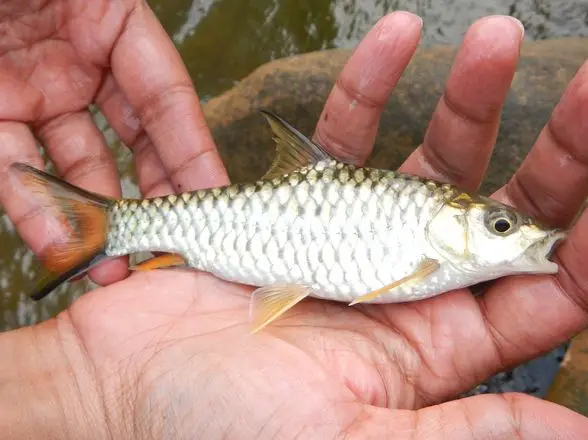
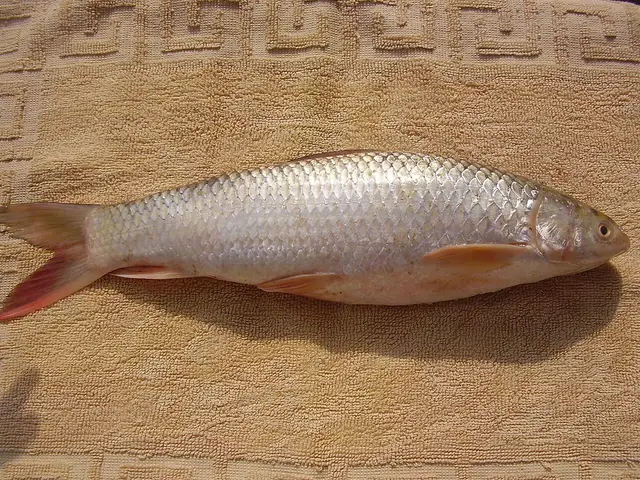
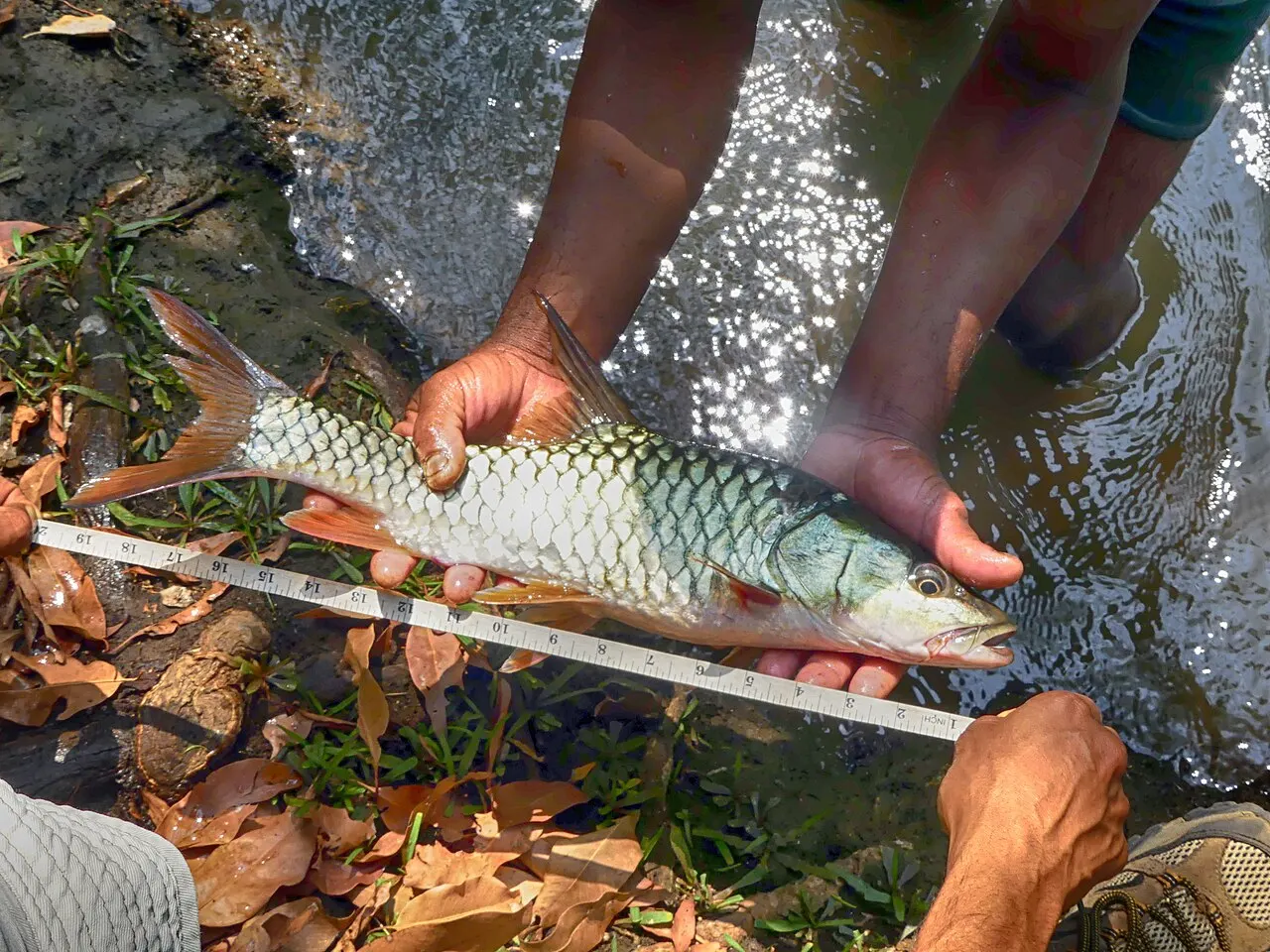
A prominent hump rises behind the head, above the pre-opercle (the bone behind the cheek), and that bone has a distinctive kink. The mouth is at the tip of the snout and the tail fin is bright orange. Those features help tell it from the introduced blue-finned mahseer.
It grows very large. A 2020 study in the Journal of Threatened Taxa measured 90 fish from angler catches in the middle Cauvery between 1976 and 1990 and found fork lengths of 40 to 175 cm and weights up to 45.3 kg. A news account says it can top 1.5 m and 55 kg.
Where it lives
It is endemic to the Western Ghats, restricted to the Cauvery basin in Karnataka, Kerala and Tamil Nadu. The IUCN counts five locations, at about 300 to 900 m above sea level, and records the fish as an altitudinal migrant, so it moves up and down the river system. Its habitat is permanent rivers and streams, including waterfalls, and large reservoirs of more than 8 hectares.
Generation length is about 7 years. The population is severely fragmented, and the IUCN records it as still declining.
Pins are Wikidata “endemic to” fields. Orange dots, when present, are GBIF occurrence tiles — survey bias included.
A fish that went unnamed
Anglers knew this mahseer well, and H. S. Thomas's 1873 book A Rod in India helped popularise it, yet for about 145 years it had no scientific name that conservationists could rely on. A description based on small juveniles from the Pambar River in Kerala was published in the mid-2000s (2006 or 2007, depending on the account), but its link to the big river fish was unclear.
In 2018, Adrian Pinder of Bournemouth University and colleagues published a study in PLOS ONE using field surveys, body measurements, DNA and the original museum type specimens. It showed the hump-backed mahseer is Tor remadevii. Researchers working with local fishers also found a small population in the isolated Moyar River in Tamil Nadu, with DNA unique among known mahseer. The Red List assessment followed that year.
Why it is in trouble
A heavy crash in numbers is reported from around 2004. A 2020 paper in Aquatic Conservation found that before 1993 every mahseer anglers landed was hump-backed, then a blue-finned form appeared and came to dominate the catches. That form is the non-native Tor khudree, which the paper says was introduced in 1976 and stocked periodically from hatcheries. Another account dates its arrival to the 1980s. Researchers link it to the collapse of the native fish.
The IUCN also lists large dams, mining and quarrying, water abstraction for homes, farms and industry, sewage, and small-scale harvest. Dynamite fishing and loss of bankside cover have been blamed as well.
What is being done
The assessment says the whole known range is a conservation site, and roughly 71 to 80 percent of the population is thought to be inside protected areas. The listed actions include harvest management, control of invasive species, habitat restoration, captive breeding, reintroduction and livelihood alternatives, though no recovery plan or systematic monitoring was in place at assessment. India's National Wildlife Action Plan 2017 to 2031 calls for removing Tor khudree and stocking captive-bred hump-backed mahseer.
Sources
Written for this catalog in our own words from the sources below, checked against them on 12 November 2026. Population figures are estimates and carry the year they were made. Status and assessment year: IUCN. 2026. The IUCN Red List of Threatened Species. Version 2026-1. iucnredlist.org.
- IUCN Red List assessment, Tor remadevii (2018)
- Orange-finned mahseer overview
- Pinder et al. 2020, Journal of Threatened Taxa 12(10)
- Down To Earth, What is in a name? Plenty if you are this fish (26 June 2018)
- The News Minute, 16 May 2015
- Pinder et al. 2020, Aquatic Conservation 30 (abstract via Crossref, DOI 10.1002/aqc.3335)