Endangered
Tor malabaricus
Tor malabaricus
The Malabar mahseer (Tor malabaricus) is a large river carp found only in the west-flowing streams of the Western Ghats in southwestern India. The IUCN Red List has rated it Endangered since its 2011 assessment, with the population still decreasing as dams, sand mining, overfishing and stocked look-alikes press in.
How to recognise it
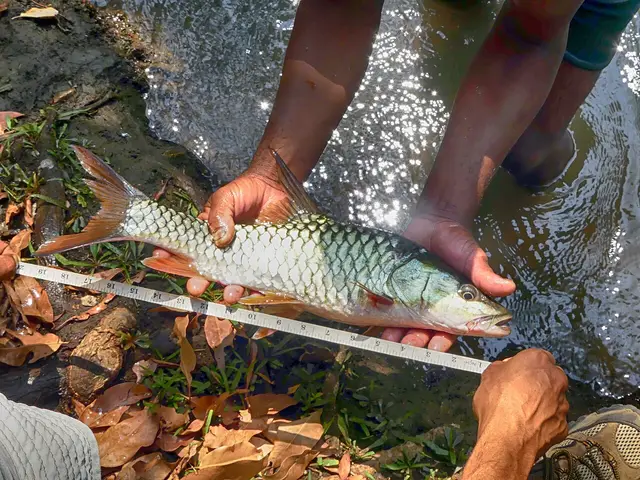
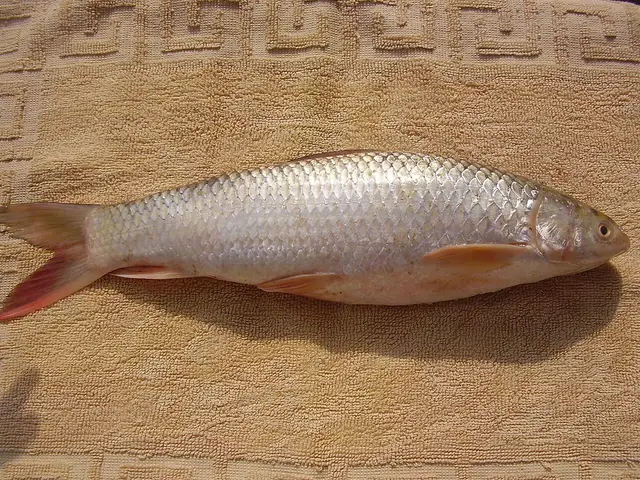
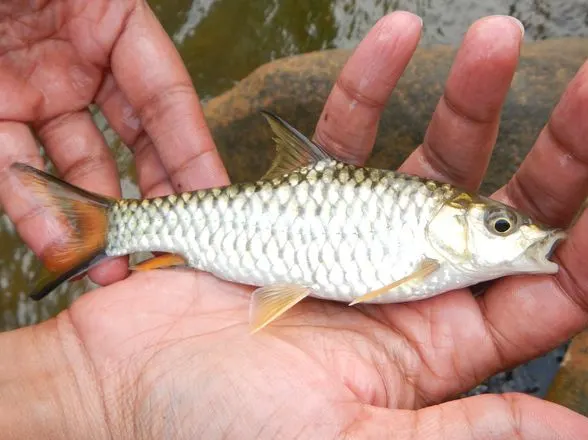
Thomas Jerdon described the fish in 1849. It has a slim, torpedo-shaped body, a large head, large scales and, reportedly, four barbels (whisker-like feelers) at the corners of the mouth. Like other mahseer, it is built for fast, clear water.
Size figures vary. FishBase gives a maximum of about 40 cm total length, while a 2024 study of fish caught in Kerala's Chalakudy River calculated a theoretical maximum near 657 mm. Small ones can be mistaken for young hump-backed mahseer (Tor remadevii), but that species lives only in the east-flowing Cauvery basin, so the two shouldn't meet in the wild.
Where it lives
The Malabar mahseer is confined to the rivers that drain west from the Western Ghats in Karnataka, Kerala and Tamil Nadu. The IUCN lists permanent rivers and streams as its habitat. These western rivers are shorter and faster than the big east-flowing ones, so its migrations are probably shorter than those of other mahseer.
Pins are Wikidata “endemic to” fields. Orange dots, when present, are GBIF occurrence tiles — survey bias included.
How it lives
Little has been recorded about its daily life. By comparison with other mahseer it is probably an omnivore, taking insects and other invertebrates, fruit, plant matter and small fish, and adults likely move upstream to spawn when the water is high. FishBase lists no reproduction data for the species.
The Chalakudy study put its potential lifespan at close to 16 years and found fish were first caught at around 200 mm, which is well short of full size.
Why it is in trouble
The IUCN's threat list for this fish is long. It names large-scale harvesting, mining and quarrying, silt and soil erosion, housing and commercial development, tourism and recreation areas, pesticides and herbicides, and introduced genetic material. Dam building, sand extraction and pollution affect mahseer across the region, and poisoning, dynamite and electrofishing are still used in parts of South Asia.
Fishing pressure is measurable. In the 2024 Chalakudy study, fishing killed fish at a rate of 0.26 per year against a natural death rate of 0.23, which the researchers called unsustainable for that fishery. They suggested closed seasons during spawning, mesh size rules and quotas for local tribal fishers.
Stocking is a quieter problem. Fish of a related species, Tor khudree, brought in from Maharashtra, are being released into rivers that held the Malabar mahseer, where they compete with native stocks. At Shishila in Karnataka, fish in a temple pool that were poisoned in 1996 were probably Malabar mahseer, and breeding programmes replaced them with T. khudree. Genetic work supports T. malabaricus as a separate species, though comparisons with T. khudree need care because T. khudree no longer lives at its type locality.
What is being done
The 2011 IUCN assessment states that no conservation actions are in place for the species. It lists resource and habitat protection and a genome resource bank (stored genetic material) as actions that would apply, and calls for work on where the fish lives and how its life history and populations work.
It also notes that the fish is common only in temple sanctuaries in Karnataka, where local communities protect stretches of river. Elsewhere it is uncommon, and survey catches since 1996 have fallen sharply.
Sources
Written for this catalog in our own words from the sources below, checked against them on 12 November 2026. Population figures are estimates and carry the year they were made. Status and assessment year: IUCN. 2026. The IUCN Red List of Threatened Species. Version 2026-1. iucnredlist.org.