Critically Endangered
Boano monarch
Symposiachrus boanensis
The Boano monarch (Symposiachrus boanensis), also called the black-chinned monarch, is a small black and white flycatcher found only on Boano, an island in Indonesia's Maluku group. The IUCN Red List rated it Critically Endangered in 2025, with an estimated 100 to 200 birds and a declining trend.
How to recognise it
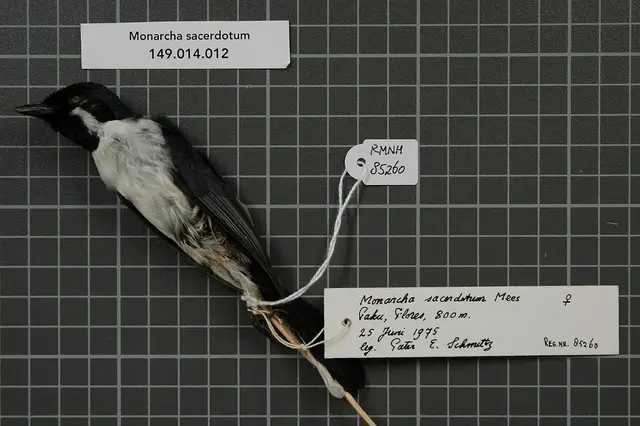
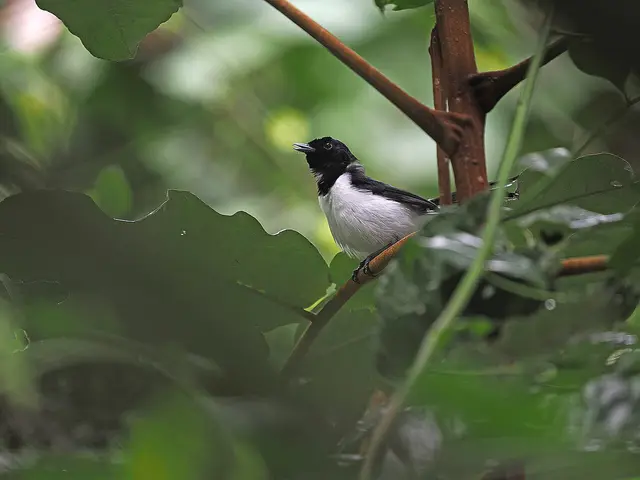
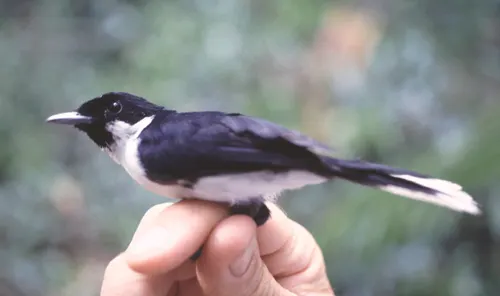
It's a compact songbird about 16 cm long and boldly patterned. The upperparts are black, including the sides of the head, with a small and variable white mark on the forecrown and white outer tail feathers. The chin is black while the rest of the underparts, cheeks included, are white.
The song is a clear, repeated two-note whistle followed straight away by a soft buzzing trill. The slaty flycatcher is the lookalike to rule out, since it has no black chin and no white in the tail.
Where it lives
Boano lies off the north-west coast of Seram in South Maluku, and the monarch occurs nowhere else. The island covers only about 134 square kilometres. The IUCN assessment lists moist lowland forest as its main habitat, with moist shrubland as a marginal one, from sea level to about 700 m. The bird is probably absent from the higher parts of the island, though these have been little explored.
It's a resident and does not migrate.
Pins are Wikidata “endemic to” fields. Orange dots, when present, are GBIF occurrence tiles — survey bias included.
How it lives
Birds have been seen foraging low, mostly below 2 m, in lush undergrowth of figs, coffee plants and bamboo thickets. They also join mixed-species flocks in the lower and middle layers of the forest.
The monarch tolerates some forest disturbance. A 2011 expedition found at least 12 birds, with around 20 more heard, in cut-over forest. It is absent from villages and open farmland.
A species lost, then found
The first specimen was collected in 1918, and the bird was described in 1939 as a form of the spectacled monarch. Nothing more was recorded for more than 50 years. Four expeditions between 1990 and 1994 went looking for it, and in 1991 a juvenile was collected in a forested limestone gorge in the foothills.
A 1994 revisit to the same gorge counted 5 to 10 birds. Moeliker and Heij reported the work in the journal Deinsea in 1995, and the plumage and measurements they recorded supported treating it as a species in its own right.
Why it is in trouble
The Red List figure of 100 to 200 birds comes from a 1995 estimate extrapolated from the amount of suitable habitat, not from a full count. The IUCN notes it could be an underestimate, but the assessment still uses it. The trend is decreasing.
Forests on Boano have long been used by people, and the IUCN gives forest loss of roughly 7% between 2014 and 2023, along with the spread of farmland. Shifting agriculture and small-scale harvesting are each listed as affecting most of the range and causing slow but significant declines.
What is being done
Very little so far. As of the 2025 assessment, no targeted measure is known, none of the population is known to be inside a protected area, and there is no recovery plan or monitoring scheme. Boano is registered as a Key Biodiversity Area.
The recommended steps are broad surveys across the island to pin down its range, numbers and threats, and a study of whether a protected area could safeguard the remaining forest.
Sources
Written for this catalog in our own words from the sources below, checked against them on 12 November 2026. Population figures are estimates and carry the year they were made. Status and assessment year: IUCN. 2026. The IUCN Red List of Threatened Species. Version 2026-1. iucnredlist.org.