Endangered
Flores Monarch
Symposiachrus sacerdotum
The Flores monarch (Symposiachrus sacerdotum) is a black, grey and white flycatcher found only in the forests of far-western Flores, Indonesia. The IUCN Red List rated it Endangered in 2025, with an estimated 2,500 to 9,999 mature birds and a falling trend as forest is cleared and burned.
How to recognise it
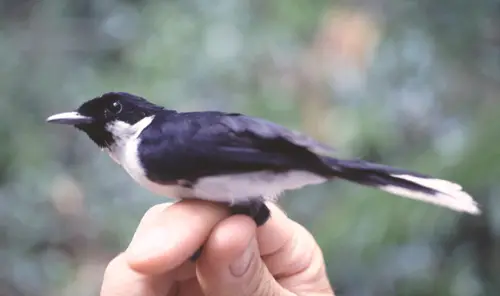
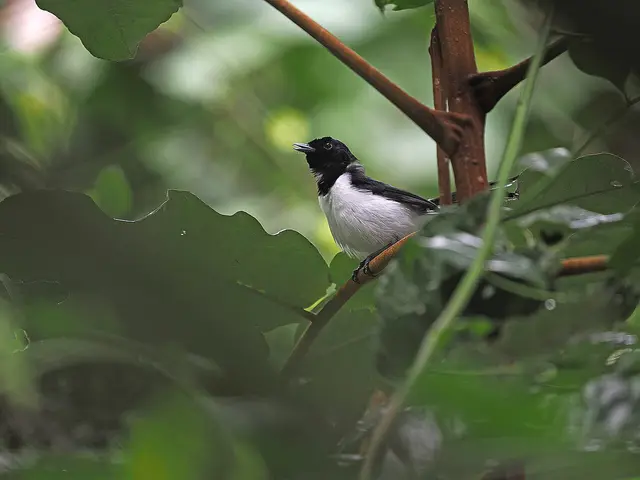
It's a neat, strongly patterned bird about 15.5 cm long. The upperparts are greyish black, darkest on the wings and tail, and the outer tail feathers are white. The forehead, throat and a mask around the eyes are black, and the rest of the underparts are white.
The look-alike to rule out is the spectacled monarch, which has rufous on the face and throat and some black at the base of the outer tail feathers. The song is a rising whistle mixed with buzzing notes, and it also gives a quiet, warbling chatter broken up by a few rising whistles. In 2016 survey notes, observers described a bird with an orange breast, probably a juvenile, but it was not seen well enough to rule out a spectacled monarch.
Where it lives
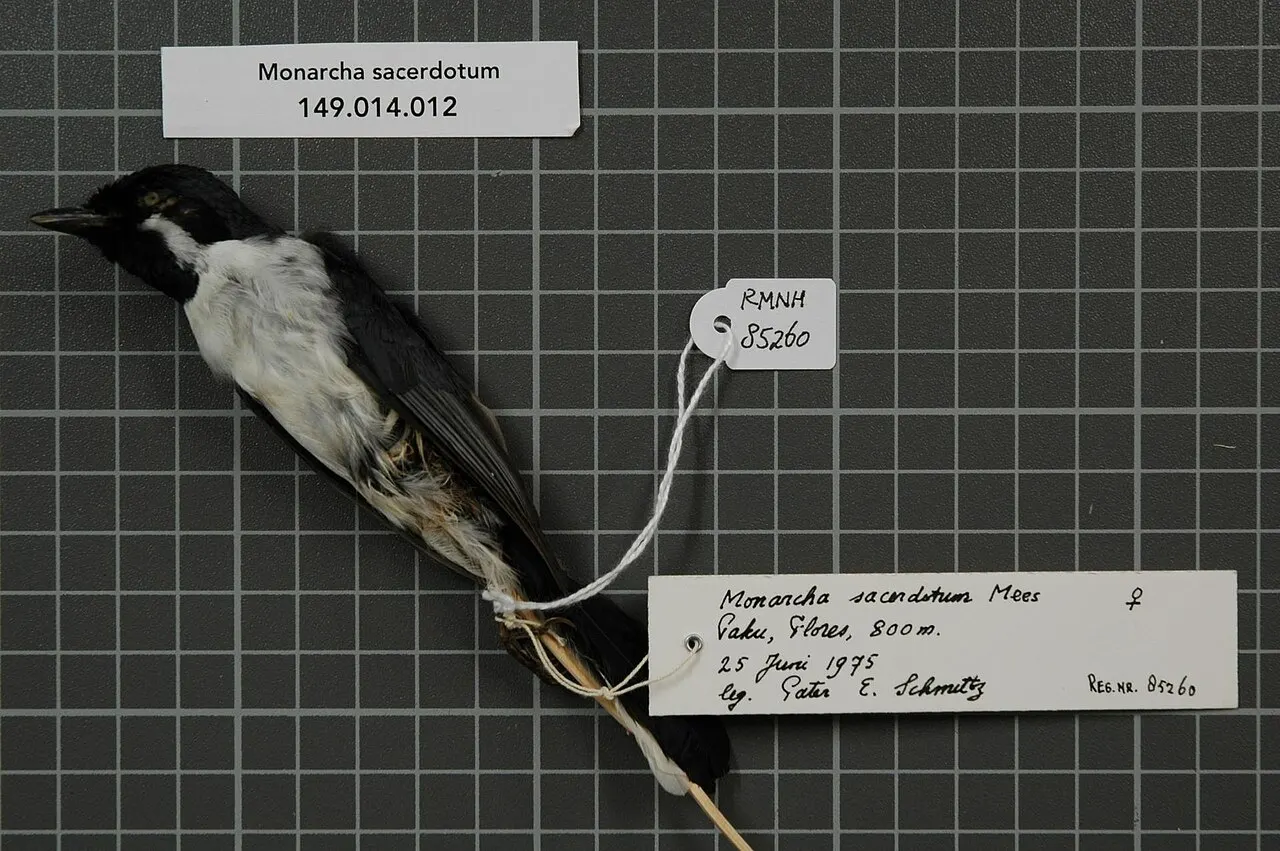
The species is restricted to the forests of the western end of Flores, one of the Lesser Sunda Islands, at about 350 to 1,000 m above sea level. The IUCN puts its extent of occurrence at roughly 820 square kilometres and counts 4 to 10 locations. It was described by Gerlof Mees in 1973. The first specimens were collected by E. Schmutz, a priest living on Flores.
A 2016 paper on the birds of Flores reported counts from three places. At Mbeliling Forest Reserve, in forest at 720 to 880 m, observers counted 61 birds in a week, making it the fifth most common of 37 species there. At Sisok they recorded just three adults. At Puarlolo it was fairly common in tall secondary forest. That paper and earlier work in the 1990s indicate its highest densities lie in a narrow belt of semi-evergreen rainforest at about 700 to 900 m.
Pins are Wikidata “endemic to” fields. Orange dots, when present, are GBIF occurrence tiles — survey bias included.
How it lives
It keeps to the lower and middle layers of the forest, and birders describe it as unobtrusive but rewarding for patient watchers. Of the 61 birds counted at Mbeliling, 30 were singles, 11 were pairs and 3 were trios. Its diet and breeding are poorly documented, and the IUCN gives a generation length of about 3.7 years.
Why it is in trouble
Its forest is shrinking and being degraded. The IUCN lists more frequent fires, shifting agriculture and small-holder farming as ongoing threats across most of its range, each causing slow but significant declines. Its habitat is moist lowland forest.
The IUCN estimates a past and projected population reduction of 1 to 9 percent, which is modest, but the trend is still downward and the range is small.
What is being done
Conservation sites have been identified across its whole range, but the IUCN records that the species does not occur in a protected area, and there is no recovery plan, monitoring scheme or captive population. Actions listed as needed are site protection, awareness work and habitat restoration. Birders name Mbeliling, Puarlolo and Kisol as the places to look.
Sources
Written for this catalog in our own words from the sources below, checked against them on 12 November 2026. Population figures are estimates and carry the year they were made. Status and assessment year: IUCN. 2026. The IUCN Red List of Threatened Species. Version 2026-1. iucnredlist.org.