Critically Endangered
Speckled smooth-hound
Mustelus mento
The speckled smooth-hound (Mustelus mento) is a houndshark of the coastal waters of the southeastern Pacific, from Peru down to southern Chile. Known locally as tollo, it is fished for food. The IUCN Red List rated it Critically Endangered in 2021, with a decreasing population.
How to recognise it
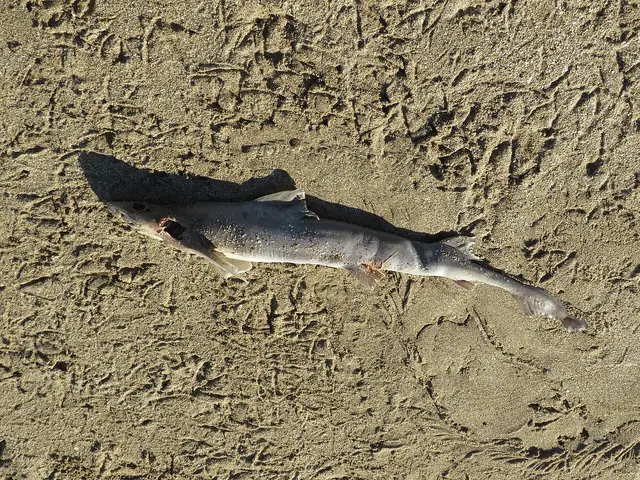
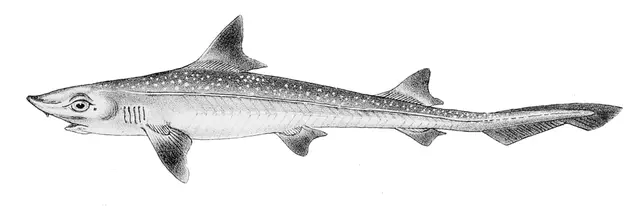
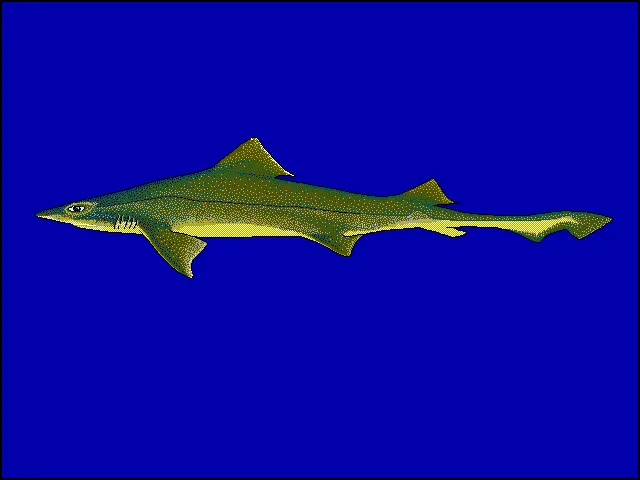
It is a sturdy houndshark with a blunt snout, small eyes and flat, cuspless, molar-like teeth. Adults are grey or greyish-brown above, paler below, and covered in small white spots, which give the species its name. Juveniles carry dark bars instead.
Maximum length is given as about 130 cm in some sources and 141 cm in FishBase. Males mature at around 70 cm and females at about 88 cm, though a 2026 study of landings in northern Chile found females maturing at 53.6 cm.
Where it lives
It is found along the Pacific coast of South America, with records from Peru to the southern tip of Chile, plus the Galapagos and Juan Fernandez islands. The Red List names Ecuador, Peru and Chile as places where it occurs, and lists Argentina as uncertain. Reports from the Argentine coast are likely to be narrownose smooth-hounds.
It lives near the bottom on the continental shelf at 16 to 50 m. The listed habitats are rocky reefs, loose gravel, sand, mud and kelp, though the assessment marks their suitability as unknown.
Pins are Wikidata “endemic to” fields. Orange dots, when present, are GBIF occurrence tiles — survey bias included.
How it lives
Pups develop inside the mother from eggs and are born at about 30 cm. Litters average seven, and the embryos feed on yolk. FishBase notes a pairing behaviour in which the male embraces the female. The assessment gives a generation length of 10 years.
The 2026 study, led by Krishna Tapia and published in the journal Fishes, is described as the first on its reproductive biology in northern Chile. It found most landed fish were immature, and it identified Bahia San Jorge near Antofagasta as a nursery area.
Why it is in trouble
Known as tollo or tollo fino, it is sold as food. It is caught mainly by small-scale fishers using gillnets, and as bycatch in larger-scale fisheries. Chilean landings reportedly peaked at around 1,300 tonnes in 1989 and have since fallen below 200 tonnes a year, as stocks declined and fishing shifted toward rays.
In Chile the catch is often recorded under the broad label of tollos, which hides the species. That national category fell from 243 tonnes in 2014 to 26 tonnes in 2024, according to a 2026 Mongabay report citing fisheries service figures. The Red List criteria A2bd (2021) record a population decline.
What is being done
Peru reportedly set a 60 cm minimum size in 2001. The assessment lists a harvest management plan as in place, but no recovery plan and no monitoring scheme, and it is unknown whether the species occurs in a protected area. Recommended actions are harvest management, species recovery and national-level measures.
Researchers quoted by Mongabay say Chile has no minimum size for these coastal sharks, and that most small boats under 18 m are largely exempt from national rules.
Sources
Written for this catalog in our own words from the sources below, checked against them on 12 November 2026. Population figures are estimates and carry the year they were made. Status and assessment year: IUCN. 2026. The IUCN Red List of Threatened Species. Version 2026-1. iucnredlist.org.