Endangered
Spotless smooth-hound
Mustelus griseus
The spotless smooth-hound (Mustelus griseus) is a slim, grey houndshark of the shallow seabed in the northwest Pacific, from Japan and Korea to Vietnam. The IUCN Red List assessed it as Endangered in 2020 after heavy fishing cut its numbers by an estimated 50 to 79 percent.
How to recognise it
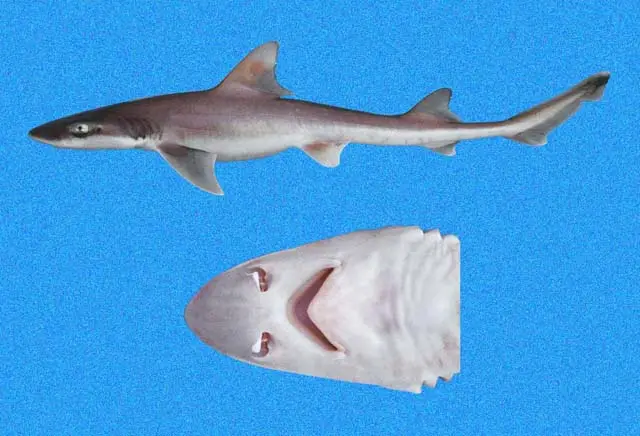
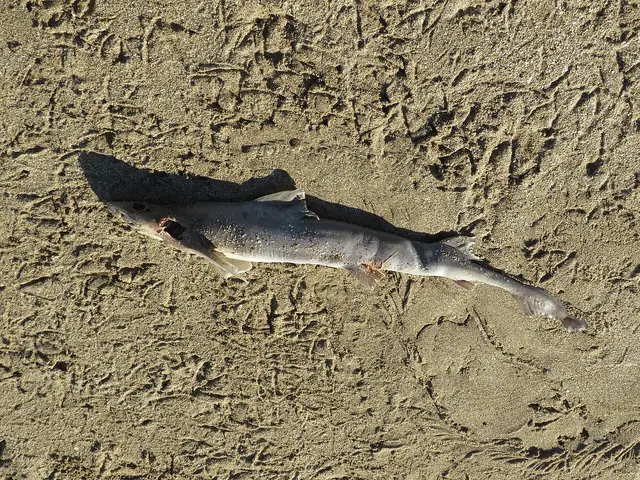
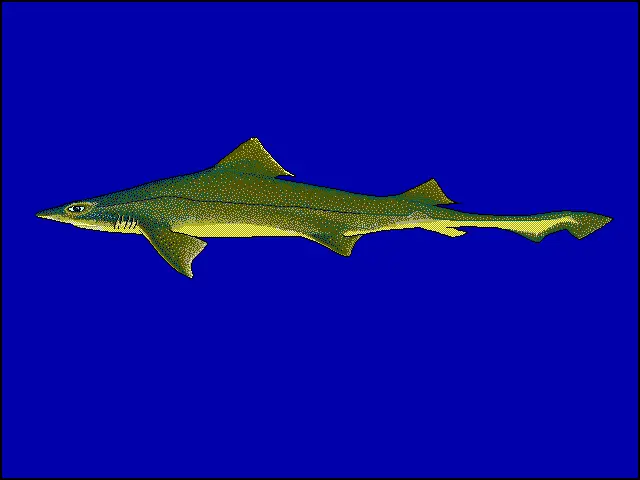
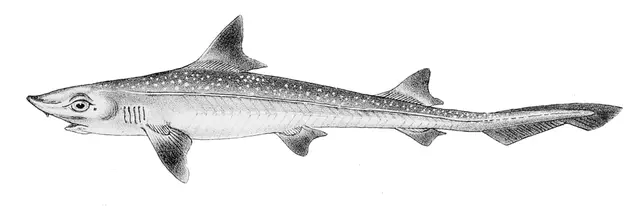
This is a slender shark with a short head and a fairly long, bluntly pointed snout. The eyes are small and set close together, and the mouth is long. The back and flanks are plain grey or greyish-brown, paler underneath, with no spots or bands, which gives the species its name.
Males reach about 87 cm and females about 100 cm. Both dorsal fins have curved rear edges, and the gap between them is about a fifth of the body length. The teeth are low-cusped and molar-like, suited to crushing prey.
Where it lives
It lives in the northwest Pacific, with the Red List naming China, Taiwan, Japan, North and South Korea and Vietnam. It may also occur in the Philippines. It stays near the seabed on the continental shelf and in semi-enclosed seas, usually over sand or mud.
The Red List gives a depth range of 1 to 260 m. FishBase gives 5 to 300 m, with records down to at least 51 m.
Pins are Wikidata “endemic to” fields. Orange dots, when present, are GBIF occurrence tiles — survey bias included.
How it lives
It probably feeds mainly on crustaceans and other animals of the seabed. Females give birth to live young nourished through a yolk-sac placenta. A litter is 5 to 16 pups, larger females carry bigger litters, and gestation lasts about 10 months. Births are reportedly in April and May, at about 28 cm.
Reported sizes at maturity differ between sources, roughly 62 to 74 cm for males and about 80 cm for females. The longest recorded lifespan is 9 years, and the Red List uses a generation length of 10 years. FishBase rates its resilience as very low, with a population doubling time of more than 14 years.
Why it is in trouble
Flesh and fins are valued as food, and the shark is taken in gillnets, trawls and longlines, sometimes as bycatch and sometimes as the target. The Red List assessment lists both small-scale and large-scale fishing as threats, with coastal housing and commercial development also named as pressures on its habitat.
The assessment estimates that numbers fell by 50 to 79 percent over three generations, with exploitation as the basis. The cause is judged understood and not yet ended. Catch data are limited, and whether current catches are sustainable is not known.
What is being done
The assessment lists harvest management, trade management and site protection among the relevant conservation actions, but records no recovery plan, no monitoring scheme and no harvest management plan in place. It is not subject to international trade controls. Further surveys are needed to pin down catches and trends.
Sources
Written for this catalog in our own words from the sources below, checked against them on 12 November 2026. Population figures are estimates and carry the year they were made. Status and assessment year: IUCN. 2026. The IUCN Red List of Threatened Species. Version 2026-1. iucnredlist.org.