Critically Endangered
Southern white-cheeked gibbon
Nomascus siki
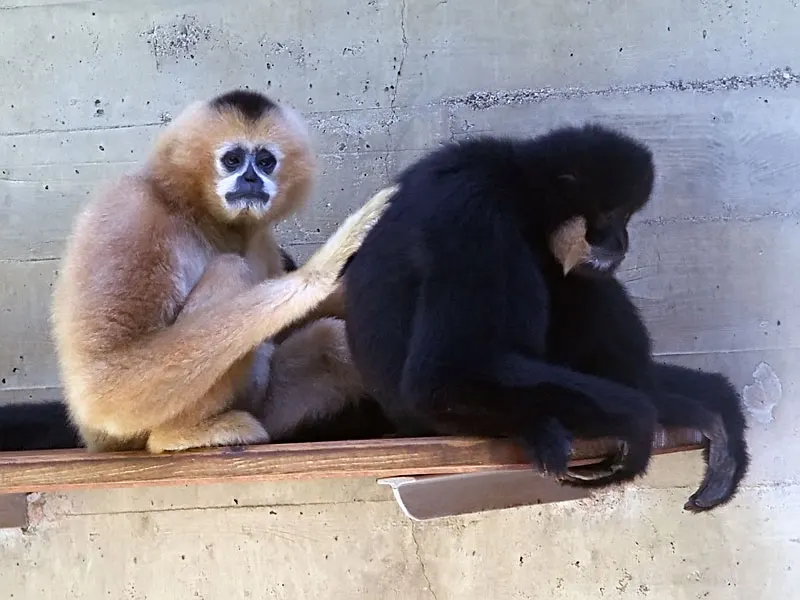
The southern white-cheeked gibbon (Nomascus siki) is a tree-living ape of central Vietnam and Laos, where males are black with white mouth patches and females are brown. The IUCN's 2020 assessment lists it as Critically Endangered, with a decreasing population hit by hunting and forest loss.
How to recognise it
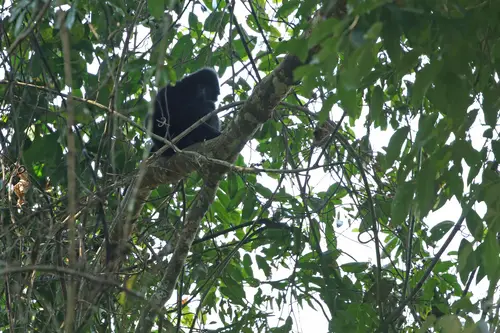
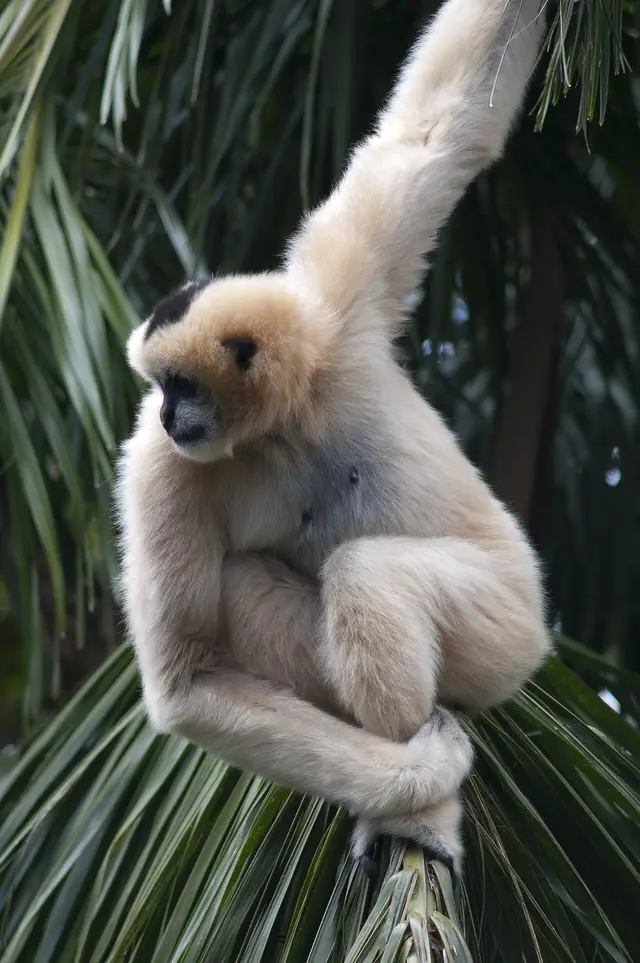
Young gibbons are light brown and turn black after weaning. Adult males stay black, with a broad white patch around the edge of the mouth that gives the species its name. Adult females are brown with only a thin white edging to the face. The male's white marking differs from the cheek streak of the northern white-cheeked gibbon.
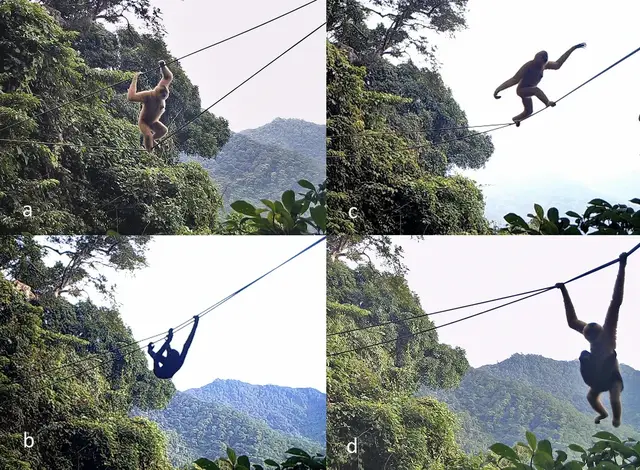
Gibbons are built for swinging through trees, and their arm span can reach about 1.5 m.
Where it lives
The species lives in Vietnam and Laos in lowland and montane moist forest, from about 30 to 1,800 m elevation. Its original range covered central Vietnam and central Laos, roughly from 19 degrees north to 17 degrees north, between river systems such as the Nam Theun and the Thach Han. Between about 19 and 20 degrees north, it intergrades with the northern white-cheeked gibbon.
Vietnam's groups are scattered in forest patches. Laos is reported to hold larger populations, though few counts exist there. Protected areas such as Phong Nha-Ke Bang National Park in Vietnam and Nakai-Nam Theun in Laos matter for its future.
Pins are Wikidata “endemic to” fields. Orange dots, when present, are GBIF occurrence tiles — survey bias included.
How it lives
It is arboreal and eats mostly fruit, plus young leaves, shoots and flowers, and occasionally small animals. Gibbons live as a monogamous pair with their offspring, and a mated pair sings a duet at dawn that can carry a long way through the forest. Its song resembles that of the northern white-cheeked gibbon.
Why it is in trouble
The IUCN assessment records a population size of 600 and a decreasing trend, with a generation length of 15 years. It was rated Critically Endangered under criteria A4cd, which concern a decline over a period of three generations that includes the effects of habitat loss and exploitation. The IUCN's estimate of the ongoing reduction is 80 percent, while another source puts the fall at about 50 percent over 45 years.
The threats named are small-holder farming, shifting agriculture, small plantations and housing, plus deliberate hunting of the animal itself. Hunting for food, traditional medicine and the pet trade is reported in both countries.
Counts depend on method and area. Surveys of the Truong Son area of Vietnam in 2018 and 2019 found 149 groups across four study areas and estimated about 425 groups for the whole area, a figure that does not line up neatly with the IUCN's 600.
What is being done
The species is on CITES Appendix I and is legally protected in Vietnam, although the protection is reportedly weakly enforced outside protected areas. The IUCN lists site and habitat protection, harvest and trade management, awareness and education as conservation actions, and records that it occurs in at least one protected area. It has no recovery plan or systematic monitoring scheme in place.
Sources
Written for this catalog in our own words from the sources below, checked against them on 12 November 2026. Population figures are estimates and carry the year they were made. Status and assessment year: IUCN. 2026. The IUCN Red List of Threatened Species. Version 2026-1. iucnredlist.org.