Critically Endangered
Eastern black crested gibbon
Nomascus nasutus
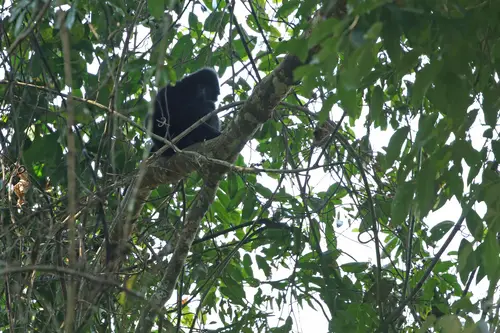
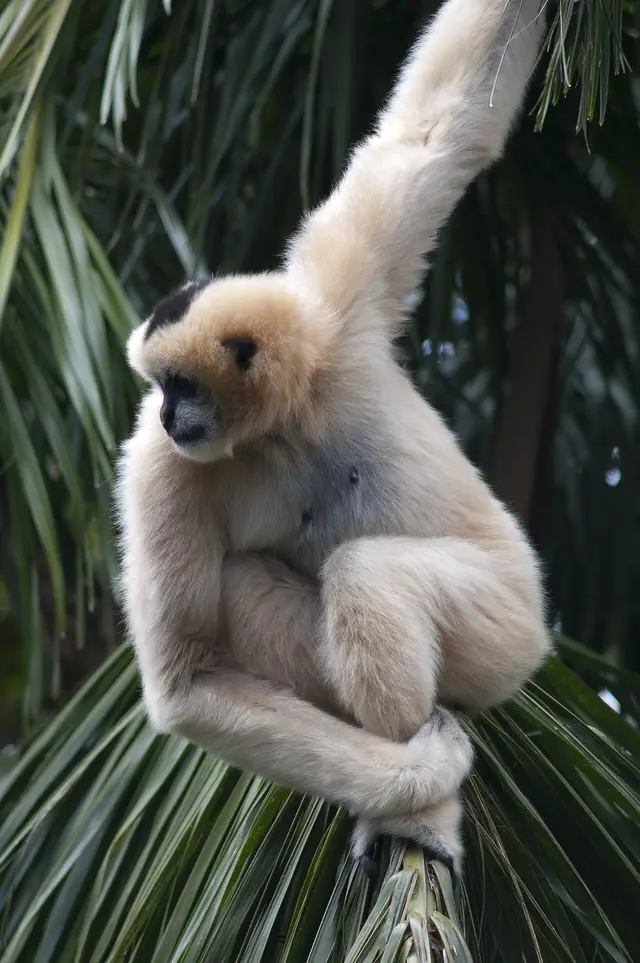
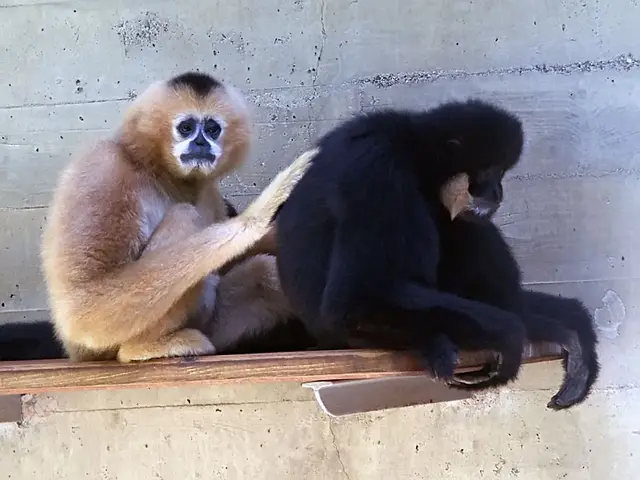
The eastern black crested gibbon, also called the Cao Vit gibbon (Nomascus nasutus), is one of the rarest apes alive. It survives only in one patch of limestone forest on the Vietnam and China border. The IUCN's 2020 assessment lists it as Critically Endangered, with a very small and decreasing population.
How to recognise it
This is a crested gibbon, a small tree-living ape without a tail. The name Cao Vit reportedly comes from the sounds of its calls, as rendered by villagers in Trùng Khánh District, Vietnam. The IUCN also records the Vietnamese names vượn cao vít and vượn đen.
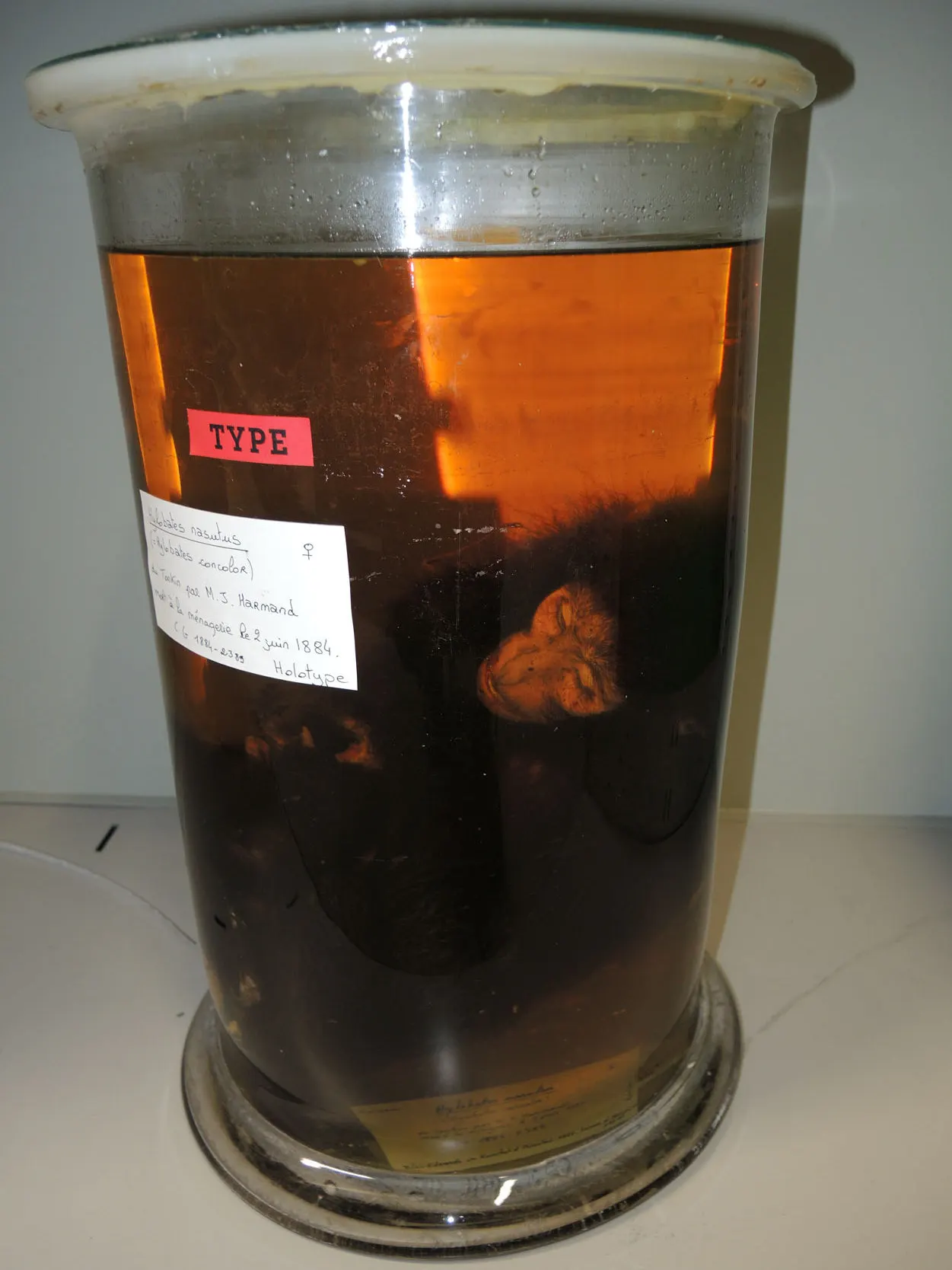
It has been treated at different times as its own species, as a relative of the Hainan gibbon and as a subspecies of the black crested gibbon. The IUCN now treats it as separate, citing differences in song and fur colour as well as genetic evidence.
Where it lives
The species lives in lowland moist karst forest between 50 and 930 m. All of it is found in a single area of roughly 2,500 hectares on the border, in Trùng Khánh District, Cao Bằng Province, Vietnam, and adjacent forest in Guangxi, China, where it was first found in 2006. It once ranged more widely across northeast Vietnam and southeast China.
Wearn and colleagues, writing in Oryx in 2023, described the forest as highly degraded. Their work suggested the gibbons occupy only about 30 to 40 percent of it, which leaves room for the group to grow if the habitat improves.
Pins are Wikidata “endemic to” fields. Orange dots, when present, are GBIF occurrence tiles — survey bias included.
How many are left
No confirmed sightings were made from the 1960s to the early 2000s, and the species was thought possibly extinct. Two biologists from Fauna & Flora International (FFI) rediscovered it in 2002, when 26 were confirmed at Trùng Khánh. A 2005 count reportedly found about 35 to 37 on the Vietnamese side, and a 2012 census recorded 129 gibbons, 17 percent more than in 2007.
Later work showed that counting from songs had overestimated numbers, because the same group could be counted twice. A 2021 drone survey with thermal cameras gave a smaller figure than the roughly 120 estimated from the ground. A 2024 reassessment using vocal fingerprinting, acoustic recorders and thermal imaging counted 74 gibbons in 11 family groups. Researchers attributed the gap to earlier double-counting, not a fall in numbers. The IUCN assessment lists 45 to 47 individuals, all in one subpopulation.
So estimates run from 45 to 129 depending on the method and year. Researchers found no sign of decline and think numbers are rising. FFI recorded infants in 2024 and 2025, but females have a single infant only every two to three years, and the protected habitat could hold at most about 200 gibbons.
Why it is in trouble
Hunting and habitat loss brought the species to the edge. The IUCN estimates a reduction of about 80 percent in the past, linked to habitat decline and to levels of exploitation. Current threats are scored as low impact: housing, small-scale farming and grazing, and targeted use of the species.
With every animal in one small forest, the species has very little room for error.
What is being done
Two protected areas have been established, including the Cao Vit Gibbon Conservation Area in Cao Bằng. The IUCN records an action plan, a monitoring scheme, conservation sites across the whole range and the species' listing on CITES Appendix I. FFI and local managers have worked on forest protection, community outreach, livelihoods, education and habitat restoration, and rangers and community groups guard against poaching.
Tree planting and assisted natural regeneration are under way, and FFI plans 3D mapping of the forest to choose where to plant. The IUCN records no captive breeding and no reintroduction.
Sources
Written for this catalog in our own words from the sources below, checked against them on 12 November 2026. Population figures are estimates and carry the year they were made. Status and assessment year: IUCN. 2026. The IUCN Red List of Threatened Species. Version 2026-1. iucnredlist.org.
- IUCN Red List assessment, Nomascus nasutus (2020)
- Eastern black crested gibbon, Wikipedia
- Drones improve counts of rare Cao Vit gibbon, Mongabay (2023)
- Glimmer of hope for one of the world's rarest primates, FFI via Phys.org (2012)
- A primate on the brink, Phys.org (2024)
- Smaller population estimate, Mongabay (2024)