Critically Endangered
Sociable Lapwing
Vanellus gregarius
The sociable lapwing (Vanellus gregarius) is a ground-nesting wader that breeds on the steppe of Kazakhstan and winters from Sudan and Arabia to India. The IUCN Red List rated it Critically Endangered in 2019. Its numbers have collapsed in recent decades, and illegal hunting on migration is the leading suspect.
How to recognise it
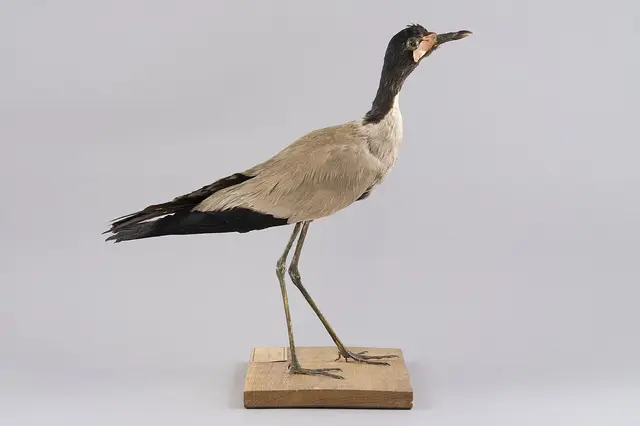
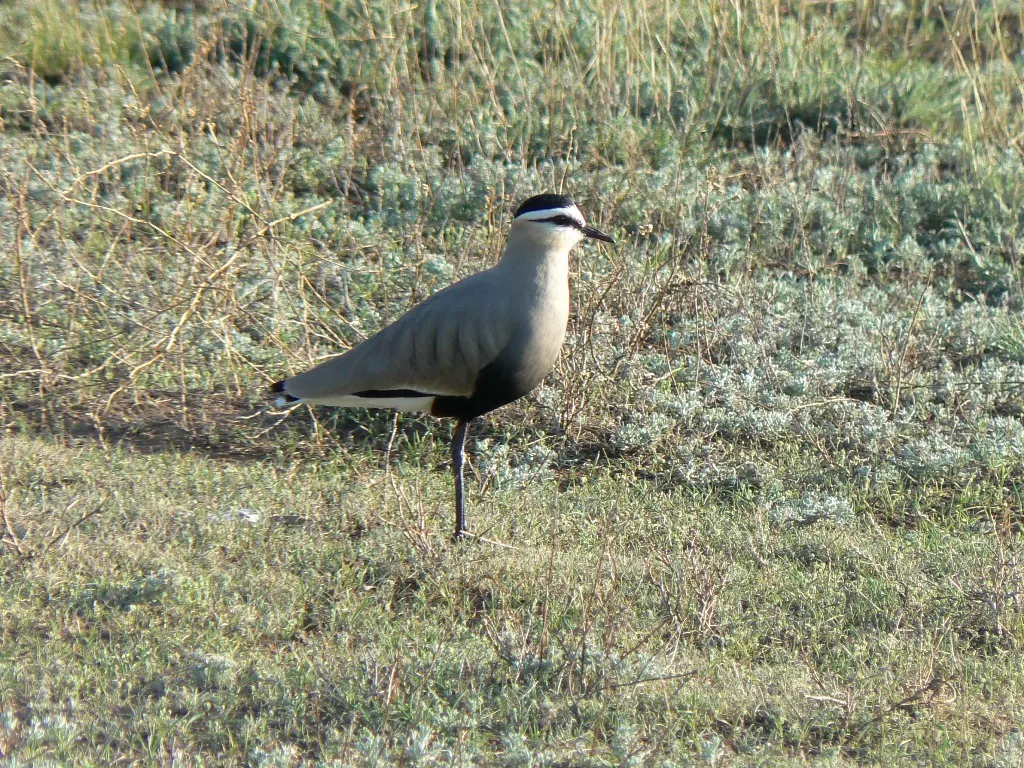
It is a plover about 27 to 30 cm long, with longish black legs and a short black bill. Breeding adults are greyish with a black and chestnut belly, a black crown and eye-stripe, and a white stripe above the eye. In winter the colours fade to browns, but the head pattern stays. In flight, a white tail with a black band is a good clue.
The white-tailed lapwing looks similar but has longer legs and lacks the striped head and the black tail band. The sociable lapwing's call is a harsh kretsch note, along with rapid chattering.
Where it lives
Unlike most lapwings, which prefer wet ground, this one nests on dry steppe, grassland and farmland. It breeds in central Kazakhstan, laying 3 to 4 eggs in a scrape on the ground, and feeds mainly on insects. The historical range once stretched from Ukraine to western China.
A 2020 study in the bioRxiv preprint archive followed 29 adults fitted with satellite tags in Kazakhstan between 2007 and 2015. Of 24 birds with clear routes, 17 took a western route averaging about 5,200 km, through southern Russia, the Caucasus and the Levant to Saudi Arabia and eastern Sudan. Seven took an eastern route of about 2,800 km, through Turkmenistan and Uzbekistan to Pakistan and northwest India. Birds reused the same flyway and stopover areas from year to year, and spent roughly a third of the year on the breeding grounds, a third on the wintering grounds and a third travelling.
Pins are Wikidata “endemic to” fields. Orange dots, when present, are GBIF occurrence tiles — survey bias included.
Why it is in trouble
Counting is hard. The 2019 Red List assessment gives a population size of 11,200 and a continuing decline. The 2020 tracking study put the global total near 24,000 (with a wide range of 13,700 to 55,560), and other estimates have been around 17,000. The population is thought to have fallen to roughly a fifth or a quarter of its historical numbers.
The tracking study pointed to illegal hunting on the western flyway as the most plausible driver of the decline, and cited recent estimates of at least 76 to 630 birds killed illegally each year. It also found that none of the main stopover areas it identified is covered by a protected area. Annual survival of tagged birds came out at about 41 percent, against 66 percent from colour-ring resightings, and tag or harness failures counted as deaths probably explain part of the gap. The Red List also names farming change, nomadic grazing and drought as threats, alongside intentional and accidental killing.
What is being done
A species recovery plan and a monitoring scheme are in place, and conservation sites have been identified across its range. The assessment lists site protection and harvest management as the actions that matter. Ringing in Kazakhstan, with about 150 adults and 1,473 chicks colour-ringed from 2004 to 2015, has supplied much of what is known about the bird's movements.
Large flocks turn up occasionally. Surveys in 2007 found a gathering of about 3,200 birds in Turkey and about 1,500 wintering in Syria.
Sources
Written for this catalog in our own words from the sources below, checked against them on 12 November 2026. Population figures are estimates and carry the year they were made. Status and assessment year: IUCN. 2026. The IUCN Red List of Threatened Species. Version 2026-1. iucnredlist.org.