Critically Endangered
Smoothnose wedgefish
Rhynchobatus laevis
The smoothnose wedgefish (Rhynchobatus laevis) is a large, shark-like ray of shallow coastal seas from the Arabian Gulf to southern Japan. The IUCN's 2024 assessment lists it as Critically Endangered and decreasing, driven by fishing pressure and the international trade in its fins and meat.
How to recognise it
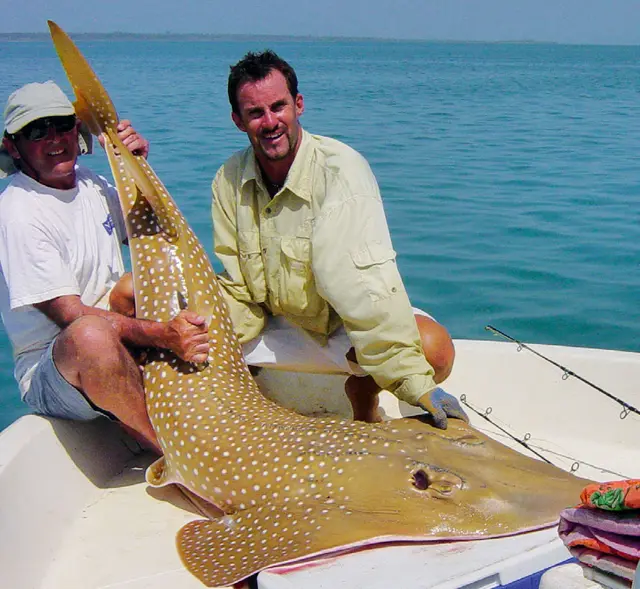
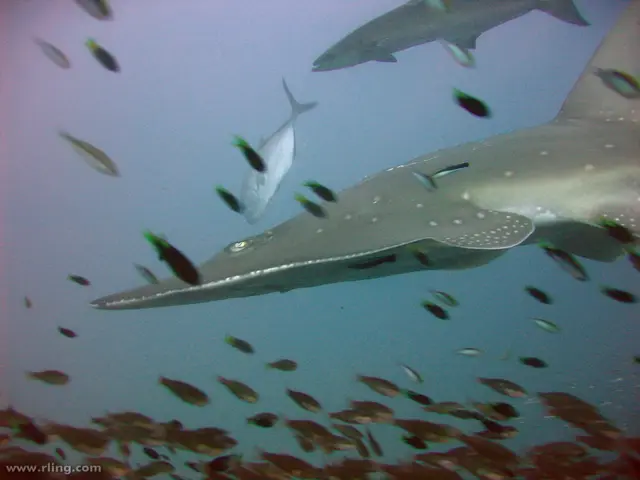
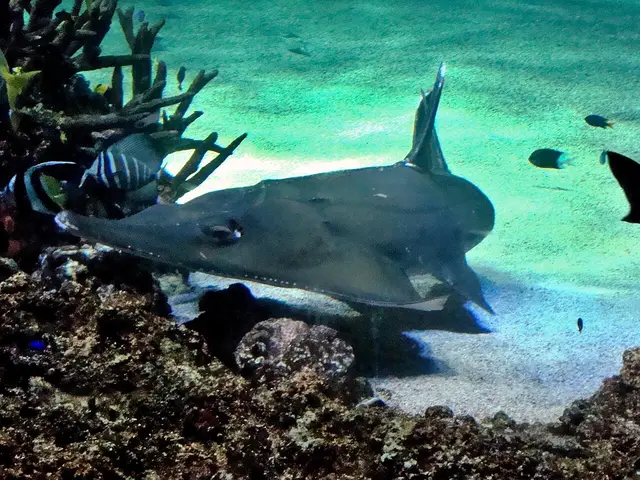
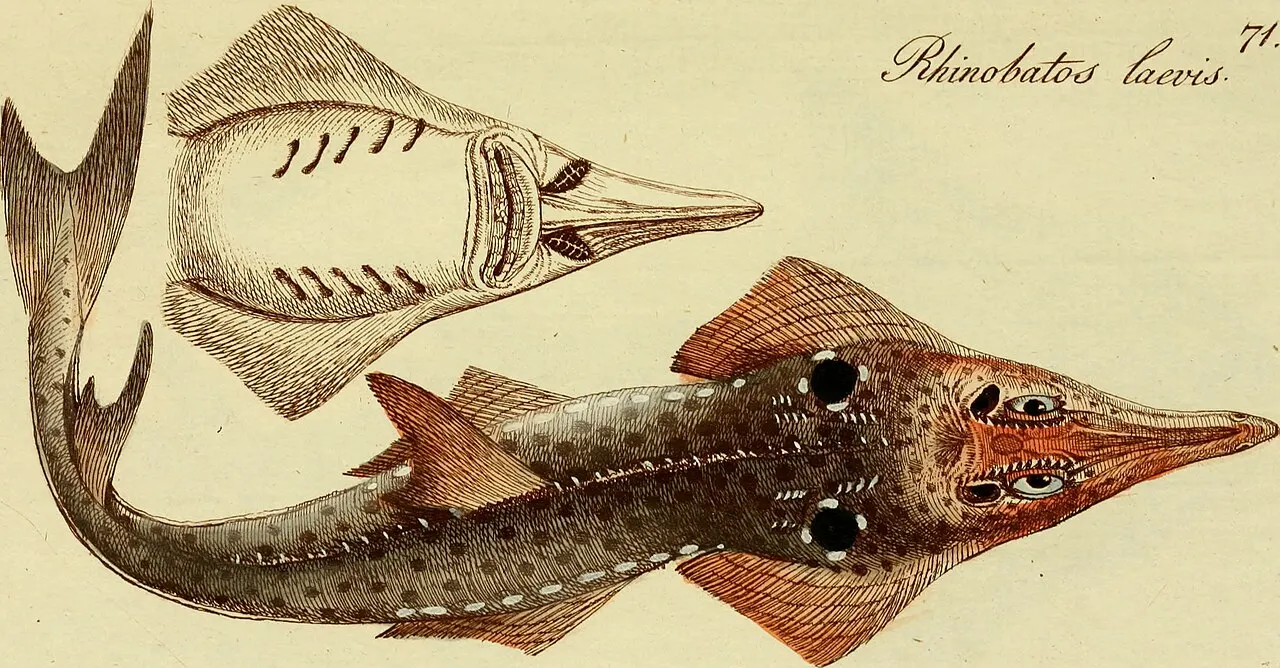
Wedgefishes are flat-bodied rays with a shark-like shape, built for life on the seabed. This one is grey or brown above, with four or five rows of white spots along each side and a dark spot over each pectoral fin that is ringed by smaller white spots. It looks much like the eyebrow wedgefish, but the two don't share a range.
It was described in 1801 by Bloch and Schneider. Size records vary because wedgefishes are easily confused with each other. FishBase gives a maximum of 270 cm total length and a published weight of up to 240 kg, with a reported length at maturity of up to 130 cm.
Where it lives
After taxonomists split the group, the name smoothnose wedgefish applies to the northern Indian Ocean and northwestern Pacific, from the Arabian Sea and Persian Gulf east to Bangladesh, and from the South China Sea to southern Japan. Populations elsewhere are now treated as separate species.
The IUCN lists it as a resident in China, Taiwan, India, Pakistan, Bangladesh, Sri Lanka, Indonesia, Oman, Iran, Iraq, Kuwait, Bahrain, Qatar, Saudi Arabia and the United Arab Emirates. It lives on the bottom from the surface down to about 60 m, over rocky reef, sand, sandy mud and mud, and in estuaries.
Pins are Wikidata “endemic to” fields. Orange dots, when present, are GBIF occurrence tiles — survey bias included.
How it lives
Its diet is poorly known, but it probably eats bottom-dwelling crustaceans and fish. It gives birth to live young. Embryos live first on yolk and then draw extra nourishment from the mother through uterine fluid.
It's slow to recover from losses. The IUCN gives a generation length of 15 years, and FishBase estimates a minimum population doubling time of 4.5 to 14 years.
Why it is in trouble
Fishing is the central threat. The IUCN lists harvest, both targeted and accidental, by small-scale and large-scale fisheries, across essentially all of the range, with international trade involved in the targeted catch. Fins and meat are traded at a scale that threatens wedgefishes. Coastal housing and commercial development add pressure on the shallow habitat across more than half of the range.
The 2024 assessment, under criterion A2bd, estimates a population reduction of about 80 percent, based on an index of abundance and on levels of exploitation.
What is being done
In August 2019, at a CITES meeting in Geneva, the wedgefish family was added to Appendix II by a vote of 112 to 30, with 4 abstentions. The listing doesn't ban trade, but it limits international trade to sustainable levels. The IUCN notes a harvest management plan, trade controls, and presence in at least one protected area. It records no recovery plan or monitoring scheme, and lists harvest and trade management, education, training, awareness and site protection among the actions needed.
Sources
Written for this catalog in our own words from the sources below, checked against them on 12 November 2026. Population figures are estimates and carry the year they were made. Status and assessment year: IUCN. 2026. The IUCN Red List of Threatened Species. Version 2026-1. iucnredlist.org.